Since October 16, 2026, USDA’s REAP grant pays at most 25% of a farm solar-plus-storage project, and only after the system has run 12 consecutive months (91 FR 62600, 2026). That single change turns agricultural solar storage from an incentive question into a financing and sizing question. What follows is the rule set that caps project size, the data to collect before buying, and the procurement file that decides approval.
What Changed in REAP, and the Numbers That Decide Project Size
The Rural Business-Cooperative Service published a final rule with comment period at 91 FR 62600 on October 1, 2026 (Docket No. RBS-26-Business-0529), amending 7 CFR 4280. It took effect October 16, 2026, and the comment window closed November 2, 2026.
A project must now be fully built and operational before an application is filed. The applicant then submits 12 months of actual production or savings data alongside 12 months of pre-installation data, an approach the rule calls a “post completion, performance validated model.” Awards rest on documented output, documented cost and documented performance instead of a technical report projecting future savings. The project period end date sits 12 to 24 months before the application date, and state competitions have been replaced by a single national scoring process.
Two consequences follow. The grant is a reimbursement, not construction capital: the farm finances the system, runs it for a year, then competes for a cheque. And the 12-month operating record becomes the most valuable document in the application, so metering and logging must be designed in at purchase. As of November 21, 2026, the USDA Rural Development program page lists the grant window as closed, with a Notice of Funding Opportunity pending and applications to be submitted through the ProsperUS portal, described as “coming soon.” The guaranteed loan track remains open.
The table collects the federal parameters that constrain an agricultural solar storage design rather than the paperwork around it. Each row either caps the grant, caps the system, or gates eligibility; state offices may add documentation requirements on top.
| Parameter (2027 program year) | Value | Unit | Source |
|---|---|---|---|
| Maximum grant share of project cost | 25 | % of total project cost | USDA RD, REAP grants (2026) |
| Minimum applicant cost share | 75 | % of total project cost | USDA RD, REAP grants (2026) |
| Combined REAP funding ceiling (grant plus guaranteed loan) | 75 | % of total project cost | USDA RD, REAP grants (2026) |
| Renewable energy system grant range | 1,500 to 500,000 | USD per award | USDA RD, REAP grants (2026) |
| Operating history required before application | 12 | consecutive months | 91 FR 62600 (2026) |
| Output and storage cap versus baseline use | 120 | % of prior 12-month consumption | 91 FR 62600 (2026) |
| Applications per entity | 1 | per federal fiscal year | USDA RD, REAP grants (2026) |
| Minimum competitive score for funding | 40 | points | 91 FR 62600 (2026) |
| Rural area population ceiling | 50,000 | residents | USDA RD, REAP grants (2026) |
Dollar values are award limits, not equipment prices; the 120% row most often forces a redesign after a quote is signed.
Can a Farm Get a REAP Grant for Battery Storage?
Not for storage on its own. The final rule lists two project types as ineligible for grant funds: retrofitting an existing renewable energy system to add storage, and stand-alone energy storage projects. The language covers battery energy storage specifically, so a farm adding a battery to an array installed in 2022 has no grant route under Subpart B.
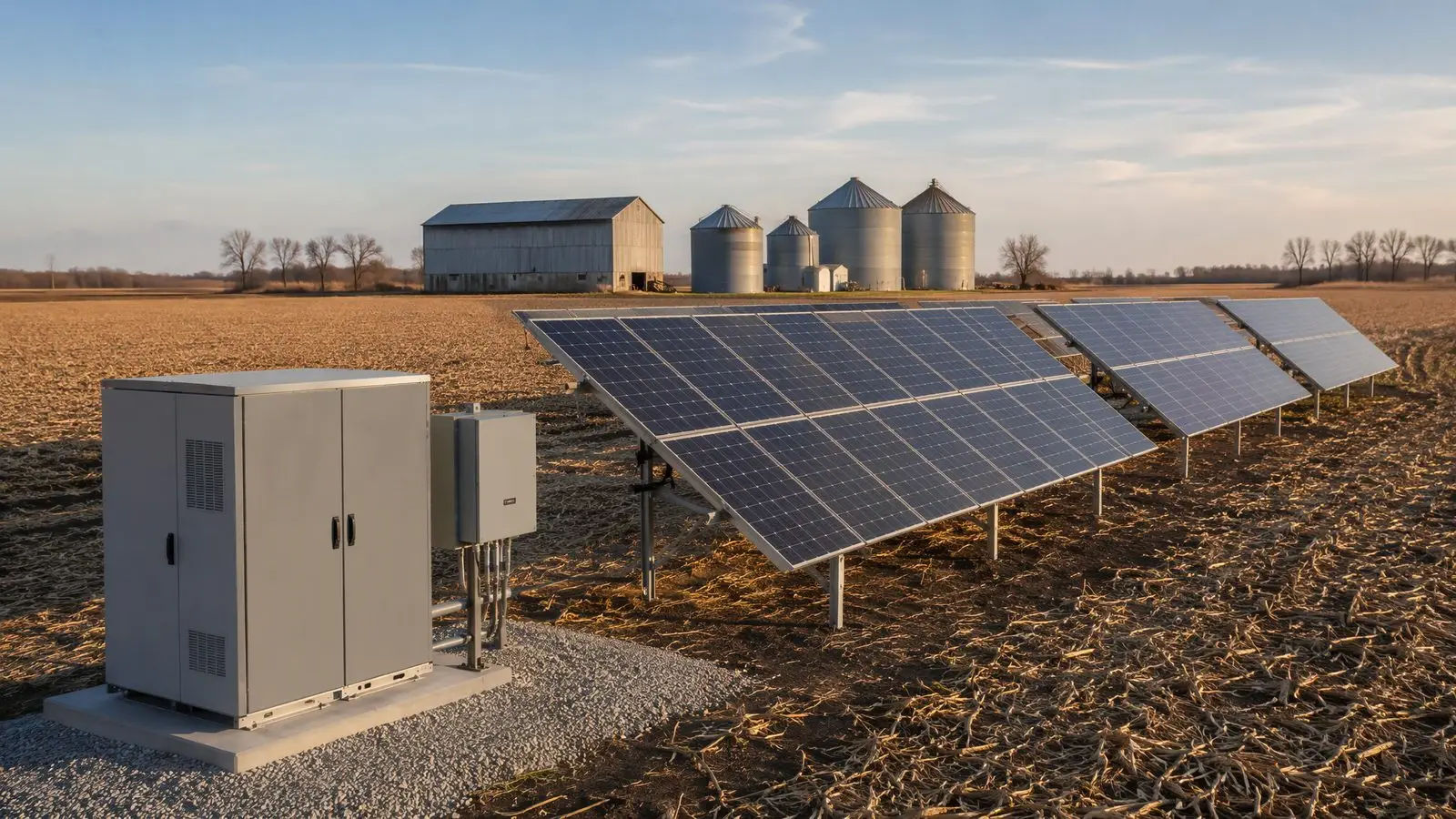
Storage does qualify when it is bought as part of a new renewable energy system. The definitions treat energy storage as a supplementary component, described as supporting systems “such as energy storage that does not generate or save energy,” and eligibility accepts a renewable energy system that includes storage provided combined output stays inside the 120% cap. Projects with storage must also supply dispatch curves for the 12 months after installation, which is an operating commitment rather than a document assembled at the end.
A second route matters if the real goal is to stop burning diesel for pumping. The Rural Development program page lists electric, solar and gravity-powered pumps for irrigation pivots, and replacing a diesel irrigation motor with an electric motor, as eligible energy efficiency improvements. That is a separate category with a $250,000 grant ceiling, and it does not require a photovoltaic array at all.
How Much Battery Storage Does a Farm Actually Need?
Size agricultural solar storage from the meter, not from the array. Four steps survive both engineering review and the 120% test.
- Export 12 months of interval data at 15-minute resolution, plus fuel records for any generator. The pre-installation baseline is a required part of the application, so the file must exist before design freeze.
- Name the load blocks that must survive an outage: irrigation pumping, barn ventilation and milk cooling, grain drying fans, shop and office loads. Each has a different duty cycle, and averaging them destroys the result.
- Set autonomy hours per block, then multiply by block power to get usable kilowatt-hours. A pump running eight hours a day in July needs a very different battery than a compressor cycling all night.
- Check the annual cap. Total renewable output, and the storage supporting it, cannot exceed 120% of consumption in the 12 months before installation. A design that fails this is not a grant problem; it is an ineligible project.
As an illustration only: a 160-acre operation consuming 210,000 kWh a year, a 60 kW irrigation pump running eight hours a day in peak season, and a barn load averaging 140 kWh a day. Peak-season daily energy is about 620 kWh, and four hours of autonomy across an 80 kW critical block implies roughly 320 kWh of usable storage. The grant ceiling is 120% of 210,000 kWh, or 252,000 kWh of annual renewable output, which a 150 kW array in a good solar resource would approach but not exceed. Substitute your own interval data before pricing.
What Diesel and Grid Power Cost in 2027, and the Payback Test That Survives Review
Payback math is only as good as its input prices, and both inputs moved this autumn. The EIA Short-Term Energy Outlook released November 10, 2026 raised its 2027 retail diesel forecast to $5.03 per gallon, 12% above the prior month’s $4.49, with 2026 at $5.25. On the electricity side, August 2026 data in the Electric Power Monthly show a national industrial average of 9.64 cents per kWh and a commercial average of 14.47 cents, with farm-state industrial rates far below coastal figures.
| Input price | 2026 | 2027 forecast | Unit | Source |
|---|---|---|---|---|
| U.S. retail diesel, annual average | 5.25 | 5.03 | USD per gallon | EIA STEO, Nov 2026 |
| U.S. industrial electricity, Aug 2026 | 9.64 | not published | cents per kWh | EIA EPM Table 5.6.A |
| U.S. commercial electricity, Aug 2026 | 14.47 | not published | cents per kWh | EIA EPM Table 5.6.A |
| Nebraska industrial electricity, Aug 2026 | 8.37 | not published | cents per kWh | EIA EPM Table 5.6.A |
| Kansas industrial electricity, Aug 2026 | 8.49 | not published | cents per kWh | EIA EPM Table 5.6.A |
| Iowa industrial electricity, Aug 2026 | 9.31 | not published | cents per kWh | EIA EPM Table 5.6.A |
| California industrial electricity, Aug 2026 | 19.26 | not published | cents per kWh | EIA EPM Table 5.6.A |
| U.S. farm sector fuel and oil expense growth, 2026 | 28.8 | not published | % year over year (plus $4.8 billion) | USDA ERS, Sep 2026 |
The table separates 2027 forecasts from 2026 actuals, which cannot be mixed without overstating savings; electricity rows carry the latest monthly actual. One thousand gallons of diesel in 2027 at $5.03 is $5,030, against $4,490 under the forecast EIA published a month earlier, so a model built in early November now understates fuel cost by roughly 12% before any volume growth. A 40,000 kWh pumping load at the national industrial average costs $3,856; the same load in California at 19.26 cents costs $7,704. That gap explains why identical equipment produces different paybacks in Nebraska and the Central Valley.
Rural Development then requires that the cost recovery period, or simple payback, not exceed the useful life of the project. Rule: simple payback equals total project cost minus grant, divided by annual avoided cost, and the result must be shorter than the useful life of the shortest-lived major component. Threshold: a battery warranted for 10 years has to pay back inside 10 years; a 25-year array does not rescue a battery that fails that test.
Worked example with stated assumptions: a project costs $180,000, the grant at the 25% ceiling is $45,000, so the owner carries $135,000. Annual diesel use is 4,000 gallons at $5.03, or $20,120, and the design displaces 70%, saving $14,084 a year before any maintenance credit for the generator that stops running. Payback is 9.6 years, inside a 10-year battery warranty with almost no margin. At 55% displacement payback stretches to 12.2 years, which fails. The grant also arrives after the 12-month operating period, so the owner finances the full project through year one; none of this is tax advice, and depreciation or credits are separate questions for an accountant.
Sizing for Irrigation, Barns and Grain Drying
Three loads dominate farm decisions and pull the design differently.
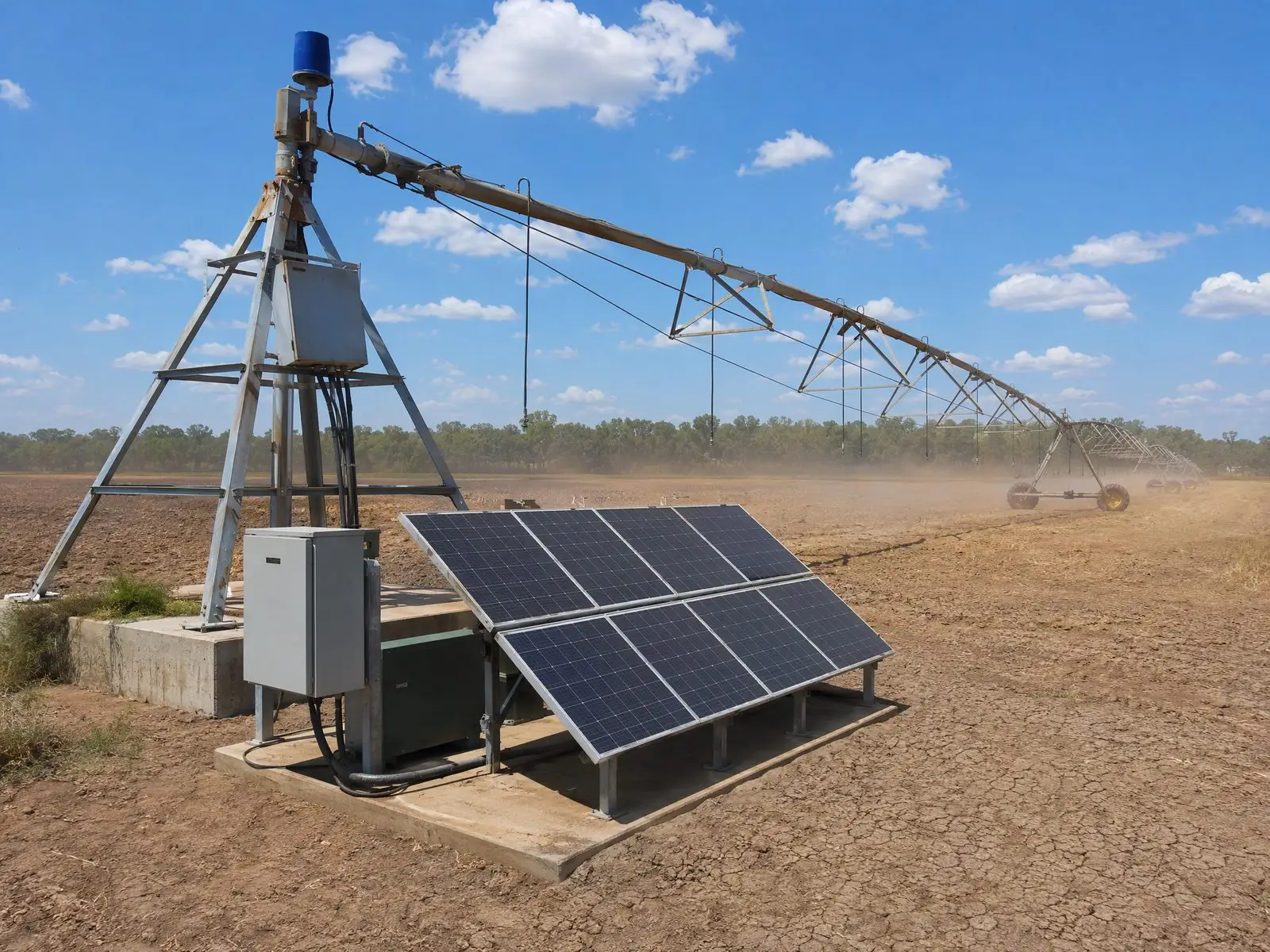
Irrigation pumping is seasonal, high-power and daylight-shaped. A center pivot runs hardest when the array is producing, which favours a large array and a comparatively small battery: the battery carries the pump through cloud transients and past sunset, not through the season. Off-grid and hybrid architectures suit fields where interconnection cost rivals equipment cost, and our off-grid solar power systems page covers those inverter and array combinations.
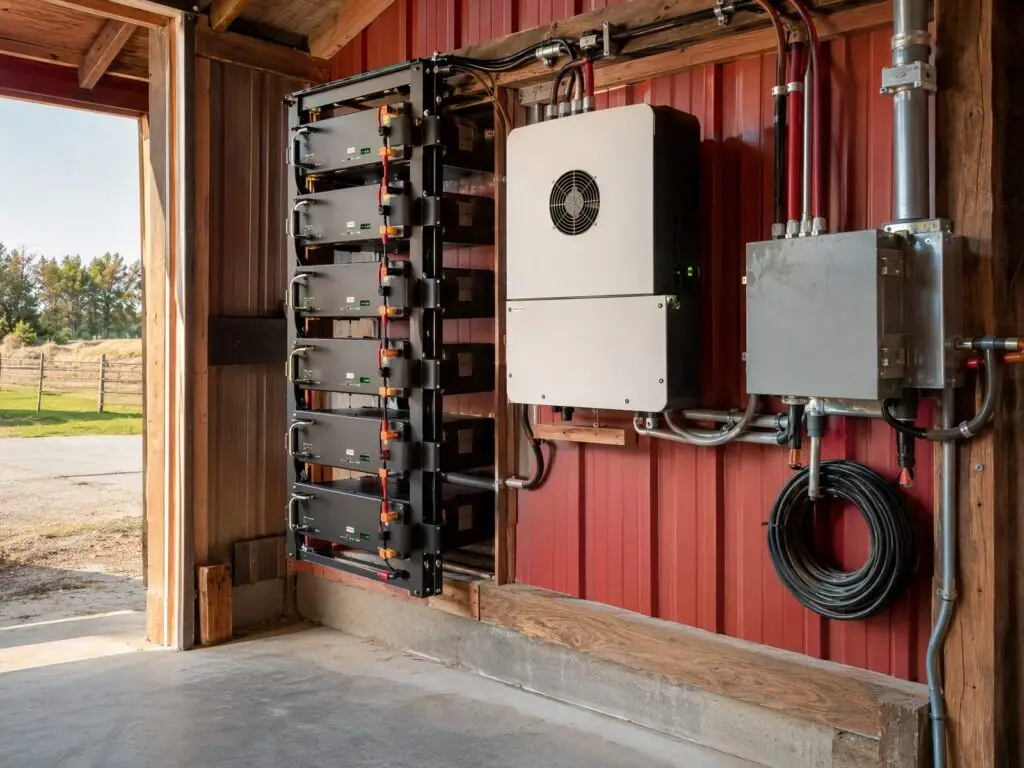
Barn and milk cooling is flat, 24-hour load with a hard reliability requirement, because a stopped compressor is product loss within hours. It rewards autonomy and a transfer scheme sized to locked-rotor current rather than running watts. A rack of LiFePO4 battery modules behind a surge-rated inverter is the usual answer, and sizing becomes hours of autonomy at full compressor load. Where the barn also runs a standby generator, the trade-off is the one quantified in our battery backup versus generator cost comparison.
Grain drying is a short autumn spike that rarely coincides with good solar yield. Storage alone will not carry it economically; the defensible design is a hybrid where array and battery shave the daytime portion and the existing generator covers the rest. Model demand charges rather than energy charges, since a drying fan starting against a commercial tariff can set a billing peak for the month.
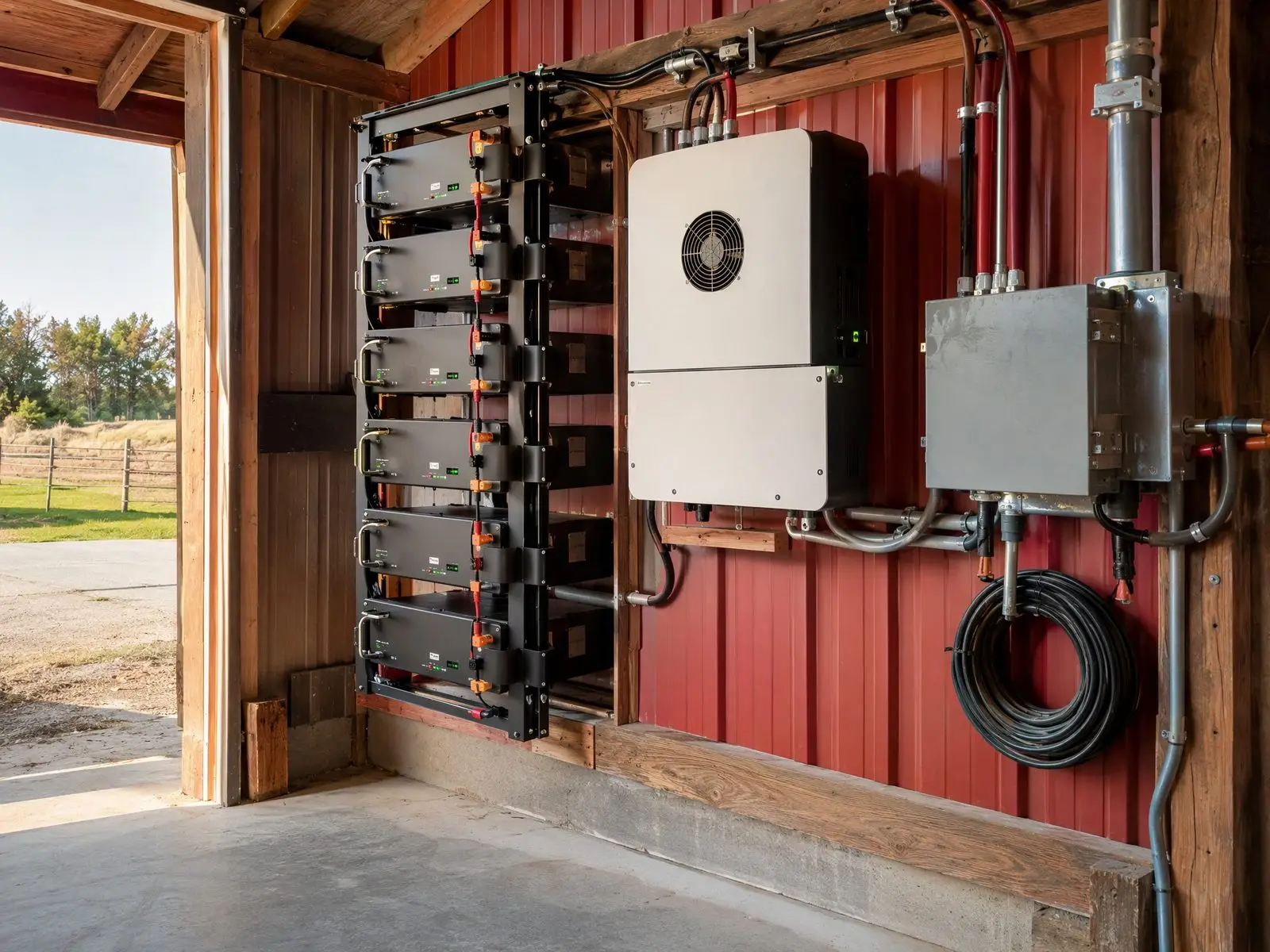
The Component-Origin Rule and the Bill of Materials File
From October 16, 2026, REAP-funded solar photovoltaic and wind projects cannot include components made in countries designated as foreign adversaries under 15 CFR 791.4, and an applicant headquartered in such a country is ineligible. Ground-mounted solar and wind are also barred from cropland, and ground-mounted systems on non-cropland must show historical energy use that justifies system size.
Those restrictions apply to grant-funded projects; a self-funded farm system is not subject to them, which matters when a grower compares a grant build against private financing on cash flow rather than headline cost. For any agricultural solar storage project headed to a REAP application, the bill of materials needs country of origin at module, inverter, cell, BMS and enclosure level, with supplier declarations on file before the purchase order. Origin cannot be fixed after delivery.
Procurement Sequence, and Five Ways It Fails
The application is a file, and the file is assembled during procurement. Collected in this order, documents arrive before the deadlines that need them.
- 12 months of interval data plus generator fuel logs, exported before design freeze.
- Load study naming critical blocks, duty cycles and autonomy hours per block.
- Single-line diagram showing array, inverter, battery, transfer equipment, generator interface and metering.
- Bill of materials with country of origin if a grant is contemplated.
- Certification pack: UL 9540 listing for the energy storage system, UL 1741 SB listing for the inverter, and local interconnection requirements.
- Site and structural plan showing the array is not on cropland, with the historical energy use justification.
- Interconnection application, which frequently governs schedule more than lead time does.
- Warranty and O&M terms in years and cycles, so payback can be tested against the shortest-lived component.
- Commissioning record with as-built settings, meter serial numbers and logging configured from day one.
Equipment is the easy part; the file is not. Our wholesale and distribution programme supplies that document set with the hardware, and the commercial and industrial storage range covers cabinet-scale systems for barn clusters and packhouses.
Five failures account for most rejections and most bad purchases. Buying storage first, when a stand-alone battery or a battery added to an existing array is ineligible. Oversizing the array above 120% to cover future load, which the previous-12-month test does not permit. Siting ground-mounted solar on cropland, which is excluded regardless of score. Missing the 12-month baseline, without which the savings claim cannot be validated. And designing a payback outside the warranty, which only works with optimistic diesel displacement. For a full cost breakdown by component, see our commercial storage cost per kWh analysis.
What to Do Before the Next REAP Window Opens
The window is closed and the Notice of Funding Opportunity is pending, which leaves a planning interval most farms will spend waiting and a few will spend measuring. The work that decides the outcome is unglamorous: pull 12 months of interval data, write down which loads must survive, confirm the array is not going on cropland, collect origin declarations if a grant is in play, and run payback against $5.03 diesel rather than last month’s forecast.
Agricultural solar storage pays back on avoided fuel and avoided demand, not on incentive headlines. Build the numbers first, then buy equipment that fits them. If you are specifying a farm, ranch or packhouse system and want the load study, certification pack and bill of materials handled together, request a quote and our engineering team will work from your interval data.
Frequently Asked Questions
Can a farm get a REAP grant for battery storage alone?
No. Stand-alone energy storage projects, and retrofits adding storage to an existing renewable energy system, are listed as ineligible for REAP grant funds at 91 FR 62600. Storage qualifies when purchased as part of a new renewable energy system, with combined output inside 120% of the farm’s prior 12-month consumption.
How much battery storage does a farm need?
Size to critical load blocks and their autonomy hours, then verify the annual cap. Export 12 months of interval data, identify loads that must survive an outage, multiply each block’s power by required hours, and sum. Most farms land at four to eight hours of autonomy on a critical block rather than whole-farm coverage, because covering every load for a full day is rarely economic.
Does the 120% rule cap the battery or the solar array?
It caps annual energy and applies to the renewable energy system including associated storage. Total annual production, and the storage sized to support it, cannot exceed 120% of consumption in the 12 months before installation, or the utility’s maximum allowable production if lower.
Is agricultural solar storage still possible on a farm with cropland?
The exclusion targets ground-mounted solar and wind on cropland. Roof-mounted systems on barns and shops, and ground mounts on non-cropland, are assessed under the historical energy use test instead. Siting questions are settled with your state Rural Development energy coordinator before design, not after.
What happens if the grant is not awarded?
REAP is competitive, with a minimum score of 40 points and no guarantee of funding. Unfunded applicants may reapply in a later cycle if the project still meets the criteria. The practical consequence is that financing must stand on the project’s own economics: a design whose payback only works with the 25% grant may never be built.
Sources
- Federal Register, “Unleashing American Energy and Economic Prosperity; Rural Energy for America Program (REAP),” 91 FR 62600, Docket No. RBS-26-Business-0529, published October 1, 2026, effective October 16, 2026. federalregister.gov
- USDA Rural Development, “Rural Energy for America Program Renewable Energy Systems & Energy Efficiency Improvement Grants,” program page accessed November 21, 2026. rd.usda.gov
- 7 CFR Part 4280, Subpart B, REAP grants, current text. ecfr.gov
- USDA Economic Research Service, “Farm Sector Income & Finances: Farm Sector Income Forecast,” updated September 3, 2026. ers.usda.gov
- U.S. Energy Information Administration, “Short-Term Energy Outlook,” released November 10, 2026. eia.gov
- U.S. Energy Information Administration, “Electric Power Monthly, Table 5.6.A, Average Price of Electricity to Ultimate Customers by End-Use Sector, August 2026,” released October 23, 2026. eia.gov
Policy details reflect the Federal Register text and the USDA Rural Development program page as published in October and November 2026. This article is not legal, tax or accounting advice; confirm eligibility and documentation requirements with your state Rural Development energy coordinator and a qualified adviser.