
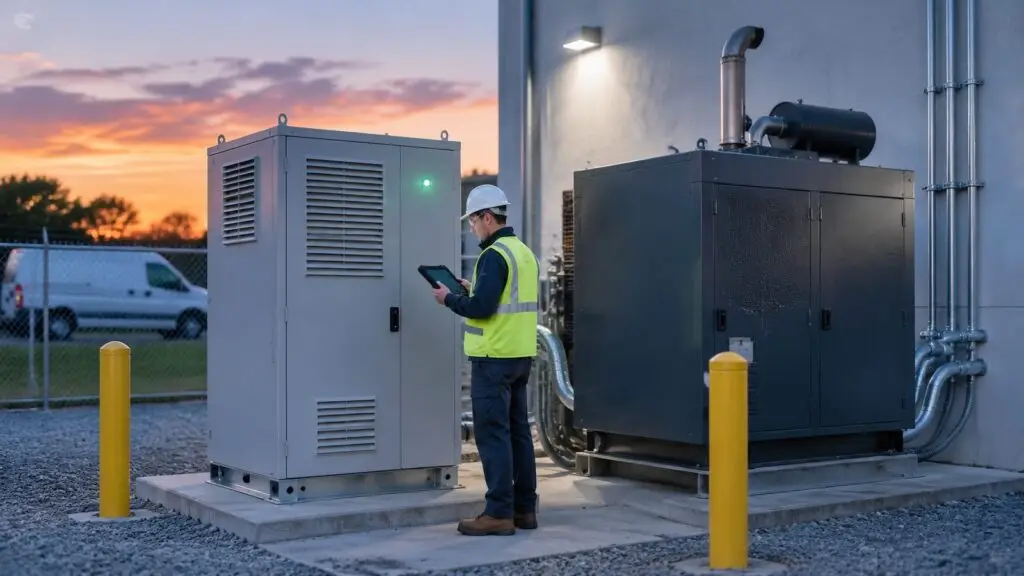
Battery backup vs generator is no longer a philosophy question for U.S. commercial sites — it is a fuel-and-rules question. At the U.S. Energy Information Administration’s November 2026 forecast of $5.03 per gallon diesel in 2027, a 200 kW facility facing 60 outage hours a year spends roughly $6,900 on fuel, testing and maintenance to keep a diesel set ready. An 800 kWh battery covering the same load profile spends about $1,100. What decides the purchase is not that gap: it is autonomy, your tariff, and a federal rule that caps how much a generator may run.
The 2027 numbers you have to plan against
Three figures from this month’s federal data set the baseline for any battery backup vs generator decision made in 2027.
Diesel. EIA’s Short-Term Energy Outlook, released November 10, 2026, forecasts U.S. retail diesel at $5.25 per gallon for 2026 and $5.03 per gallon for 2027. The 2027 number is 12% higher than the agency forecast a month earlier, because product markets are assumed to stay tight through the end of next year. Diesel is cheaper than it was this year — and still roughly five dollars a gallon.
Grid electricity. The same outlook puts average U.S. residential electricity at 18.2 cents/kWh in 2026 and 18.7 cents/kWh in 2027, with total generation rising 2.7% in 2026 to 4,539 billion kWh before slowing to 1.2% growth in 2027. For commercial buyers, the more useful number is in the Electric Power Monthly table 5.6.A (data for August 2026, released October 23, 2026): the U.S. average commercial price was 14.47 cents/kWh, up from 13.87 cents a year earlier, while industrial averaged 9.64 cents. The state spread is the part that changes project math — California commercial customers averaged 30.02 cents/kWh in August 2026, Texas 8.96 cents.
Generation mix. Utility-scale solar rises from 7% of U.S. generation in 2025 to 8% in 2026 and nearly 10% in 2027, while coal falls from 17% to 15%. More inverter-based supply on the system is good for emissions and indifferent to your transfer switch: a battery still needs a listed, grid-code-compliant interface, which is why the UL 1741 SB interconnection checklist belongs in the same folder as this cost model.
The practical translation: the spread between $5.03 diesel and 14.47-cent grid power is now wide enough that a battery recharged from the grid delivers backup energy at roughly one-twelfth the marginal fuel cost of a diesel set. That spread, not hardware fashion, is what has moved storage into commercial RFQs.
The 100-hour rule that most generator quotes ignore
Here is the constraint that rarely appears in a standby generator proposal. Under 40 CFR 60.4211(f), a stationary compression-ignition engine qualifies as an emergency engine only if it is operated within three limits:
- Unlimited hours during actual emergency situations;
- 100 hours per calendar year for maintenance checks and readiness testing;
- Up to 50 hours per calendar year in non-emergency situations, counted inside that 100-hour budget — and those 50 hours may not be used for peak shaving, non-emergency demand response, or generating income, apart from a narrow exception for dispatch by a balancing authority to relieve local transmission or distribution limits.
Exceed the limits and the engine is no longer treated as an emergency engine; it must meet the full non-emergency requirements of 40 CFR Part 60 Subpart IIII. In plain terms: a diesel standby unit can protect your building, but it cannot earn. A battery can do both — absorb demand spikes, shift load under a time-of-use rate, and still carry the critical panel when the grid drops.
Note also that NFPA 110, the Standard for Emergency and Standby Power Systems (2025 edition), requires scheduled maintenance and operational testing of emergency power supply systems. Those test hours are legitimate, but they consume the same annual budget. A facility that tests monthly and also wants to shave peaks is typically already spending its allowance before the first outage arrives.
Battery backup vs generator: a 200 kW site modeled three ways
Assumptions, stated up front so you can substitute your own: 200 kW of critical load; five outages of 12 hours each per year (60 hours); diesel consumption of 0.075 gallons per delivered kWh, a mid-range planning figure for modern sets running at 60–80% load — check your vendor’s fuel curve, because it moves the result; grid electricity at 14.47 cents/kWh; battery round-trip efficiency 90%; undiscounted 10-year totals with no fuel escalation.
| Line item | Diesel only (200 kW) | Battery only (800 kWh) | Hybrid (400 kWh + 100 kW diesel) |
|---|---|---|---|
| Energy delivered during outages | 12,000 kWh (60 h) | 4,000 kWh (4 h per event) | 12,000 kWh (60 h) |
| Fuel or recharge cost | $4,527 | $643 | $2,208 |
| Compliance testing fuel | $377 | $0 | $377 |
| Routine O&M | $2,000 | $500 | $1,500 |
| Annual operating cost | $6,904 | $1,143 | $4,085 |
| 10-year total (undiscounted) | $69,040 | $11,430 | $40,850 |
| Cost per delivered kWh | $0.58 | $0.29 | $0.34 |
| Coverage beyond autonomy | Unlimited, if fuel arrives | None without recharge | Unlimited, if fuel arrives |
| Peak shaving / demand response | Not permitted inside the 100-hour cap | Eligible | Eligible on the battery portion |
The arithmetic is blunt: the battery-only column is the cheapest to operate and the least resilient, because 800 kWh runs a 200 kW load for four hours and then stops. The diesel-only column covers anything but costs $5.03 a gallon to do it, and cannot offset a demand charge. The hybrid column is the one most facilities should be pricing, because it buys autonomy with a smaller, cheaper generator while letting the battery handle the first hours — and the tariff work.
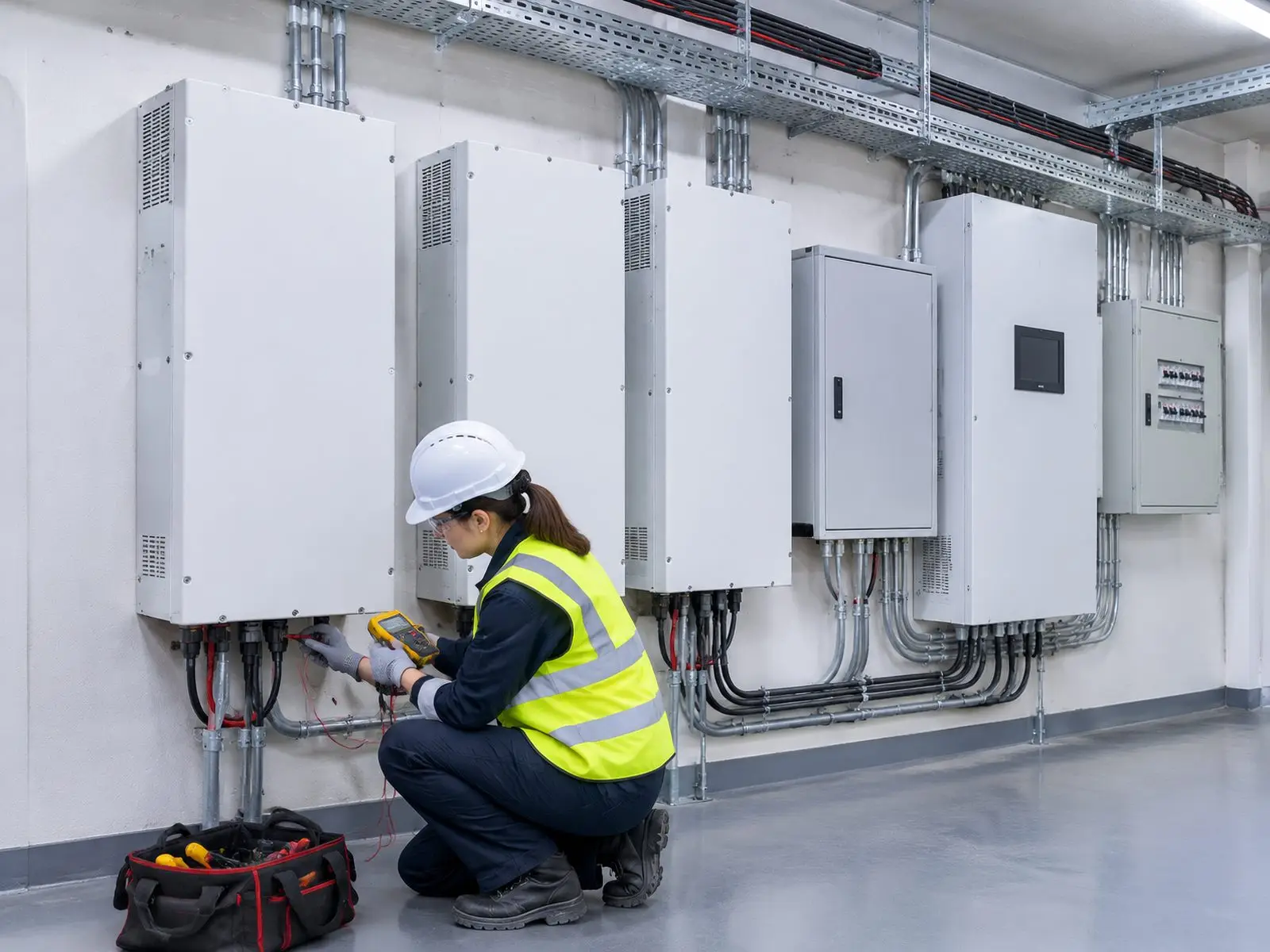
Where each option wins — and where it loses
Battery backup wins when:
- Outages are shorter than your autonomy target. If your history is two-to-six-hour events rather than multi-day storms, a battery sized to that window removes the fuel line item entirely. The cost per delivered kWh above is roughly half the diesel figure.
- The site has demand charges or time-of-use rates. A generator cannot legally shave a peak under the 100-hour rule; a battery can, and that second revenue stream is what carries the capital cost. The 2027 shift toward higher demand charges is the largest single change in commercial storage payback this year.
- Loads cannot tolerate a transfer gap. Static transfer and closed-transition designs, paired with a listed hybrid inverter, keep IT and refrigeration loads up without waiting for a generator to start and accept load.
- Air permits, noise limits or fuel-storage rules apply. A battery cabinet needs NFPA 855 compliance and clearances, not an exhaust stack, a fuel tank and a monthly fuel-polishing routine.
- The asset must keep working between outages. Self-consumption with PV, peak shaving and demand response all monetize the same enclosure.
The generator still wins when: outages run for days and fuel can be delivered; the continuous load is very large relative to any battery you can afford; there is no footprint for cabinets and no room to meet NFPA 855 separation distances; the job is temporary construction power; or capital is the binding constraint, since a 200 kW diesel set remains cheaper to buy than 800 kWh of storage. There is also a temperature clause — battery capacity, charge limits and heater load all move in cold weather, so winter derating has to be modeled rather than assumed.
The hybrid design that satisfies both constraints
A hybrid is not “a battery plus a generator”. It is a sequence, and the sequence is what keeps you inside the 100-hour budget:
- Battery carries the first 2–4 hours — the window that covers most events and all short interruptions, with zero fuel and a transfer measured in milliseconds.
- Generator starts only on low state of charge — not on every outage. In the model above, that cuts diesel running from 60 hours to 50 and lets a 100 kW set replace a 200 kW set.
- Generator charges the battery while carrying the load, so the set runs at a healthy block load instead of idling wet for hours.
- Battery resumes peak shaving when the grid returns, which is where the project earns its keep.
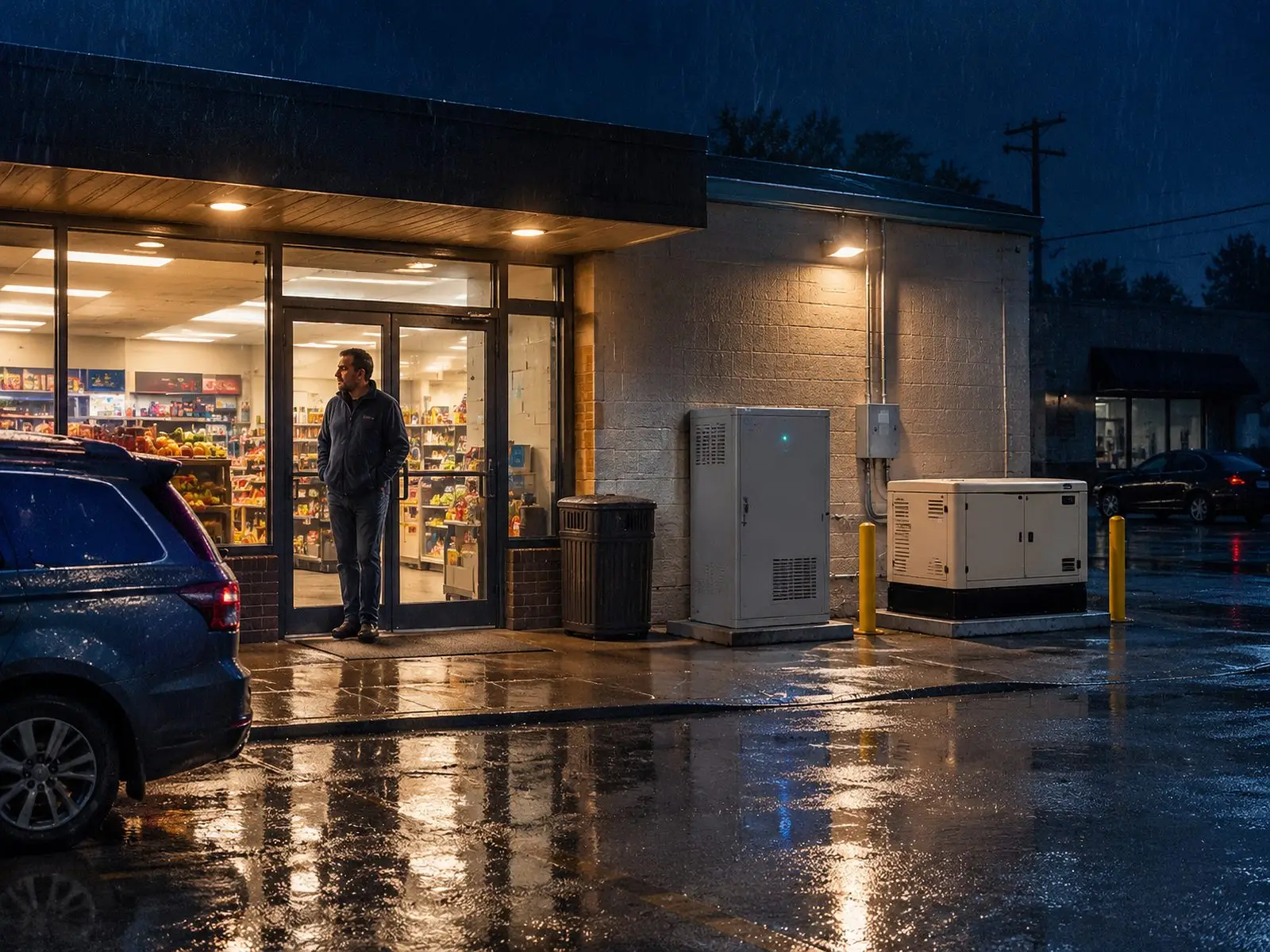
Two engineering details decide whether that sequence works in practice. First, the transfer architecture: an automatic transfer switch with a generator, a multi-mode inverter with a critical-load panel, or both — each has a different failure mode and a different cost. Second, the generator’s minimum block load. A 100 kW set carrying 30 kW for six hours is worse for the engine than running at 70% for two; size the generator to the recharge-plus-load duty, not to the nameplate emergency load.
Procurement checklist: the RFQ items that decide the outcome
Most disappointing storage projects are specified badly, not built badly. Before you compare battery backup vs generator quotes, require these ten items in writing:
- Interval data, not nameplate. Fifteen-minute load data for the critical panel, with peak demand and load factor called out.
- Autonomy target stated in hours and kW, plus the temperature at which that autonomy must still hold.
- Transfer scheme and transfer time, matched to the loads that cannot ride through a 10-second gap.
- ESS listing: UL 9540 certificate for the complete system, with the UL 9540A test report behind it — not just a cell datasheet.
- Inverter listing: UL 1741 SB for grid-tied operation, plus the settings file your utility will actually accept.
- Site compliance: NFPA 855 separation distances, fire-rated assembly, ventilation and signage for your AHJ.
- Certification document pack: UL certificates, CEC listing where applicable, FCC Part 15 report, UN38.3 transport test summary for cells, and safety data sheets.
- Warranty expressed in throughput (MWh) and capacity retention, not only years, with freight and labor responsibility written down.
- Monitoring and firmware policy: remote diagnostics, who can push firmware, and how long the vendor commits to support.
- Commercial terms: lead time by SKU, Incoterms, spare BMS and module availability, and the MOQ that governs your landed cost.
For distributor and OEM programs, items 7 through 10 matter more than the cell price, because they determine whether you can resell the system without re-certifying it. Our wholesale and distribution program is built around that document pack, and the import calendar behind it is worth planning against: the 2027 tariff schedule still decides a meaningful share of landed cost.
What changed this month: a thinner summer margin
On November 13, 2026, EIA reported that hydropower generation in the Southwest fell to record lows this summer: April-through-August output in Arizona, New Mexico and parts of Nevada and California was 19% below the same period in 2025, and 28% below the 10-year average, after prolonged Colorado River Basin drought.
This does not change a single line in the cost table. It changes the assumption behind it. Sites in that region that used to treat a 12-hour outage as an outlier should now model a longer event — precisely the scenario where the hybrid column, not the battery-only column, is the honest comparison. Where the grid is thinner, autonomy beats elegance.
Incentive treatment for storage has moved repeatedly in recent legislation and depends on ownership, placed-in-service date and domestic-content rules. Confirm eligibility with your tax adviser; nothing in this article is tax advice.
Frequently asked questions
Is battery backup cheaper than a diesel generator for a commercial building?
On operating cost, usually yes: in the 200 kW model above, $1,143 a year for the battery against $6,904 for diesel, at EIA’s $5.03 per gallon 2027 forecast and 14.47-cent commercial power. On capital cost, usually no — a diesel set is still cheaper to buy per kW. The battery closes the gap when demand-charge savings or incentives are stacked on top of outage protection.
How many hours a year can an emergency generator run under EPA rules?
Unlimited hours during actual emergencies, 100 hours per calendar year for maintenance and readiness testing, and no more than 50 of those hours in non-emergency situations, which may not be used for peak shaving or non-emergency demand response. Those limits come from 40 CFR 60.4211(f) and apply to engines qualifying as emergency stationary engines.
Can a battery replace a generator completely?
Only if your autonomy target is short. An 800 kWh system carries a 200 kW load for about four hours; after that it needs either a recharge or a generator. For facilities with multi-day outage exposure, the defensible design is hybrid: battery for the first hours and for tariff work, generator for extended autonomy.
What size battery do I need for a 200 kW load?
Multiply the critical load by the hours you must cover, then add margin for round-trip efficiency and end-of-life capacity: 200 kW for four hours is 800 kWh delivered, roughly 890 kWh of usable nameplate at 90% efficiency. Size on interval data rather than nameplate, because the real critical load is usually well below connected load.
Do I still need a generator if I add storage?
If your utility has a history of multi-day restoration after storms, yes — or a documented plan to recharge from PV. If your outages are short and your battery is sized to them, the generator becomes optional, and dropping it removes fuel storage, exhaust permitting and the annual testing burden from the site.
How to decide in one meeting
Three questions, in this order, settle most commercial backup decisions:
- What is the longest outage you must survive without refueling? Under four hours, price battery-only. Over eight, price hybrid. Between, price both — the gap is usually smaller than the fuel difference suggests.
- Does the site have a demand charge or a time-of-use spread worth capturing? If yes, the battery has a second revenue stream and the generator does not. If no, the battery is buying resilience, and should be judged on outage cost alone.
- Can the site host a listed ESS? NFPA 855 clearances, floor loading, thermal management and the AHJ’s view of your wall decide feasibility before price does.
Sites that answer “under four hours, yes, yes” should be pricing storage this quarter, while the 2027 diesel forecast is still the reference point in every vendor’s model. Sites that answer “multi-day, no, no” should keep the generator and spend the difference on fuel contracts and load-bank discipline. Either way, send us your interval data and outage target and we will size the battery, the generator block and the transfer scheme together — starting from the commercial and industrial storage range, the emergency backup power configurations, or the commercial energy system catalog. Residential retrofit work uses the same architecture at smaller scale, on the LiFePO4 battery and solar inverter lines.
Sources
- U.S. Energy Information Administration, Short-Term Energy Outlook (released November 10, 2026; forecast completed November 5, 2026) — diesel, gasoline, electricity price and generation forecasts. https://www.eia.gov/outlooks/steo/
- U.S. Energy Information Administration, Electric Power Monthly, Table 5.6.A, data for August 2026 (released October 23, 2026) — average retail price by sector and state. https://www.eia.gov/electricity/monthly/epm_table_grapher.php?t=epmt_5_6_a
- U.S. Energy Information Administration, Today in Energy, “Hydropower generation in the Southwest fell to record lows this summer” (November 13, 2026). https://www.eia.gov/todayinenergy/detail.php?id=68445
- U.S. Environmental Protection Agency, 40 CFR 60.4211(f), compliance requirements for owners and operators of stationary CI internal combustion engines (eCFR, current as of November 12, 2026). https://www.ecfr.gov/current/title-40/section-60.4211
- National Fire Protection Association, NFPA 110: Standard for Emergency and Standby Power Systems, 2025 edition. https://www.nfpa.org/codes-and-standards/nfpa-110-standard-development/110
- National Fire Protection Association, NFPA 855: Standard for the Installation of Stationary Energy Storage Systems, 2026 edition (Errata 855-26-1, issued October 13, 2025). https://www.nfpa.org/codes-and-standards/nfpa-855-standard-development/855