

Commercial battery storage cost per kWh in 2026 is not one market price. It is the output of five cost layers that most quotes collapse into a single number, which is why two suppliers can bid the same 500 kWh project more than 2x apart and both be telling the truth. With lithium back in an upcycle and US wholesale power up 11% year over year, the buyers who win are the ones who normalize every bid to usable energy, fix the scope boundary in writing, and verify the compliance package before the purchase order.
Why Commercial Battery Storage Cost per kWh Varies 2x for One Project
Commercial and industrial storage is a bespoke business sitting between two industrialized ones. In Q2 2026 the US installed 5.4 GW / 18.9 GWh of storage, of which utility-scale projects took 4.7 GW / 17.6 GWh, according to the Wood Mackenzie and American Clean Power Association US Energy Storage Monitor: Q3 2026 (via ESS News, October 1, 2026). The C&I segment accounted for just 48 MW / 103 MWh — down 2% year over year, even as the market set an energy-capacity record.
That asymmetry explains most of the pricing noise. Utility-scale buyers procure hundreds of megawatt-hours against standardized frames with lender-grade documentation. A factory or cold-storage operator buys 200–2,000 kWh once and compares line items that were never defined the same way.
Three structural forces make 2026 harder than 2024:
- The cell price assumption inverted. BloombergNEF’s second-half 2026 outlook reports lithium prices multiplying tenfold since October 2025 to reach US$11.5/kWh by May 2026, while lithium iron phosphate (LFP) BESS cell prices in China more than doubled over the same period (Energy-Storage.news, October 23, 2026). LFP materials are roughly half the cost of a complete system, so a cell-market move moves the whole quote.
- Supply chains are being re-routed by policy, not price. BNEF’s October 22, 2026 outlook notes that protectionist policy is reshaping regional battery supply chains, with the US leading on tariffs and local-content incentives. Documenting origin is now part of procurement, not paperwork for later.
- Demand is being pulled forward. Wood Mackenzie withdrew its earlier forecast of a near-term contraction, citing the volume of projects starting construction to secure Investment Tax Credit safe-harbor status (ESS News, October 1, 2026). Forward demand means less willingness to hold prices.
2026 Benchmarks, and What Each One Actually Measures
Most of the numbers quoted in sales decks are not capex. Before you compare anything, match the metric to the question you are asking.
| Published figure | What it measures | Use it for |
|---|---|---|
| US$78/MWh levelized cost for a four-hour battery project, down 27% year over year in 2025 (BloombergNEF LCOE 2026, February 18, 2026) | Lifetime cost of delivered energy, global benchmark | Sanity-checking a business case, not pricing hardware |
| 188 GW / 535 GWh of global storage additions forecast for 2026, up 45% year over year (BloombergNEF, October 22, 2026) | Market volume | Judging allocation and lead-time risk |
| ~52 GW of US utility-scale battery capacity after 8.3 GW added in H1 2026; 54 GW more planned through 2028 (EIA, August 7, 2026) | Installed base and pipeline | Benchmarking interconnection congestion by region |
| US wholesale electricity averaging US$52/MWh in 2026, up 11%, with PJM up 41% (EIA Short-Term Energy Outlook, October 6, 2026) | Value of avoided purchases | Estimating arbitrage and demand-charge savings |
| 48 MW / 103 MWh of US C&I storage in Q2 2026 (Wood Mackenzie / ACP, October 1, 2026) | Segment volume | Explaining why C&I equipment is not commoditized |
None of these rows is a price you can put in a purchase order. The only number that belongs in a capital request is your own landed cost, normalized to usable kilowatt-hours at the site.
The Five Layers of a Landed Cost
A credible commercial battery storage cost per kWh can be decomposed into five layers. Ask every bidder to price them separately — the request alone filters out suppliers who are repackaging someone else’s container.
- DC block. Cells, modules, racks, busbars and the battery management system. This is where LFP material cost sits, and where BNEF’s roughly-half-of-system-cost figure applies. Ask for cell manufacturer, cell model, and whether the cells are A-grade with a traceable production date.
- Power conversion. The PCS or hybrid inverter, plus transformer and switchgear where the site needs a voltage change. In 2026 this layer carries compliance weight as well as cost: it must be certified to UL 1741 SB / IEEE 1547-2018 for grid-interactive operation.
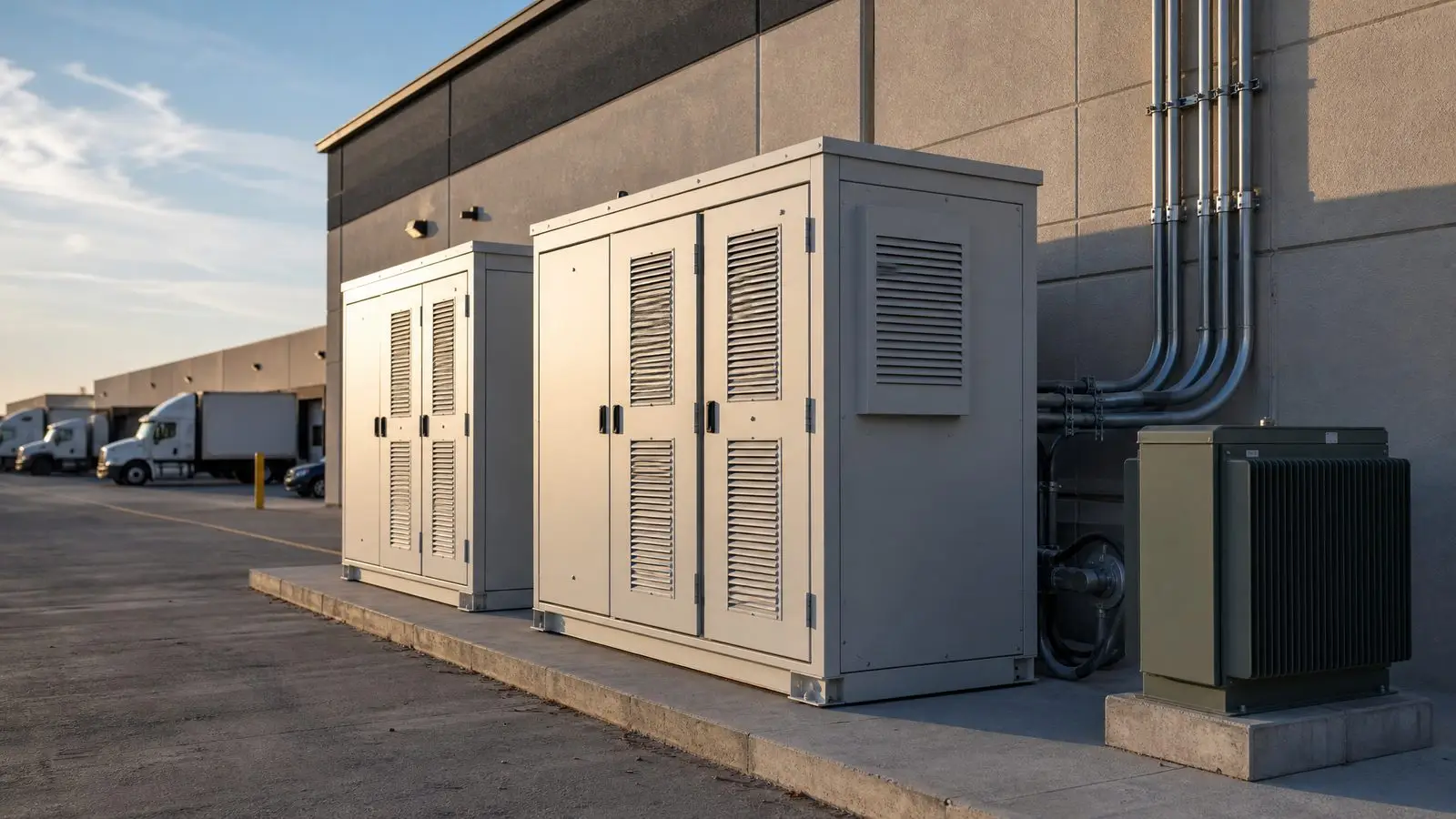
- Enclosure, thermal and fire protection. Cabinet or container shell, HVAC or liquid cooling, aerosol or water-based suppression, gas detection, and the hazard mitigation documentation that goes with it. Cheap enclosures pass capital review and fail insurance review.
- Balance of system, EPC and commissioning. Concrete, conduit, cabling, labour, utility coordination, functional testing and performance verification. This is the layer most often excluded from a “battery price” and discovered later.
- Soft costs and risk. Interconnection studies and upgrades, permits, ocean and inland freight, duties, warranty reserve, and financing. These are site-specific, which is why a supplier’s list price can be accurate and irrelevant at the same time.
When a quote presents one blended number, you cannot tell whether a price gap sits in the cells or in the electrician. On a 500 kWh project, that ambiguity is worth more than the negotiation.
Normalize Before You Compare: Five Conversions
Every bid should be converted to the same basis before the numbers are put side by side. Do these five conversions in this order.
1. Nameplate to usable. A system rated 500 kWh at the cell level rarely delivers 500 kWh at the meter. Usable energy = nameplate × depth of discharge × round-trip efficiency × degradation allowance at end of warranty.
2. DC to AC. Prices quoted at the DC bus omit inverter losses and, sometimes, the inverter itself. Move every bid to AC energy at the point of connection.
3. Beginning of life to end of warranty. A quote that prices 500 kWh but warrants 60% state of health is selling a different asset from one that warrants 70% with a defined augmentation schedule.
4. Cycle count to throughput. “6,000 cycles” without a depth-of-discharge and temperature assumption is marketing. Ask for warranted throughput in MWh and the test conditions behind the curve.
5. Scope boundary. List what the supplier supplies and what the site supplies: civil works, MV transformer, utility meter, EMS integration, network access, spares, training, commissioning witness.
A simple normalization that catches most inflated bids:
Normalized $/kWh = (quoted price + excluded scope estimate) ÷ (nameplate kWh × usable fraction × end-of-warranty SoH)
Purely as arithmetic illustration, not a market price: a US$150,000 quote for 500 kWh nameplate, 90% usable, 70% end-of-warranty state of health, plus US$25,000 of excluded electrical work, normalizes to about US$556/kWh of delivered lifetime energy — while the headline reads US$300/kWh. The gap is not dishonesty; it is definition. Without this step, a commercial battery storage cost per kWh comparison is just two different units with a currency symbol in front.
Turnkey or Split-Source?
Splitting the battery from the power conversion can reduce the equipment line; it also splits the warranty covering the interface between them.
| Buyer profile | Structure that usually fits | Why | Main risk to manage |
|---|---|---|---|
| Single-site factory or cold store, first project | Turnkey system from one integrator | One party owns performance, commissioning and the utility interface | Less price transparency; demand a cost breakdown by layer |
| Multi-site portfolio, repeat build | Frame agreement plus split PCS sourcing | Standardized DC blocks across sites; competitive tension on inverters | Interface and firmware compatibility between BMS, PCS and EMS |
| EPC contractor | Equipment-only, self-performed BOS | Margin capture on civil and electrical scope you already control | You inherit commissioning risk and warranty coordination |
| Distributor or OEM buyer | Factory-direct with private-label documentation | Cost position plus a product line you can support locally | Certification must be in your brand’s name, not the factory’s |
Whichever structure you choose, put the interface in writing: who supplies the Modbus map, who is on site for point-to-point testing, who answers the phone at 2 a.m. when the EMS drops the PCS, and whose insurance responds.
The Document Package to Request Before the Purchase Order
Compliance documentation is a procurement deliverable, not an afterthought. Request these ten items with the quote and treat a missing item as a schedule risk.
- UL 9540 system listing certificate, with model numbers that exactly match the quoted configuration — not a certificate for a sibling product.
- UL 9540A test report at cell, module and unit level, including the edition tested against. Our UL 9540A Edition 6 buyer checklist explains what changed and why the edition number matters.
- UL 1741 SB / IEEE 1547-2018 certification for the PCS, with the utility-specific settings you will actually use.
- CEC listing if the project is in California, plus any state incentive program eligibility letter.
- NFPA 855 compliance statement and a site-specific hazard mitigation analysis covering separation distances, detection and suppression.
- UN38.3 test summary and safety data sheets for every cell and module shipped, needed for freight booking.
- IEC 62619 and IEC 63056 reports where the buyer’s insurer or lender applies IEC rather than UL language.
- Warranty document with the state-of-health curve, throughput cap, augmentation terms, exclusions and claim process.
- Factory acceptance test protocol and the commissioning report template — agreed before shipment, signed after energization.
- Country-of-origin declaration and BOM summary for tariff and foreign-entity screening, plus a cybersecurity attestation for any network-connected equipment.
Compliance requirements are set by your authority having jurisdiction, utility and insurer, and they change. Confirm the current requirements for your site with them; nothing here is legal, tax or insurance advice.

Lead Time, Payment Milestones and Price Protection
When cell prices move materially within a year, commercial terms carry as much risk as the technical specification.
- Price validity in writing. Ask each bidder to state the validity window and what happens at expiry. In a rising cell market, be suspicious of a long window with no escalation clause — it is usually priced in.
- An index-linked escalation clause with a collar and a cap. Tie any adjustment to a named, published index; define the reference date and the calculation; add a cap and a collar so neither party carries an unlimited position.
- Milestone payments tied to evidence. Deposit, payment on approved factory acceptance test, payment on shipment, payment on energization, retention released after the performance test. Never pay the balance against a promise of shipment.
- Delivery liquidated damages. A defined daily rate with a cap, applied from a contractual delivery date — not from “estimated lead time”.
- Allocation and substitution rights. If the supplier may substitute cell makers, require written notice, equivalent specifications, and re-testing at their cost.
- Spares and service. One spare module per string count, plus a named service partner within a stated response time.
One timing note worth planning around: because a large volume of US projects moved into construction to preserve tax-credit safe harbor (ESS News, October 1, 2026), equipment and interconnection capacity are both being consumed earlier in the cycle than the interconnection queue alone would suggest. Tax treatment depends on your facts and the current rules — confirm eligibility with a qualified adviser; this is not tax advice.
A 30-Minute Sanity Check on Any Quote
Six arithmetic checks catch most quotes that will not survive commissioning.
- Duration consistency. Divide stated energy by stated power. If the result does not match the advertised duration, one of the two numbers is defined differently than you assume.
- C-rate feasibility. A 2-hour LFP system runs at roughly 0.5C. A quote implying 1C from a standard rack is either a different product or an optimistic datasheet.
- Module arithmetic. Modules per rack × rack count × module kWh should reproduce the nameplate within a few percent. A large discrepancy usually means “nameplate” includes something other than cells.
- Physical footprint. Check cabinet dimensions and weight against the delivery route, floor loading and door widths. Retrofits fail here more often than in the electrical design.
- Headline versus normalized gap. If normalized cost per usable kWh is more than about 20% above the headline, ask for the excluded scope in writing before discussing price.
- Warranty economics. Compare the warranty term and throughput cap with the implied reserve in the price. A long warranty at an aggressive price is a counterparty question, not a bargain.
What This Means for 2027 Budgets
Two forces are pulling in opposite directions, and the practical answer is to separate the frame from the cells. Long-run costs keep falling: BNEF forecasts a 25% decline in battery storage levelized cost by 2035 (February 18, 2026). Short-run input costs are volatile, with LFP material prices rising through 2026. Meanwhile the value of storage is rising in the markets that matter most — US wholesale power averages US$52/MWh in 2026, up 11%, with PJM up 41% (EIA, October 6, 2026).
For a commercial buyer that means standardizing the platform and the documentation package, buying DC blocks when the index is favourable rather than when the building is ready, and keeping the interconnection application moving independently of the equipment order. For distributors, it means frame agreements with defined escalation instead of spot buying.
If you are sizing the system rather than pricing it, start with our commercial battery storage sizing and payback framework and bring the normalized numbers back to a supplier once the load profile is settled.
Frequently Asked Questions
How much does commercial battery storage cost per kWh in 2026?
There is no defensible single figure, because published numbers measure different things. Third-party benchmarks such as BloombergNEF’s US$78/MWh levelized cost describe lifetime delivered energy, not equipment price. Installed cost per kWh depends on duration, enclosure type, interconnection scope and site electrical work, and it should always be quoted per usable kWh at end of warranty. Ask for the five cost layers separately and normalize before comparing.
Is commercial battery storage worth it for a factory in 2026?
The case rests on three revenue lines: demand-charge reduction, time-of-use arbitrage and backup value. With US wholesale power averaging US$52/MWh in 2026, up 11% year over year, and PJM up 41% (EIA, October 6, 2026), the arbitrage signal is stronger in some regions than others. Model your own interval data — a system sized for a 41% price region rarely pays back the same way in a 23% decline region.
What is the difference between nameplate and usable kWh?
Nameplate is the DC energy installed. Usable is what the system delivers at the point of connection after depth-of-discharge limits, conversion losses and degradation. The ratio is typically the single largest source of confusion in bid comparison, which is why every quote should state both figures and the assumptions behind them.
Which certificates should a C&I battery supplier provide?
At minimum: a UL 9540 system listing matching the quoted configuration, UL 9540A cell/module/unit test reports with the edition stated, UL 1741 SB or IEEE 1547-2018 certification for the inverter, NFPA 855 compliance documentation, and UN38.3 plus safety data sheets for shipping. California projects also need CEC listing. Requirements vary by jurisdiction and insurer — confirm with your AHJ.
How do I protect a storage order from battery price increases?
Four mechanisms: a written price validity window, an index-linked escalation clause with a cap and collar, milestone payments tied to factory acceptance rather than calendar dates, and a defined delivery date with liquidated damages. Avoid open-ended “price subject to cell market” language with no formula, and treat a long validity window with no escalation mechanism as exposure priced into the base number.
Get a Normalized Quote, Not a Headline Price
Ruihan Energy manufactures LFP battery systems, hybrid and grid-tied inverters and commercial storage cabinets, and quotes with the five cost layers separated so you can compare like with like. Send your load profile, site constraints and target duration through our quote request form and we will return a normalized breakdown with the compliance document list attached. Distributors start at wholesale and distribution or OEM/ODM manufacturing; project teams can review the commercial and industrial storage range and the C&I system category.
Sources
- BloombergNEF, “Energy Storage Growth Surge Goes Global: Three Things to Know,” October 22, 2026 — about.bnef.com
- Energy-Storage.news, “Global energy storage deployments will see 45% year-on-year growth surge in 2026: BloombergNEF,” October 23, 2026 — energy-storage.news
- BloombergNEF, “Battery Storage Costs Hit Record Lows as Costs of Other Clean Power Technologies Increased,” February 18, 2026 — about.bnef.com
- US Energy Information Administration, “Battery storage capacity averaged 70% growth over the last three years,” August 7, 2026 — eia.gov
- US Energy Information Administration, Short-Term Energy Outlook, released October 6, 2026 — eia.gov/outlooks/steo
- ESS News, “US energy storage deployments hit record 18.9 GWh in Q2,” reporting Wood Mackenzie and ACP US Energy Storage Monitor: Q3 2026, October 1, 2026 — ess-news.com