
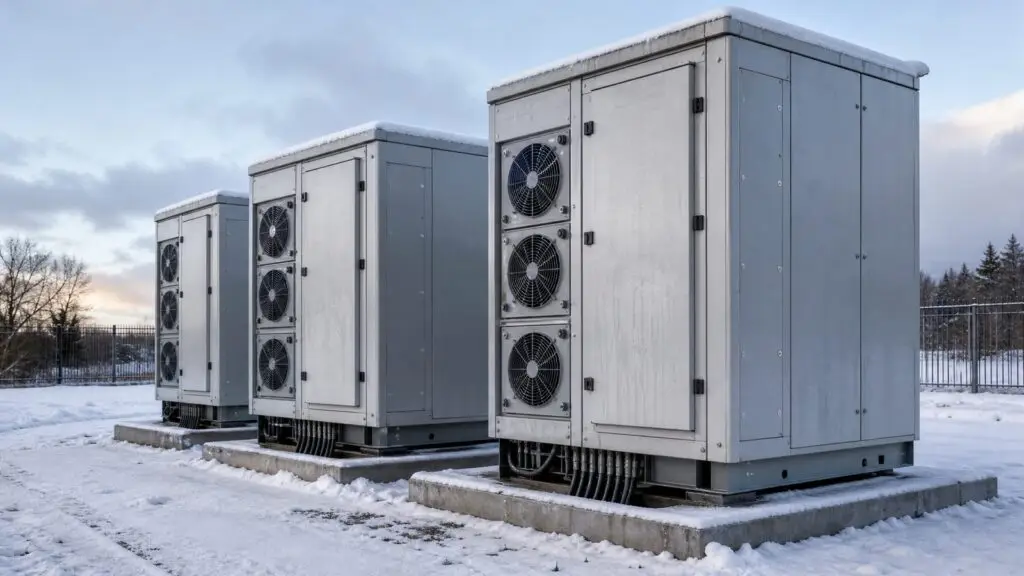
Cold weather does not kill lithium iron phosphate storage — unmanaged cold does. Below freezing a LiFePO4 pack loses usable capacity, refuses charge to protect its anode, and spends energy heating itself. Those are three separate penalties, and they rarely appear on the same quote line. This guide sets out what actually changes below 0 °C, how BMS charge lockout and heater logic differ, and what belongs in the specification and commissioning checklist so a cold-climate battery storage system still delivers close to nameplate in February.
Cold climate battery storage: why winter now decides the economics
U.S. electricity demand keeps setting records, and the marginal load is increasingly electric heat. EIA’s November 2026 Short-Term Energy Outlook puts electric power sector generation at 4,539 billion kWh in 2026, up from 4,425 billion kWh in 2025, and forecasts the average residential price rising from 18.2¢/kWh in 2026 to 18.7¢/kWh in 2027.
EIA’s Winter Fuels Outlook 2026–27 sharpens the picture for anyone selling storage into homes and small commercial sites:
- More than 40% of U.S. households heat mainly with electricity, and EIA expects a 3% winter price increase to lift their electricity bills about 4%.
- The U.S. average residential price for November through March is forecast at 18.23¢/kWh, up 3% on last winter.
- Regional weather diverges. Western heating degree days are forecast 25% above last winter (2,781 degree days), pushing western electricity spending up 9%, while the Northeast is forecast 12% milder.
- Household electricity consumption peaks in January at roughly 1,494 kWh, exactly when PV yield is at its annual low.
That combination — highest load, lowest generation, coldest cells — is the operating point a cold-climate battery storage system is actually bought for. A pack validated at 25 °C is being asked to perform at −10 °C to −20 °C, often for the first time, on the night the grid fails. Backup buyers should start with emergency backup power sizing rather than with kWh headlines.
Three penalties cold imposes on a LiFePO4 pack
Every cold climate battery storage design inherits all three, whether it is a 5 kWh wall unit or a cabinet in a warehouse yard.
1. Less energy out of the same enclosure
Lower cell temperature raises internal resistance. Under load, voltage sags earlier, the BMS reaches its cutoff voltage sooner, and the pack delivers fewer kilowatt-hours before it declares itself empty. This is not a chemistry defect; it is kinetics. It also means the number that matters on a winter quote is usable energy at the lowest expected ambient temperature, not the 25 °C figure printed on the datasheet.
2. Charge that has to be refused
Charging is the dangerous half of the temperature problem. Pushing current into a cold anode causes lithium to plate onto the graphite surface instead of intercalating, which permanently removes capacity and creates a safety risk. DOE’s Energy Storage Safety Strategic Plan (May 2024) states the control plainly: to prevent lithium deposition, the battery management system must limit charge currents to safe levels. In practice, reputable LiFePO4 systems publish a separate charge window and lock out charging at or just above freezing. A system that keeps accepting full charge current at −5 °C is not more capable — it is unmanaged.
3. Energy spent keeping the cells warm
Heaters consume stored energy. In a deep cold snap, a heated enclosure may spend a meaningful share of daily throughput on thermal management before a single load is served — and that energy has to be bought, stored, and replaced, which is where most winter sizing errors originate.
The parasitic load most quotes miss
The best public quantification comes from Sandia National Laboratories. Olis, Nguyen, Rosewater and Byrne modelled a peak-shaving BESS in eight U.S. locations, including extreme cold, using EnergyPlus to simulate the enclosure HVAC load. Their result: accounting for heating and cooling raised optimal energy capacity by 42% to 300%, power rating by 43% to 217%, and capital cost by 43% to 296%, depending on location and on whether the power conversion system sat inside or outside the enclosure.
| Design parameter | Increase when HVAC load is modelled (Sandia, 2023) |
|---|---|
| Optimal energy capacity | +42% to +300% |
| Power rating | +43% to +217% |
| Capital cost | +43% to +296% |
Two caveats keep this honest. The study modelled NMC cells and a conventional enclosure, so the percentages are not a transferable rule of thumb for every LFP cabinet. And it sized for a peak-shaving duty cycle, not for a multi-day outage. What transfers is the mechanism: thermal management is a load, not a feature, and it belongs on the energy balance sheet. For commercial and industrial projects, see commercial energy storage systems with published operating envelopes.
BMS charge lockout versus heater logic: three architectures
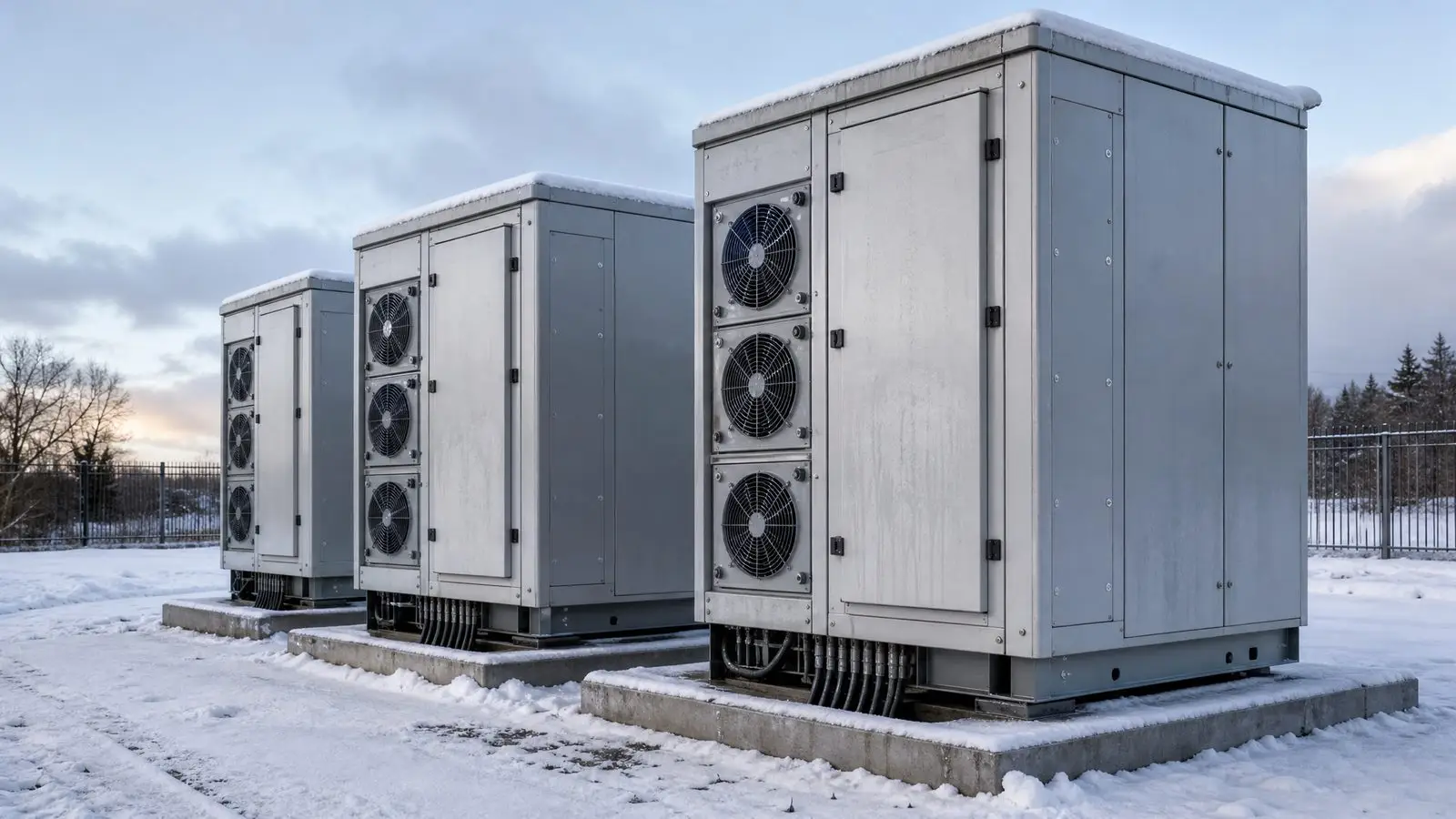
Most winter failures in a cold climate battery storage installation are configuration failures, not cell failures. Three architectures dominate, and they behave very differently on a January morning when PV production begins before the pack has warmed.
| Architecture | Behaviour in freezing conditions | Parasitic load | Where it fits |
|---|---|---|---|
| Charge inhibit only | BMS blocks charge below the floor; discharge continues. Charging resumes only when ambient or self-heating lifts cell temperature | None | Mild-winter markets, intermittently heated spaces, cost-sensitive portable units |
| Inhibit plus pad heater | Heater raises cell temperature to the charge floor, then charge is released; hysteresis prevents heater chatter | Material — sized in watts, not percentages | Residential wall units in garages and basements, small C&I cabinets |
| Self-heating cells / internal heating | Heat generated inside the cell stack; faster warm-up and better uniformity, released charge earlier in the morning | Lower than external pads for the same warm-up | Cold-climate residential and off-grid systems where morning recharge matters |
Whatever the architecture, four firmware details decide whether it works in the field: the charge-release threshold and its hysteresis band, whether heating is powered from grid, PV, or the pack itself, whether heating is allowed at low state of charge, and whether the BMS logs the charge-inhibit events so an installer can prove what happened. Ask for the log format before you buy. If the answer is a screenshot, keep shopping.
Sizing a cold climate battery storage system: a worked example
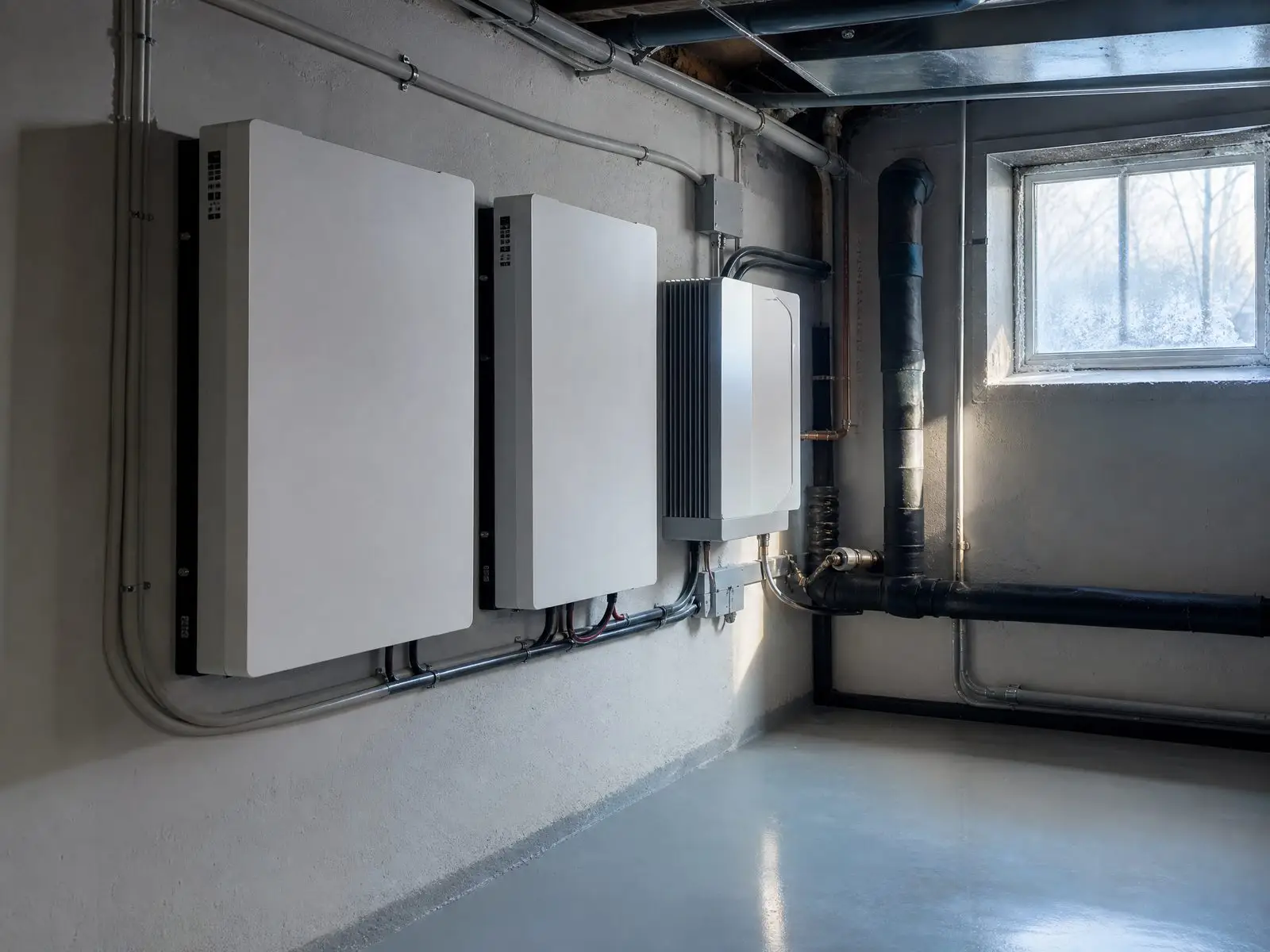
The arithmetic below is illustrative — the inputs are stated assumptions, not a product specification — but it shows where winter numbers go wrong in a cold climate battery storage quote.
Assume a 100 kWh nameplate pack, 90% depth of discharge, 15% usable-energy derate at −10 °C, a 300 W enclosure heater running continuously through a deep cold snap, and 55 kWh of daily throughput.
- Warm-weather usable energy: 100 kWh × 0.90 = 90 kWh.
- Cold-weather usable energy: 100 kWh × 0.90 × 0.85 ≈ 76.5 kWh — a 15% loss before any heater is switched on.
- Heater energy: 0.3 kW × 24 h = 7.2 kWh/day, or about 13% of the 55 kWh daily throughput.
- Replacement burden: every kWh delivered in that week effectively costs about 1.13 kWh of throughput once heating is included.
The two penalties compound but they are not the same penalty. Derating reduces what the pack can hold; heating reduces what the pack can deliver and forces additional recharge. Sizing on capacity margin alone and ignoring the heater load is the most common cold-climate error we see in distributor spreadsheets — and it is invisible in summer commissioning tests.
Where a cold climate battery storage specification is won or lost
Enclosure decisions move winter performance more than cell-level marketing claims:
- Power conversion inside or outside. Sandia’s model treated this as a variable for good reason: an inverter inside the thermal envelope dumps its losses into the space the heater is trying to control. In cold climates that can be useful heat; in summer it becomes cooling load.
- Insulation and thermal breaks. Gasketed doors, insulated penetrations for conduit, and separation between the battery compartment and the electronics bay decide how much heater power is wasted on the outdoors.
- Sensor placement. Cell-temperature sensing, not ambient sensing, should drive charge release. An ambient probe on a sunlit south wall can read 10 °C warmer than the cells behind it.
- Condensation and snow. Freeze-thaw cycling drives moisture through cable entries; roof snow load and drift against a cabinet door block service access when you need it most.
- Morning recharge sequencing. In off-grid and hybrid architectures, pair heater scheduling with hybrid solar inverters so the array’s first kilowatt-hours warm the pack instead of tripping a charge lockout.
For sites with an existing array, the same logic applies to retrofitting storage onto an existing solar system: the retrofit must be evaluated against the coldest week, not the shoulder season.
The documentation package to demand from a supplier
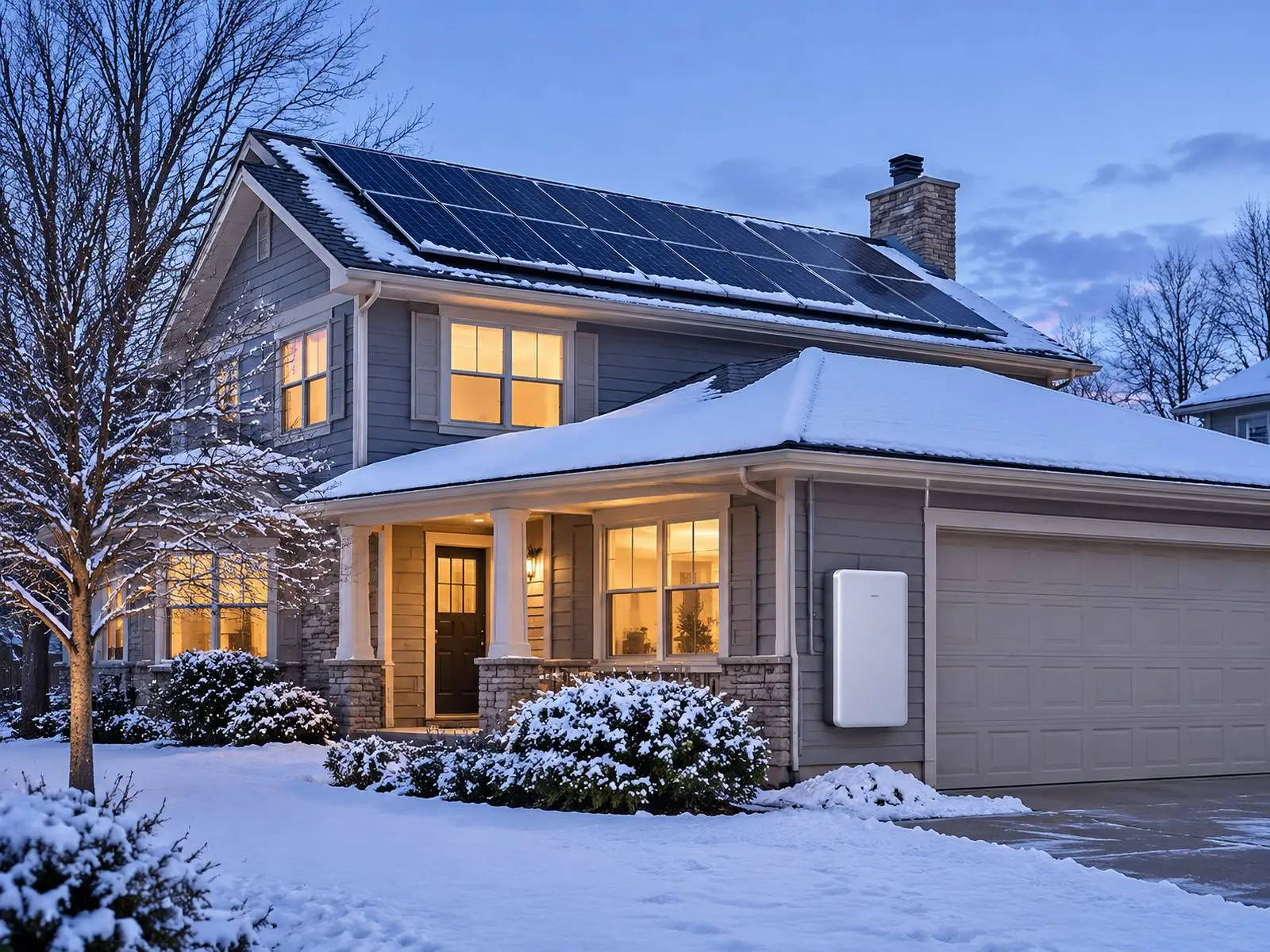
Claims about cold climate battery storage performance are only as good as the paperwork behind them. For a U.S. project, request the following and read the temperature columns, not the cover page:
- UL 9540 system listing with its stated operating temperature envelope, and UL 1973 module reports for the packs inside it — the baseline evidence for any cold climate battery storage claim.
- UL 9540A test summary if the unit goes indoors or into an occupied structure.
- Separate charge and discharge temperature windows, plus the exact charge-release threshold and hysteresis.
- Heater rated power, control source, and low-SOC behaviour.
- A derating table at the temperatures your site actually sees, not a single 25 °C efficiency number.
- The warranty clause that governs low-temperature operation, and the BMS event-log export format.
- For modular DC architectures, the evaluated subsystem combinations. UL Solutions announced a certification pathway on 20 October 2026 that evaluates a DC energy storage system together with each identified subsystem against UL 9540 and documents compatible models in the UL Product iQ database — which is precisely the evidence a code authority will look for when your design is not a single matched assembly.
NFPA 855, the installation standard for stationary energy storage systems, sets the minimum requirements for mitigating ESS hazards, and the 2026 edition is the current reference for U.S. installations. Local adoption still varies by jurisdiction, and electrical inspectors will hold you to the installation instructions that accompany the listing. Confirm the applicable edition and any local amendments with your authority having jurisdiction.
This article is technical guidance, not legal, tax, or permitting advice. Verify requirements with your AHJ and a qualified engineer.
Cold-climate winter readiness checklist
Run this list on any cold climate battery storage site before the first hard freeze, not after the first nuisance alarm.
- Confirm the installed pack’s charge floor and set the BMS charge-release threshold with hysteresis at least 2 °C wide.
- Record cell temperature at three depths (top, middle, bottom) during the first cold morning charge.
- Verify heater control source and confirm it cannot drain the pack below the reserve SOC you sold.
- Compute heater kWh/day at design ambient and add it to the daily energy balance — separately from capacity derating.
- Re-run the outage-duration calculation using cold-derated usable energy, not nameplate.
- Check that derating, heater load, and low-temperature warranty terms appear in the same document the customer signs.
- Photograph cable entries, door gaskets, and drain paths before winter; re-inspect after the first freeze-thaw cycle.
- Test the BMS event-log export and confirm charge-inhibit events are timestamped.
- Walk the snow-clearance path to the cabinet, disconnects, and any rapid-shutdown device.
- Brief the site contact on what a charge lockout looks like in the app — so it is not reported as a failed battery.
Distributors building a winter-ready portfolio should start with LiFePO4 battery modules and matched home energy storage systems, and check the cycle-life evidence behind the warranty — our breakdown of what LiFePO4 warranty data really says is a useful cross-check. Off-grid sites carry the highest exposure and deserve their own review of off-grid solar power systems.
Frequently asked questions
Can you charge a LiFePO4 battery below freezing?
Not with normal charge current. In any cold climate battery storage system, below the charge floor lithium plates onto the anode instead of intercalating, which permanently reduces capacity and creates a safety risk, so a correctly configured BMS blocks charge until the cells warm. Discharge usually continues at reduced capability, which is why a cold battery can run a load overnight and still refuse to accept PV the next morning.
How much capacity does cold weather take from a storage system?
It depends on the cell, the enclosure, and the duty cycle, so any single percentage should be treated with suspicion. The published range for thermal management effects is large: Sandia’s modelling of cold-climate BESS siting found optimal energy capacity rising 42% to 300% once heating and cooling loads were included. Ask suppliers for a derating table across the temperatures your site actually experiences.
Do heated batteries cost more to run?
They consume energy, but the alternative is worse. A heater drawing 300 W continuously uses 7.2 kWh per day, which is a real line item against a daily throughput in the tens of kilowatt-hours. That energy is what buys back charge acceptance; without it the pack simply sits locked out through the morning PV window.
What makes cold climate battery storage compliant in the U.S.?
Three layers: a UL 9540 system listing that covers your operating temperature envelope, installation under NFPA 855 as adopted by the local jurisdiction, and installation strictly per the listing instructions. Where a design combines separately evaluated subsystems, the documented evaluated combinations are the evidence an inspector can check.
What should a distributor put in a cold-climate RFQ?
Separate charge and discharge temperature windows, heater power and control logic, a derating table at −10 °C and −20 °C, the low-temperature warranty clause, the UL 9540 listing scope, and a sample BMS event log. A supplier who cannot produce all six is selling a warm-weather product into a cold market.
Conclusion
Winter performance in cold climate battery storage is a design and documentation problem, not a chemistry problem. The systems that hold up are the ones specified with a charge floor that is enforced, a heater whose energy is counted, a derating table that is published, and a listing envelope that matches the site. EIA’s winter outlook makes the commercial case: electric heat is now a large share of U.S. load, prices are forecast higher, and the coldest weeks are when backup is judged. Specify for that week and the rest of the year takes care of itself.
Planning a cold climate battery storage project or building a winter-ready product line? Send your site conditions and load profile through our quote request form and we will come back with a configuration and the documentation package that supports it.
Sources
- U.S. Energy Information Administration, Short-Term Energy Outlook, released 10 November 2026 — Electricity, coal, and renewables.
- U.S. Energy Information Administration, Winter Fuels Outlook 2026–27 (published 6 October 2026, updated with the November 2026 STEO) — eia.gov.
- Olis, W.P., Nguyen, T.A., Rosewater, D., Byrne, R.H., “Impact of heating and cooling loads on battery energy storage system sizing in extreme cold climates,” Sandia National Laboratories, 2023 — sandia.gov.
- U.S. Department of Energy, Energy Storage Safety Strategic Plan, May 2024 — energy.gov (PDF).
- National Fire Protection Association, NFPA 855: Standard for the Installation of Stationary Energy Storage Systems, 2026 edition — nfpa.org.
- Energy-Storage.news, “UL Solutions launches certification pathway for modular DC BESS,” 22 October 2026 — energy-storage.news.