
The tariff that matters most to U.S. storage buyers is not the one making headlines. Since January 1, 2026, lithium-ion batteries for non-electric-vehicle use have carried an additional 25% Section 301 duty, and on October 7, 2026 the U.S. Trade Representative confirmed that the underlying action will not lapse. The date that actually moves before the new year is January 9, 2027, and it concerns ships rather than cells. Plan your 2027 solar battery tariffs off the battery line, not off the news cycle.
Three dates that decide your 2027 landed cost
Two separate Section 301 actions run on two separate clocks, and most cost models collapse them into one number. They should not be collapsed. The battery duty is continuous and has no announced expiry. The maritime action is suspended, and that suspension is the item with a deadline attached.
| Date | What happens | What it touches | Who owns it |
|---|---|---|---|
| October 30, 2026, 5:00 p.m. ET | Comment window closes on USTR’s proposal to suspend the maritime Section 301 action for two more months (docket USTR-2026-0694). | Whether vessel-linked fees return in November. | Trade compliance |
| November 9, 2026, 11:59 p.m. ET | The current one-year suspension, running from November 10, 2025, expires. | Ocean freight quotes and port-related charges on Q4 shipments. | Logistics |
| January 9, 2027, 11:59 p.m. ET | End of the proposed further suspension now out for comment. | Anything booked for Q1 2027 delivery. | Sourcing and finance |
| Continuous | 25% additional Section 301 duty on lithium-ion non-EV batteries, effective for entries on or after January 1, 2026. | Every battery line in your bill of materials. | Sourcing and customs broker |
Read the table vertically and the planning logic falls out. Solar battery tariffs on the goods themselves are a known, budgeted 25% that has already been absorbed into 2026 pricing. What is still unknown is the freight-and-fee layer after January 9, 2027 — the line most distributors forgot to put in the 2027 model.
How the 2027 solar battery tariffs actually stack up
The first thing to clear up is what February 2026 did and did not do. On February 20, 2026, the Supreme Court held in Learning Resources, Inc. v. Trump and Trump v. V.O.S. Selections, Inc. that the International Emergency Economic Powers Act does not give the President authority to impose tariffs. The Congressional Research Service summarized the six-to-three decision and its aftermath: the IEEPA-based tariffs were terminated, and the administration pivoted to a temporary import surcharge under Section 122 of the Trade Act of 1974, a statute capped at 150 days and a maximum rate of 15% (CRS Legal Sidebar LSB11398, February 23, 2026).
The ruling did not touch Section 301 or Section 232, and that distinction is the whole story for storage importers. If your landed-cost sheet still carries a line labelled “reciprocal tariff” or “IEEPA,” it describes a duty that no longer exists sitting next to one that does. Rebuild the model from the entry summary, line by line, and ask your broker to show the authority cited for each duty assessed on your last three entries.
The solar battery tariffs most importers ask about are the Section 301 duties, and the rate itself is not ambiguous. In its September 18, 2024 modification notice following the four-year review, USTR listed “lithium-ion non-electrical vehicle batteries — increase rate to 25% in 2026,” and stated that increases scheduled for 2025 and 2026 apply to products entered for consumption, or withdrawn from warehouse for consumption, on or after January 1 of the corresponding year (89 FR 76581, September 18, 2024).
The more consequential document for 2027 planning is the October 7, 2026 continuation notice. USTR had opened the second statutory four-year review in May 2026, advised domestic industries of the possible termination of the actions, and received requests for continuation. The notice states plainly that the July 6, 2018 action “did not terminate on July 6, 2026, and will remain in effect, subject to possible further modifications” (FR Doc. 2026-20510, October 7, 2026).
Translate that into procurement language. There is no sunset date to plan around, so a strategy built on waiting out the duty has no event to wait for. The residual risk is modification, not expiry — which means the clause you need in a supply agreement is a tariff-change clause, and its trigger should be the statutory notice, not a press release.
A word of caution before these numbers reach a business case: this is regulatory and commercial analysis, not tax or legal advice. Duty treatment depends on classification, origin, and the facts of each entry, and credit treatment is handled under separate rules entirely.
The maritime track runs on a separate clock
The April 2025 action in the maritime, logistics, and shipbuilding investigation is a different instrument from the battery duty, and it has been suspended for a year. USTR’s notice of October 26, 2026 proposes to extend that relief: it would suspend the responsive actions from 12:00 a.m. Eastern on November 10, 2026 through 11:59 p.m. Eastern on January 9, 2027, and confirms that during the suspension no party accrues liability for the maritime transport service fees under Annexes I, II, or III of the April 23, 2025 notice, or for the duties in Annex V.A of the October 16, 2025 notice (FR Doc. 2026-21755, October 26, 2026). Comments are due October 30, 2026.
For a distributor, the practical consequence is narrower than the headline suggests and wider than the freight desk assumes. None of this changes the solar battery tariffs you owe at entry. It changes what it costs to move the container, and whether certain vessel-linked charges reappear at all. If the suspension lapses, the increase lands in the freight line — the line quoted last, marked up least, and audited rarely. Ask your forwarder for a written rate validity date that brackets January 9, 2027 instead of one that quietly ends in December.
Where solar battery tariffs land in a storage quote
Solar battery tariffs are assessed at entry, on the customs value of the goods, at the rate attached to the classification you declare. That single sentence explains most of the spread between competing quotes for what looks like the same cabinet. A containerised system can be entered under a battery classification, under a static converter or inverter classification, or as a complete machine, and the applicable Section 301 treatment is not identical across those outcomes. U.S. customs value is generally the transaction value of the imported goods, with freight and insurance typically outside that value — but assists, tooling, royalties, and related-party pricing all change the arithmetic, which is why the valuation question belongs to your broker rather than a spreadsheet template.
| Cost line | What drives it | 2027 risk | Where to verify |
|---|---|---|---|
| Battery cells and modules | Section 301 at 25% since January 1, 2026, applied to the declared classification and origin. | Medium: no expiry, but modification risk during the four-year review. | Entry summary (CBP Form 7501) plus broker confirmation of HTS. |
| Inverter and power conversion | Section 301 list coverage varies by subheading; Section 232 measures apply to some steel and aluminium content. | Medium to high, because classification drives the outcome. | Binding ruling request if annual volume justifies it. |
| Ocean freight and vessel-linked fees | Maritime Section 301 action, suspended only through January 9, 2027 on the current proposal. | High for Q1 2027 bookings. | Forwarder rate validity plus the USTR docket. |
| Assembly, warehousing, and FTZ treatment | Origin rules, substantial transformation, and zone procedures. | Opportunity, not a free pass. | Trade counsel before committing capex. |
Five clauses that stop a tariff change becoming a margin event
Most supply agreements in this category were signed when the duty picture looked different. These are the terms worth renegotiating before the next purchase order, in the order that matters:
- Name the authority, not the word “tariff.” A clause referencing “any applicable tariffs” invites argument. A clause referencing Section 301 duties on named HTS lines, with the rate stated, does not — and that precision is what keeps solar battery tariffs from becoming a quarterly negotiation.
- Decide who is importer of record, in writing. DDP, DAP, and FOB allocate duty very differently. If your supplier quotes DDP and you have never seen their entry, you do not know what rate was declared on your behalf.
- Tie price validity to statutory dates. November 9, 2026 and January 9, 2027 are real dates in the Federal Register. Quarter-end is not. A quote expiring December 31 hides a decision that lands three weeks later.
- Add a classification warranty and a cooperation obligation. The supplier warrants the HTS lines it ships against and agrees to support a ruling request or a prior disclosure if classification is challenged.
- Put the document pack on a schedule. Certification files, bills of material, and origin evidence should arrive with the proforma invoice, not after the container is on the water.
The document pack, and why origin is a legal finding
Customs queries in this product category are rarely about the invoice total. They are about what is inside the box and where the cells came from. The pack we ship with every U.S.-bound order includes a commercial invoice with HTS at line level rather than one blended code for the whole system; a bill of materials listing cell manufacturer, cell model, and country of cell production; UL 9540 and UL 9540A documentation for the energy storage system with certificate numbers and revision dates; UL 1741 SB certification for grid-interactive inverters; UN 38.3 transport test summaries for the modules as shipped; and steel mill certificates for enclosures and racks, which matter when Section 232 content questions arise. The drawing set should match the shipped configuration, because a datasheet describing last year’s cabinet is the most common cause of a classification argument.
Origin deserves its own paragraph because it is where 2025 sourcing decisions are now being tested. Assembling modules into a cabinet in a third country does not, by itself, change origin. Origin turns on whether the process results in a substantial transformation, and that is a finding authorities make from records, not a statement a supplier can print on a carton. Buyers who moved final assembly offshore to manage duty exposure are discovering that the documentation, not the geography, decides the outcome. If a sourcing change is material to your 2027 cost base, request a binding ruling; it is slow, but it is the only answer that survives an audit.

Why the demand side still absorbs solar battery tariffs
Duty is only half of a payback calculation. The other half is what the customer avoids paying for electricity, and that number moved in 2026. EIA’s October 2026 Short-Term Energy Outlook puts the U.S. wholesale electricity price at an average of $52 per megawatt hour in 2026, 11% above 2025, with PJM up 41% and the Northwest Mid-Columbia hub down 23% (EIA STEO, released October 6, 2026). The same outlook has solar rising from 8% of U.S. generation in 2026 to 9% in 2027.
Those two facts pull in opposite directions by region, and that is the actionable part. In high-price markets, solar battery tariffs of 25% are absorbed by a larger avoided-cost stream, so the project still clears. In low-price markets the same duty is a direct hit on payback, and the winning architecture is the cheaper one — fewer kilowatt-hours, a higher C-rate, a DC-coupled design — rather than the bigger one. Applying a single price book across both is how distributors lose the second deal in a territory.
What this means for how we quote U.S. projects
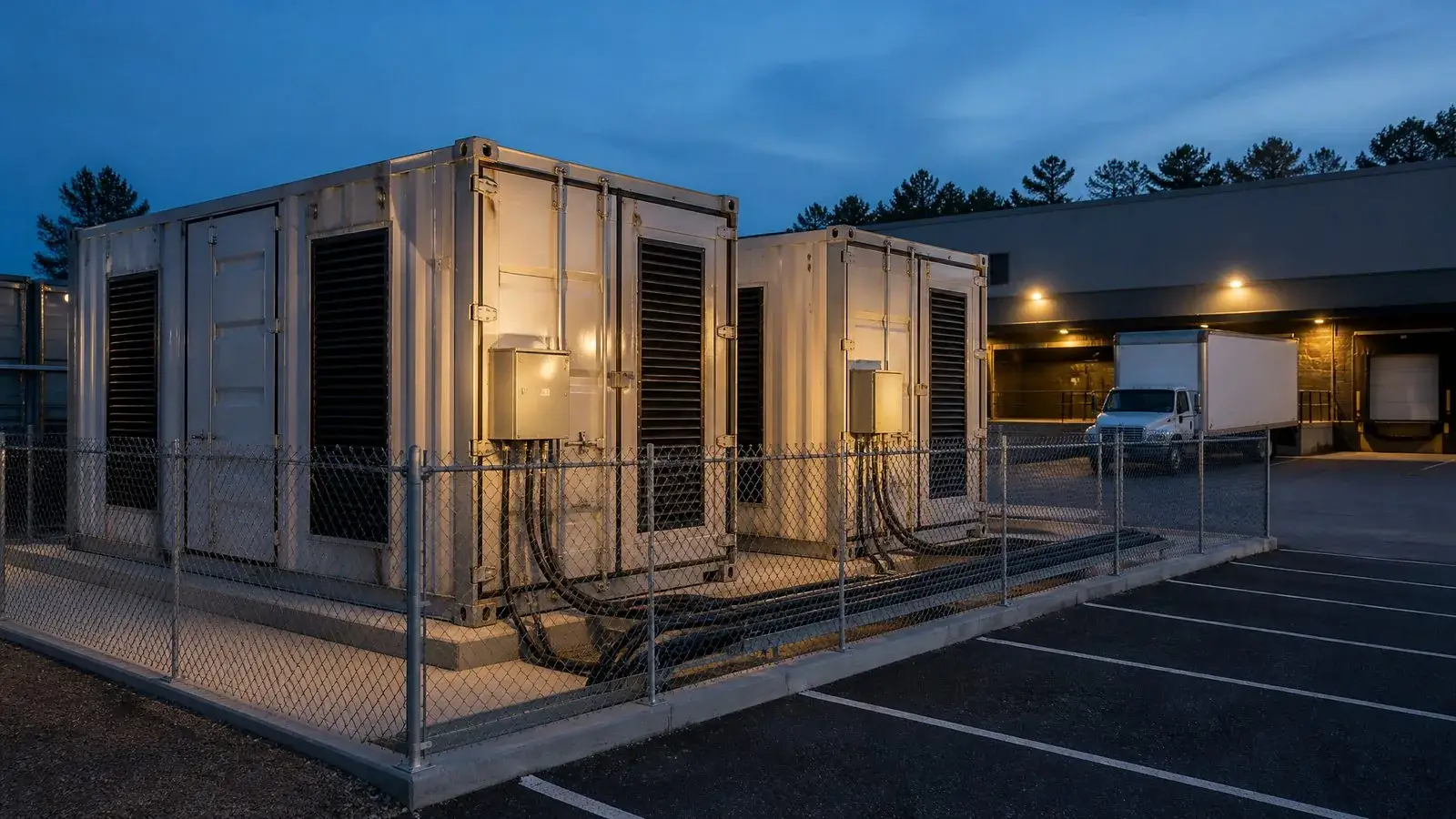
Ruihan Energy manufactures the hardware on both sides of this calculation: solar inverters and hybrid inverters, LiFePO4 battery modules and packs, residential energy storage systems, and containerised commercial and industrial energy storage. Because we ship to distributors and installers rather than to end users, solar battery tariffs and the documentation question arrive together, and we quote them together.
Three things follow for 2027 budgeting. We quote with the HTS lines stated, so your broker can price the entry instead of guessing it. Our terms carry price validity that brackets the January 9, 2027 date rather than ending before it. And for buyers adding a U.S. assembly step, our OEM and ODM programme ships documented sub-assemblies with cell-origin evidence attached, because that is the file an origin review will ask for.
If you are rebuilding a 2027 cost model, two companion pieces are worth reading alongside this one: our breakdown of what a commercial battery storage cost per kWh actually includes, and our October 2026 note on the solar battery tax credit. Duty and credit are different instruments, and conflating them is the most expensive modelling error in this category.
Frequently asked questions
Is there a tariff on solar batteries from China in 2026?
Yes. Lithium-ion batteries for non-electric-vehicle use carry an additional 25% Section 301 duty, effective for goods entered on or after January 1, 2026, under USTR’s September 18, 2024 modification notice. Most-favoured-nation duty and any other applicable measures sit alongside it, so the effective rate on a given shipment depends on its classification. Confirm the rate against your own entry summary rather than a headline figure.
Will the Section 301 battery duty expire?
No expiry date is scheduled. On October 7, 2026, USTR confirmed that the July 6, 2018 action did not terminate on its four-year anniversary and remains in effect, subject to possible modification as the second statutory four-year review proceeds. Treat solar battery tariffs as a permanent line in the model and manage modification risk in contract terms instead.
Did the Supreme Court’s February 2026 ruling remove tariffs on batteries?
No. The Court held that IEEPA does not authorize tariffs, which ended the IEEPA-based tariffs, and the administration then used Section 122 for a temporary surcharge capped at 150 days and 15%. Section 301 and Section 232 were untouched by the decision, which is why the battery duty survived it intact.
What happens on January 9, 2027?
That is the end date of the further suspension USTR proposed on October 26, 2026 for the maritime, logistics, and shipbuilding Section 301 action. It governs vessel-linked fees and certain duties, not the battery classification rate. If the suspension is not extended again, expect the freight side of your landed cost to move first.
Does a complete battery storage system carry the same duty as loose cells?
Not necessarily. Solar battery tariffs follow the classification you declare and the origin customs determines, and a complete system may be classified differently from modules or cells. Third-country assembly does not automatically change origin either. For anything above trial volume, a binding ruling is cheaper than a correction.
The planning takeaway
Solar battery tariffs in 2027 are, for the goods themselves, a 25% line item you can budget today and should already have priced. The variable is the maritime track: a suspension that currently runs to November 9, 2026, a proposal to carry it to January 9, 2027, and a comment window closing October 30, 2026. Build the model with the battery duty fixed and the freight layer dated, and the plan survives whichever way the docket goes.
If you want the classification lines, the certification pack, and a quote whose validity covers that January date, request a quote and tell us the destination state and the volumes you are planning for 2027.
Sources
- Office of the U.S. Trade Representative, “Notice of Modification: China’s Acts, Policies and Practices Related to Technology Transfer, Intellectual Property and Innovation,” 89 FR 76581, September 18, 2024. https://www.federalregister.gov/documents/2024/09/18/2024-21217/notice-of-modification-chinas-acts-policies-and-practices-related-to-technology-transfer
- Office of the U.S. Trade Representative, “Continuation of Actions: China’s Acts, Policies, and Practices Related to Technology Transfer, Intellectual Property, and Innovation,” FR Doc. 2026-20510, October 7, 2026. https://www.federalregister.gov/documents/2026/10/07/2026-20510/continuation-of-actions-chinas-acts-policies-and-practices-related-to-technology-transfer
- Office of the U.S. Trade Representative, “Request for Comments on Further Suspension of Section 301 Action: China’s Targeting of the Maritime, Logistics, and Shipbuilding Sectors for Dominance,” FR Doc. 2026-21755, October 26, 2026. https://www.federalregister.gov/documents/2026/10/26/2026-21755/request-for-comments-on-further-suspension-of-section-301-action-chinas-targeting-the-maritime
- Congressional Research Service, “Supreme Court Rules Against Tariffs Imposed Under the International Emergency Economic Powers Act (IEEPA),” Legal Sidebar LSB11398, February 23, 2026. https://www.congress.gov/crs-product/LSB11398
- U.S. Energy Information Administration, “Short-Term Energy Outlook,” released October 6, 2026. https://www.eia.gov/outlooks/steo/