
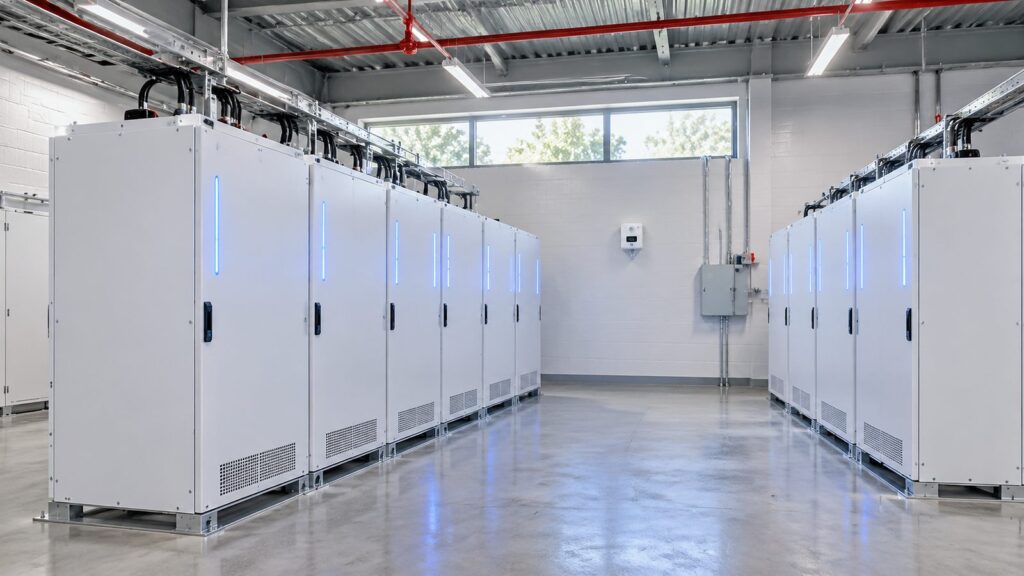
U.S. power-sector battery capacity reaches 66.0 GW by end-2026 (EIA, November 2026), and from January 1, 2027 UL 9540A Edition 6 makes an installation-level large-scale fire test a pass/fail requirement. Together, NFPA 855 (2026 edition) and that test method move compliance from a datasheet claim to a site-specific file: a hazard mitigation analysis, an explosion-control design basis, and separation distances proven by test rather than assumed from a table.
For a commercial or industrial project, that changes the critical path. Equipment selection still matters, but the permit now turns on documents a purchasing department rarely asks for. This guide covers what changed in NFPA 855, which thresholds still drive layout, and the evidence a supplier should hand you before submittal.
What NFPA 855:2026 changed for commercial battery storage
The 2026 edition is not a light revision. Three changes matter most to owners, EPCs, and distributors selling into the U.S. market.
The hazard mitigation analysis becomes the default
In earlier editions, an HMA was triggered only when an installation exceeded certain stored-energy limits, and projects below those limits could often be permitted without a formal hazard analysis. The 2026 edition removes that threshold-based approach and expects an HMA for most battery storage installations unless a technology-specific chapter explicitly exempts them (Exponent, March 2026, summarizing §4.4; NFPA 855:2026).
Explosion control moves from venting to prevention
The standard now requires explosion control designed to NFPA 69, or a performance-based alternative supported by installation-level fire and explosion testing. Deflagration venting under NFPA 68 is no longer accepted as the primary explosion control strategy. Combustible concentration reduction systems are expected to remain operational during the failure scenario they mitigate, and to account for gas migration between interconnected units (Exponent, March 2026).
Large-scale fire testing becomes an installation requirement
A new Annex G.11 sets expectations for testing where fire could spread from one enclosure to another, including how a developed fire condition is initiated and how separation distance and active fire protection are evaluated (UL Solutions, The Code Authority). Chapter 9 of the standard governs electrochemical systems, Chapter 15 covers one- and two-family dwellings, and Annex G is the suppression and safety guide for lithium-ion systems.
The capacity curve and the compliance calendar
Deployment and rulemaking now run on the same schedule. The table pairs each year’s installed power-sector battery capacity with the milestone that governs projects built in it. Capacity is end-of-period nameplate capacity for plants larger than one megawatt, from the EIA Short-Term Energy Outlook published in November 2026, which closed modeling on November 5, 2026; the right column reflects published effective dates, not local amendments.
| Year (end of period) | U.S. power-sector battery capacity (GW) | Compliance milestone in effect |
|---|---|---|
| 2025 | 43.1 | NFPA 855 (2023) is the reference edition in most jurisdictions; California amendments referencing it take effect January 1, 2026 |
| 2026 | 66.0 | NFPA 855 (2026) published: hazard mitigation analysis becomes the default requirement for most installations |
| 2027 | 91.7 | UL 9540A Edition 6 effective January 1, 2027; California targets early adoption of the 2026 provisions on July 1, 2027 |
Read that as a procurement warning. Capacity roughly doubles between 2025 and 2027 on EIA’s numbers, so most systems that will be inspected under the new rules have not been ordered yet. EIA’s inventory work separately puts end-2025 operational capacity at 43.6 GW with 8.3 GW added in the first half of 2026 (EIA, August 7, 2026). The volume of systems needing an HMA and a fire test report is growing faster than the pool of reviewers who can read them.
Does your project need a hazard mitigation analysis?
In practice, yes, unless you can point to an explicit exemption in the chapter covering your technology and occupancy. Treat the HMA as a design document rather than a permit formality: it is the one artifact that forces the manufacturer’s test data, the site layout, and the fire protection strategy to agree.
Section 4.4 frames the analysis around the consequences, survivability, and reliability of five things (Exponent, March 2026):
- Initiation and propagation of thermal runaway events;
- Generation and dispersion of hazardous gases;
- Potential for deflagration or explosion;
- Performance of detection, suppression, and ventilation systems;
- Separation, containment, or compartmentation strategy, including its defects.
Each item consumes data only the manufacturer can supply. Gas composition and volume come from cell- and module-level testing. Propagation behavior comes from the enclosure test. Separation strategy comes from a large-scale fire test run at the spacing you intend to build. If a supplier cannot provide those three data sets for the exact model and configuration quoted, the HMA cannot be finished on schedule no matter how experienced the fire protection engineer is.
What is a large-scale fire test, and when does it apply?
A large-scale fire test evaluates what happens when an entire enclosure burns, not whether a single cell failure stays contained. That distinction is the core of UL 9540A Edition 6, published in March 2026 with an effective date of January 1, 2027 (UL Solutions). We covered the edition change in detail in our UL 9540A Edition 6 breakdown; the short version follows.
Editions 1 through 5 were sequential: cell test, module test, unit test, then installation-level test only if earlier results required it. Because manufacturers designed systems to pass at the unit level, most never proceeded further. Edition 6 keeps the cell- and module-level tests and their criteria but does not stop there: the installation-level test is conducted regardless and carries its own pass/fail criteria. The unit-level test is retained for systems intended for residential applications, and may also be used to show that an active propagation-prevention system stays functional during the large-scale test.
The test is deliberately severe. Vented gases from a propagating event are intentionally ignited, establishing a developed fire condition and aligning the method with Annex G.11. For indoor systems it also produces the sprinkler density and ceiling height data the industry has lacked, which will determine whether standard NFPA 13 Extra Hazard Group 1 criteria remain adequate for battery enclosures.
The Association of Clean Power’s technical summary adds the detail that matters at the permit desk: the test treats the battery as a fuel source in a developed fire, target enclosures sit at the manufacturer’s minimum recommended spacing, and results are evaluated by a registered design professional against the wind conditions expected at the site (ACP, May 2026). A test report is therefore not a universal pass. It describes a specific configuration, at a specific spacing, under specific conditions.
Separation distance is now a test output, not a table lookup
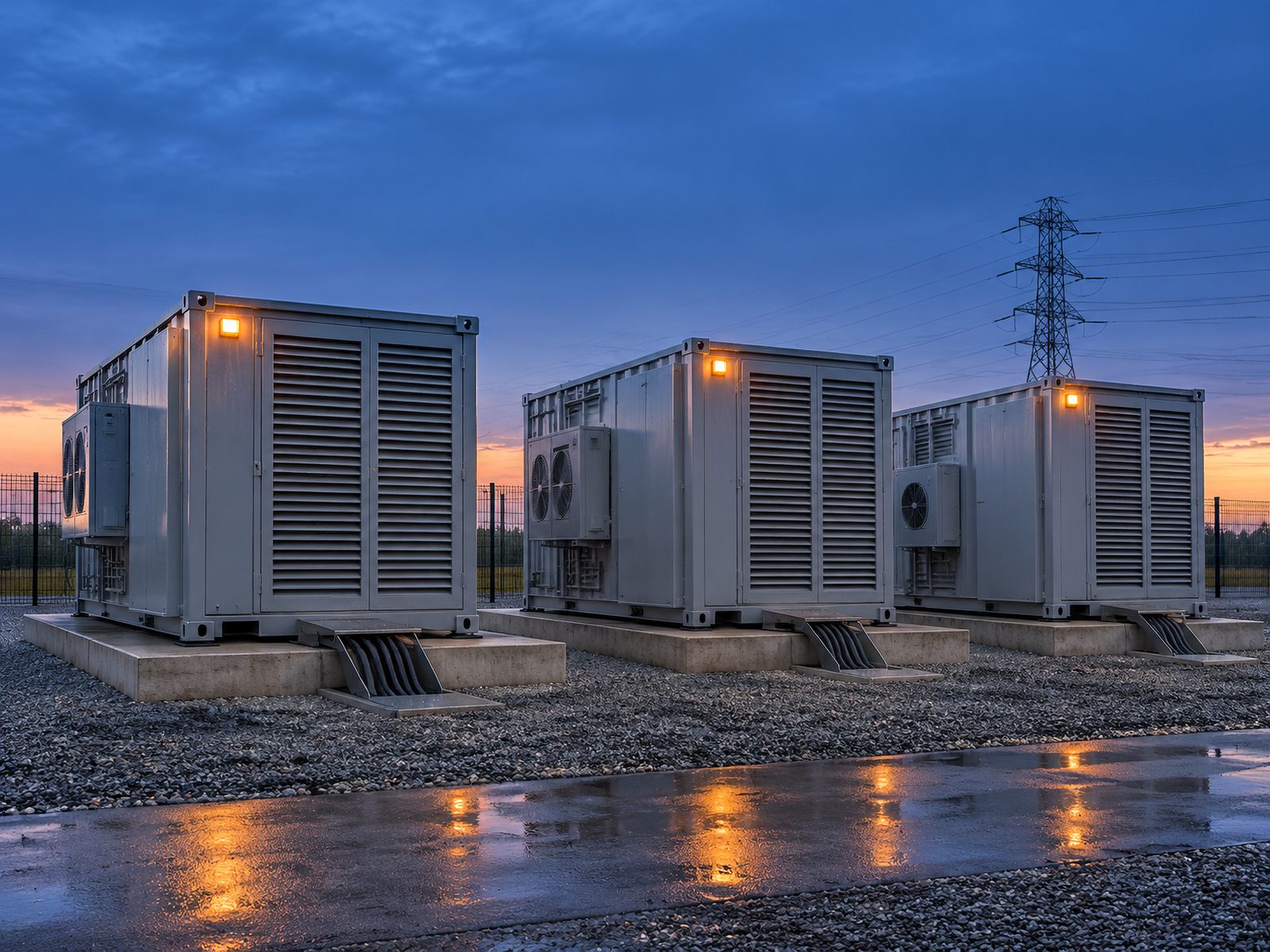
Older practice treated separation as a code table: measure the gap, confirm the number, move on. Under the 2026 framework, a published spacing should be traceable to a test in which an adjacent enclosure did not propagate thermal runaway. Three questions follow for anyone writing a specification. Ask for the spacing actually tested and compare it with the layout drawing. Ask whether the report evaluates heat flux to adjacent equipment such as oil-filled transformers, which is a separate exposure question from unit-to-unit propagation. And ask for the report revision and the UL 9540A edition it was run under, because a report issued to Edition 5 does not answer the Edition 6 question even if the enclosure design has not changed.
This matters more than it used to because the initiating event is often outside the cell. ACP cites EPRI’s 2024 analysis of BESS failure root causes, which found that the majority of events originated in components outside the cells or modules, with stormwater intrusion and coolant leaks among the causes. It also cites historical cell failure rates from less than 1 in 10 million to 1 in 40 million cells (Sandia National Laboratories, 2012) and a recent manufacturer figure of one part per billion. The fire test changed because the failure modes reaching the field were not the ones the earlier sequence modeled. Enclosure design and site layout decide whether those modes stay local, which is why our LiFePO4 battery and enclosure range is documented at the configuration level rather than the cell level.
California’s two-step adoption
California shows how a revision reaches a project schedule. State fire code amendments covering battery storage, referencing the 2023 edition of NFPA 855, were adopted on March 7, 2025 and took effect on January 1, 2026. The Office of the State Fire Marshal intends to propose early adoption of the drafted 2026 edition provisions in the next intervening code cycle, effective July 1, 2027 (California GO-Biz).
Two details from that collaborative matter to product selection. The CPUC now holds maintenance and operations oversight for grid-scale battery facilities under General Order 167-C and verifies that owners have filed emergency response plans with the local fire department. And the CPUC’s survey of the state’s grid-scale fleet found most of it sits outdoors in dispersed containers and uses lithium iron phosphate chemistry, a configuration the collaborative describes as a safety improvement.
Elsewhere, the lesson is procedural: the edition governing your permit is the edition your AHJ has adopted, not the edition on the cover of the standard you downloaded. A project permitted in late 2026 may be reviewed under the 2023 edition while its 2027 siblings are reviewed under the 2026 edition.
Pre-submittal checklist: the file an AHJ will ask for
Use this as a document tracker. Each line is something a reviewer can request, and something you can lose a week to if it arrives late.
- UL 9540 certificate for the exact model, with the UL 9540A edition identified on the marking label and in the installation instructions; UL has proposed making that marking a requirement.
- UL 9540A cell- and module-level test reports, including gas composition and volume data.
- Installation-level large-scale fire test report, run at the spacing shown on your layout drawing.
- Manufacturer’s minimum spacing statement, dimensioned on the site plan.
- Hazard mitigation analysis covering the five §4.4 elements, prepared or directed by a qualified professional.
- Explosion control design basis: NFPA 69 approach or performance-based alternative, with the CCR sizing calculation.
- Gas migration assessment for interconnected or adjacent units.
- Sprinkler or suppression design basis, including ceiling height and density assumptions for indoor rooms.
- Detection, alarm, and emergency shutdown narrative, including the shutdown path for first responders.
- Emergency response plan filed with the local fire department where required.
- Commissioning plan and acceptance test records.
- Operation, maintenance, and decommissioning documentation, including the battery handling plan.
What to write into the purchase order
Compliance failures are usually procurement failures that surface at inspection. Four clauses close most of the gap and cost nothing to add before the order is placed. Require the UL 9540A edition number and the tested spacing in the technical annex, not a brochure. Require the gas data package as a deliverable, since the HMA cannot be finished without it. Require written confirmation that the explosion control concept is NFPA 69 compliant or backed by installation-level testing. And require the certificate of compliance to name the same model and configuration being shipped, because a family certificate covering a different enclosure is not evidence for your site.
For distributors and installers building a repeatable line, those clauses double as a screening tool, and they are worth applying to OEM and ODM programs before tooling starts. A supplier that answers all four in writing is a supplier whose projects will not stall at the fire marshal’s desk. The same logic applies to pairing storage with inverters: our commercial and industrial energy storage systems are specified with the certification file in mind, and the solar inverter range is documented to the interconnection standard separately from the battery enclosure.
Where this leaves a 2027 project
The direction is clear: less acceptance of a datasheet, more demand for site-specific evidence. A 2027 commercial project should assume an HMA, an installation-level fire test report at its declared spacing, and an explosion control design that survives review by someone who has read Annex G. Projects that assemble those documents during design will permit on schedule; projects that treat them as closeout paperwork will not.
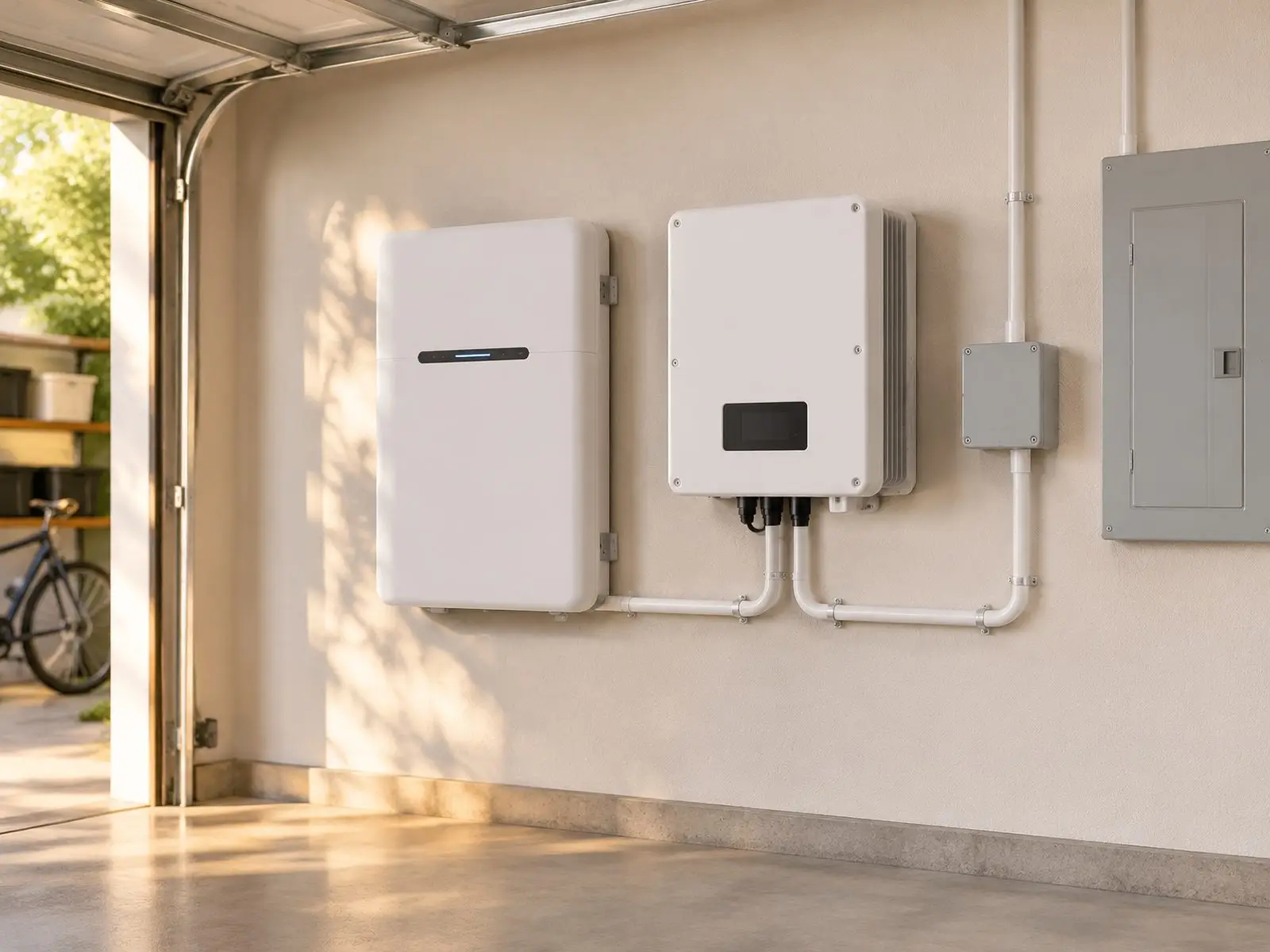
Residential work runs on a lighter path: the unit-level test remains available, which keeps documentation proportionate for a single-family installation, and Chapter 15 governs those dwellings. The dividing line in UL 9540A Edition 6 is application class rather than stored energy, and that is worth confirming with the AHJ before assuming a small commercial cabinet qualifies for the residential route. Home systems are documented separately in our residential energy storage materials.
Rule: from January 1, 2027, a commercial battery energy storage system cannot rely on a unit-level test result alone; compliance requires an installation-level large-scale fire test with published pass/fail criteria, evaluated at the manufacturer’s declared spacing. Threshold: the unit-level test path is retained only for systems intended for residential applications.
If you are specifying storage for a 2027 project, start with the documents rather than the price sheet: enclosure certificate, cell and module reports, installation-level fire test at your intended spacing, and gas data for the HMA. Send your site layout and target capacity and we will map the certification file and enclosure spacing to your drawing. Request a quote to begin.
This article summarizes published code and standard requirements for planning purposes. It is not a substitute for review by the authority having jurisdiction, a licensed fire protection engineer, or a registered design professional.
Frequently asked questions
Does a 500 kWh commercial battery system need a hazard mitigation analysis?
Assume yes. NFPA 855:2026 removes the stored-energy threshold that previously let smaller projects skip a formal analysis, making the HMA the default for most installations unless a technology-specific chapter exempts them. Size is no longer the deciding factor; occupancy, technology, and the exemptions in the applicable chapter are.
Is a UL 9540 listing enough without a large-scale fire test?
No, not for a commercial installation after January 1, 2027. UL 9540 remains the product safety standard for the system, but UL 9540A Edition 6 adds an installation-level large-scale fire test with its own pass/fail criteria, and UL has proposed requiring the applicable UL 9540A edition on the UL 9540 marking label. A listing without that report leaves the fire review incomplete.
What is Annex G.11 and why does it affect my permit?
Annex G.11 is the guidance added in the 2026 edition for large-scale fire testing, focused on scenarios where fire spreads from one enclosure to another. It describes how a developed fire condition is initiated and how separation distance and active fire protection are evaluated, which is the same question an AHJ asks when reviewing your layout drawing.
Will the new requirements delay a project that is already designed?
They can, mainly through document gaps rather than equipment changes. If the specified enclosure was tested to Edition 5, the installation-level report may not exist for the configuration, and obtaining one takes manufacturer time. Checking the report edition and the tested spacing at specification stage is the cheapest way to avoid that delay.
Does NFPA 855 apply to a home battery installation?
Yes, but on a different path. Chapter 15 addresses one- and two-family dwellings and townhouse units, and UL 9540A Edition 6 retains the unit-level test for systems intended for residential applications. Local amendments still control, so confirm the adopted edition with the AHJ before finalizing a residential design.
Sources
- U.S. Energy Information Administration, Short-Term Energy Outlook, Table 7e, U.S. Electricity Generating Capacity, November 2026 (modeling completed November 5, 2026). eia.gov
- U.S. Energy Information Administration, “Battery storage capacity averaged 70% growth over the last three years,” Today in Energy, August 7, 2026. eia.gov
- UL Solutions, “Understanding UL 9540A, NFPA 855 and Large-Scale Fire Testing for Battery Energy Storage Systems,” The Code Authority, 2026. ul.com
- National Fire Protection Association, NFPA 855:2026, Standard for the Installation of Stationary Energy Storage Systems. nfpa.org
- California Governor’s Office of Business and Economic Development, “State Battery Storage Collaborative,” 2026. business.ca.gov
- Association of Clean Power, “Large-Scale Fire Testing of Battery Energy Storage Systems,” fact sheet, May 2026. cleanpower.org
- Exponent, “Expanded Safety Guidelines for Battery Energy Storage Systems,” March 27, 2026. exponent.com