
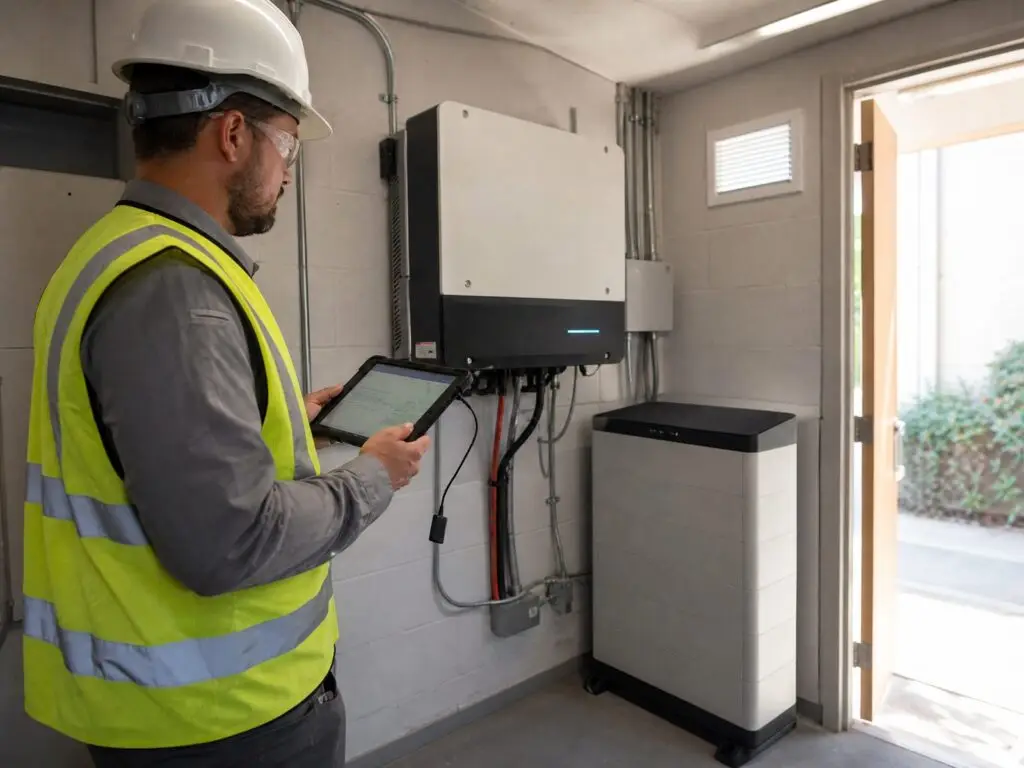
BESS commissioning is where a commercial battery project stops being shipped equipment and becomes a revenue asset — and it is usually where the schedule slips. Plan two to five weeks from mechanical completion to signed site acceptance on a multi-cabinet C&I system, and treat the closeout document package as a deliverable, not paperwork. The projects that pay back fastest are rarely the ones with the cheapest cells; they are the ones that reach a verified, monitored, dispatchable state without rework.

Why BESS commissioning decides the payback
Commercial electricity is expensive and getting more so. The U.S. average commercial retail price reached 14.47 cents per kWh in August 2026, up 4.3% from 13.87 cents a year earlier, while the industrial average rose 7.3% to 9.64 cents per kWh (U.S. Energy Information Administration, Electric Power Monthly, Table ES1.A, data for August 2026, released October 23, 2026). Those are averages; demand charges and time-of-use windows sit on top.
That price pressure is why storage is moving into ordinary commercial real estate. GridPoint said on November 4, 2026 that it is targeting 2 GW of distributed battery capacity across the more than 20,000 commercial sites it manages, citing customer bills up more than 40% in four years and tariffs that increasingly combine seasonal rates with larger demand charges (pv magazine USA, November 4, 2026). Its stated value stack — bill optimization, grid services, resilience — describes what a commissioned system must deliver on day one.
None of that value appears during shipping. It appears once a BESS commissioning record shows batteries, power conversion, protection settings, communications and the utility interface proven together. Using the EIA commercial average as an illustration, a 500 kWh system cycling once per day at 90% round-trip efficiency and offsetting load at 14.47 cents per kWh shifts roughly $65 per full cycle, or about $1,950 in a 30-day month before demand-charge savings. Two weeks of rework is therefore a measurable share of year-one savings, and it delays the baseline that capacity warranties are measured against.
What BESS commissioning actually covers
Commissioning proves the installed system matches the approved design, the listing and the interconnection agreement. It overlaps with inspection and with acceptance testing, but the four activities are distinct:
- Factory acceptance test (FAT) — pre-shipment proof that the assembly works, and the firmware baseline you compare against later.
- Installation inspection — the authority having jurisdiction (AHJ) confirming working clearances, labeling, disconnects, grounding and fire separation.
- Commissioning — the documented sequence of pre-energization checks, energization, functional tests, grid-setting verification and performance measurement, run by the installer with the owner witnessing.
- Site acceptance test (SAT) — the contractual gate where the owner accepts the system against criteria that reference the commissioning records rather than replace them.
The code framework is not optional. NFPA 855, Standard for the Installation of Stationary Energy Storage Systems, is in its 2026 edition and remains active, with Errata 855-26-1 issued on 13 October 2025 (NFPA). NFPA 70, the National Electrical Code, is also in its 2026 edition, and Article 706 addresses energy storage systems specifically (NFPA). At equipment level, UL 9540 (Edition 3) is the system-level safety listing an AHJ will look for on the nameplate before energization (UL Standards & Engagement). Our guide to UL 9540A Edition 6 and what buyers must verify covers the test-report side.
The 14-stage BESS commissioning sequence
This BESS commissioning sequence is the one our field engineers use on commercial cabinet and container systems. Order matters more than labels: every later test depends on an earlier record being clean. Durations are Ruihan field estimates for a 100–500 kWh cabinet system with one power conversion unit, not an industry benchmark.
| # | Stage | Hold point before proceeding | Record you keep | Typical duration |
|---|---|---|---|---|
| 1 | Design and submittal freeze | Approved drawings match the ordered bill of materials | Stamped drawing set, equipment schedule, listing references | Pre-site |
| 2 | Factory acceptance test | Witnessed or recorded functional test passed | FAT report, serial list, firmware versions | 1–2 days (factory) |
| 3 | Receiving inspection | No shipping damage; serials match the manifest | Photo log, damage report, delivery receipts | 2–4 hours |
| 4 | Mechanical installation and anchorage | Clearances, anchorage and ventilation per approved plan | Anchor torque record, clearance photos | 1–3 days |
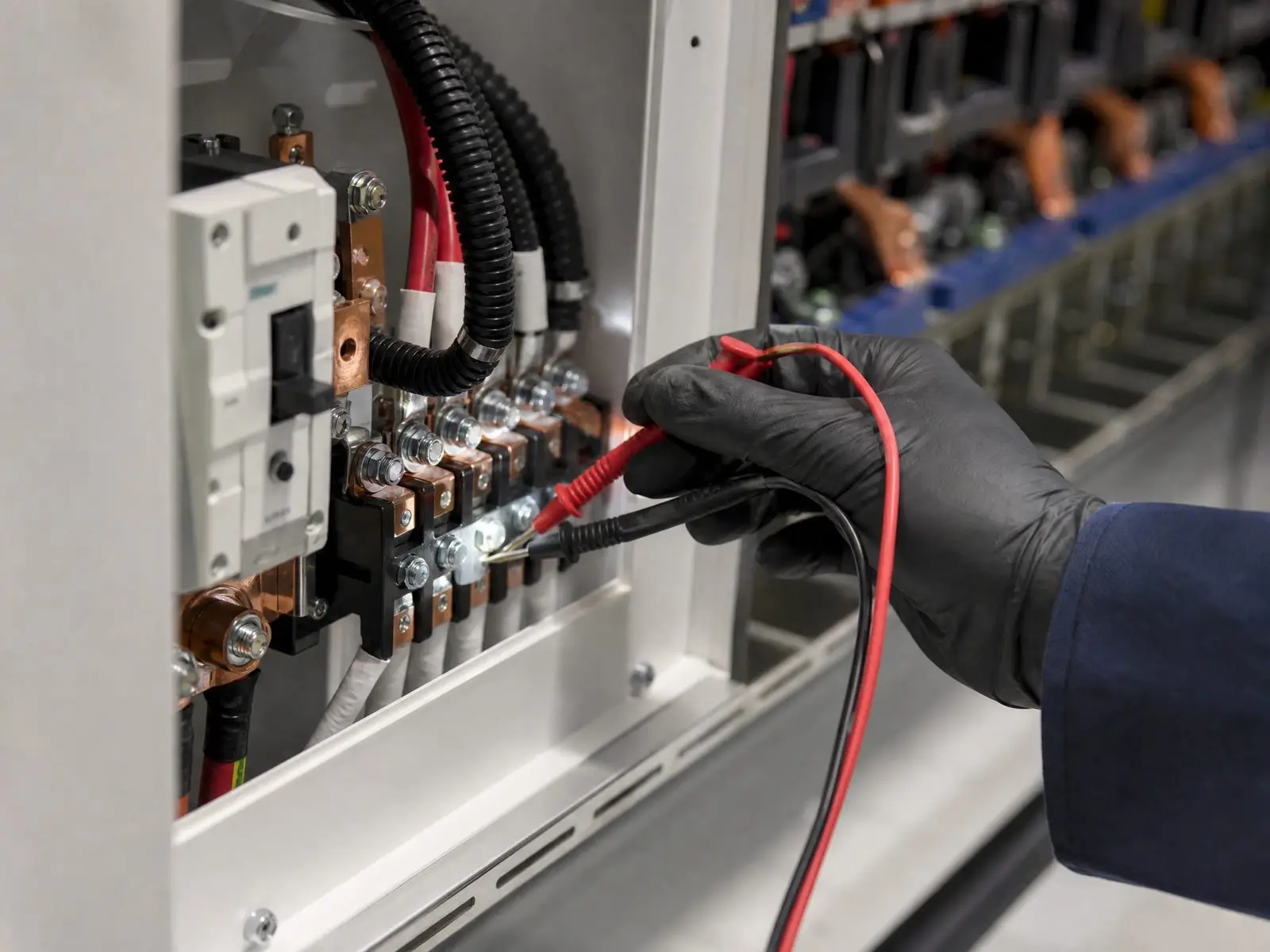
| 5 | Grounding and bonding continuity | Continuity verified at every bonded point | Continuity and resistance readings by location | 2–4 hours |
| 6 | DC side: modules, busbars, torque | Cell and module voltages balanced; torque logged | Torque log with wrench ID, voltage table | 4–8 hours |
| 7 | AC side, PCS wiring, disconnects | Insulation resistance and phase sequence verified | Insulation test sheet, disconnect verification | 4–6 hours |
| 8 | Communications and data acquisition | Every point on the list reports a live value | Points list with pass/fail, telemetry sample | 4–8 hours |
| 9 | Pre-energization safety review | LOTO, PPE, labels, fire plan and egress confirmed | Signed pre-energization checklist | 2–3 hours |
| 10 | First energization and smoke test | No unexplained alarms; charge and discharge demonstrated | Event log export, alarm list | 3–5 hours |
| 11 | Protection and grid settings verification | Settings match the interconnection agreement, not factory defaults | Settings file with checksum, date and witness | 3–6 hours |
| 12 | Performance and capacity test | Measured capacity and efficiency within agreed tolerance | Test data at recorded ambient temperature | 1–2 days |
| 13 | Monitoring and dispatch handover | Owner accounts live; alarm routing tested end to end | Access matrix, alarm test results | 2–4 hours |
| 14 | Closeout package and training | As-builts, O&M documents, spares and training signed off | Signed SAT, training attendance, warranty registration | 1 day |
Two stages are routinely compressed and should not be. Stage 11 is often treated as a formality because the inverter arrives with a working default profile — that default is not the profile your utility approved. Stage 12 is often run right after energization in whatever weather the crew gets, which produces a number nobody can defend later.
The document package to demand before energization
Ask for these before the crew energizes, not at punch-list time. Each item exists because a specific later conversation is impossible without it.
- UL 9540 listing certificate matching the exact model and file number on the nameplate. A certificate for a similar model is not a certificate for yours.
- UL 9540A test report summary at cell, module and unit level, with the edition identified.
- Inverter and PCS compliance documents — UL 1741 SB certification plus the grid-support profile you will actually load. Our UL 1741 SB interconnection checklist lists what reviewers expect.
- NFPA 855 installation compliance statement from the designer, mapped to the site’s separation, ventilation, detection and signage conditions.
- As-built single-line diagram and layout reflecting field changes, not the permit set.
- Torque and continuity records with instrument identification; untraceable readings are treated as not performed.
- BESS commissioning plan with hold points naming who signs each stage and what constitutes a failure.
- Points list or register map for the monitoring platform, including alarm codes and severity.
- O&M manual, spare parts list and warranty terms, including the warranty start trigger and how capacity retention is measured.
- Cell-level transport and safety documents (UN 38.3 test summary, safety data sheets) plus a fire-department pre-plan.
If a supplier cannot produce items 1, 2 and 5 before shipment, the project has a schedule problem no commissioning crew can fix on site. That is why our own documentation set ships with each commercial and industrial energy storage order rather than following acceptance.
Five failure patterns that surface at closeout
Independent commissioning teams see the same defects repeatedly. Day Electric, writing in pv magazine USA on November 4, 2026, lists ten installation deficiencies that delay solar closeouts — among them mismatched or improperly crimped connectors, grounding and bonding gaps, untorqued terminations, inverter settings that do not match approved documents, data acquisition systems that fail to report, incorrect labeling, and final drawings that no longer match what was installed. Storage projects inherit every one of them. The five BESS commissioning failures below account for most closeout delays.
1. Grounding and bonding assumed rather than measured. Visual inspection cannot confirm continuity through powder-coated enclosures and painted strut. Measure at each bonded point and record the reading; a failed check found at inspection means reopening finished work.
2. Torque undocumented. Loose terminations heat under load and trip nuisance alarms months later; over-torqued terminals damage busbars. Require a torque log with wrench identification and the value used, per connection type.
3. Factory grid settings left in place. The most common cause of a failed utility witness test is a conversion unit still running a default profile. Load the approved settings, save the file, record the checksum.
4. Monitoring that reports but does not alarm. A dashboard with live values is not a monitoring system. Test each alarm path end to end, including who receives it before the owner signs acceptance.
5. As-builts that drift from the field. Capture every field change the day it happens; reconciling drawings at closeout is the most reliable way to add a week to a schedule.
Where UL 1741 SB and IEEE 1547 land in the closeout file
Grid-support settings are the BESS commissioning step that touches the utility, verified in order: confirm the certified functions, load the approved profile, demonstrate the response, then lock it.
- Confirm the certified function set in the UL 1741 SB documentation, and confirm on-site firmware matches the certified version.
- Load the approved profile — voltage and frequency trip points, ride-through category, volt-VAR or volt-watt curves, frequency-watt response, and ramp rates as agreed with the utility.
- Demonstrate at least one response with a witness present, recording the injected signal and the observed reaction.
- Lock and baseline the settings with a password and a stored file; re-verify after any firmware update, because updates can reset profiles.
Writing BESS commissioning into the purchase order
Most commissioning disputes are procurement problems that show up on site. Four clauses prevent nearly all of them:
- Tie money to hold points. Release the final 10–15% only at signed SAT, with acceptance criteria defined by reference to the commissioning plan and its tolerances.
- Buy witness rights and a spare kit. Include the right to witness FAT, plus fuses, a BMS module, a communications gateway and the sensors most likely to fail in year one. Waiting on one board from overseas is how a two-day repair becomes a three-week outage.
- Freeze firmware and change control. Name the versions accepted at FAT and require written approval, with re-test scope, for any change before handover.
- Define the warranty trigger and test conditions. Warranty should start at substantial completion, not shipment, and capacity retention should reference a stated ambient temperature, rate and measurement point.
Distributors carrying stock face a second layer: systems they hold must ship with the same documentation set, or every downstream project restarts the same argument. Our wholesale and distribution program is built around shipping that package with the goods, and OEM/ODM projects can specify it as a contractual deliverable from the first prototype.
How long BESS commissioning takes
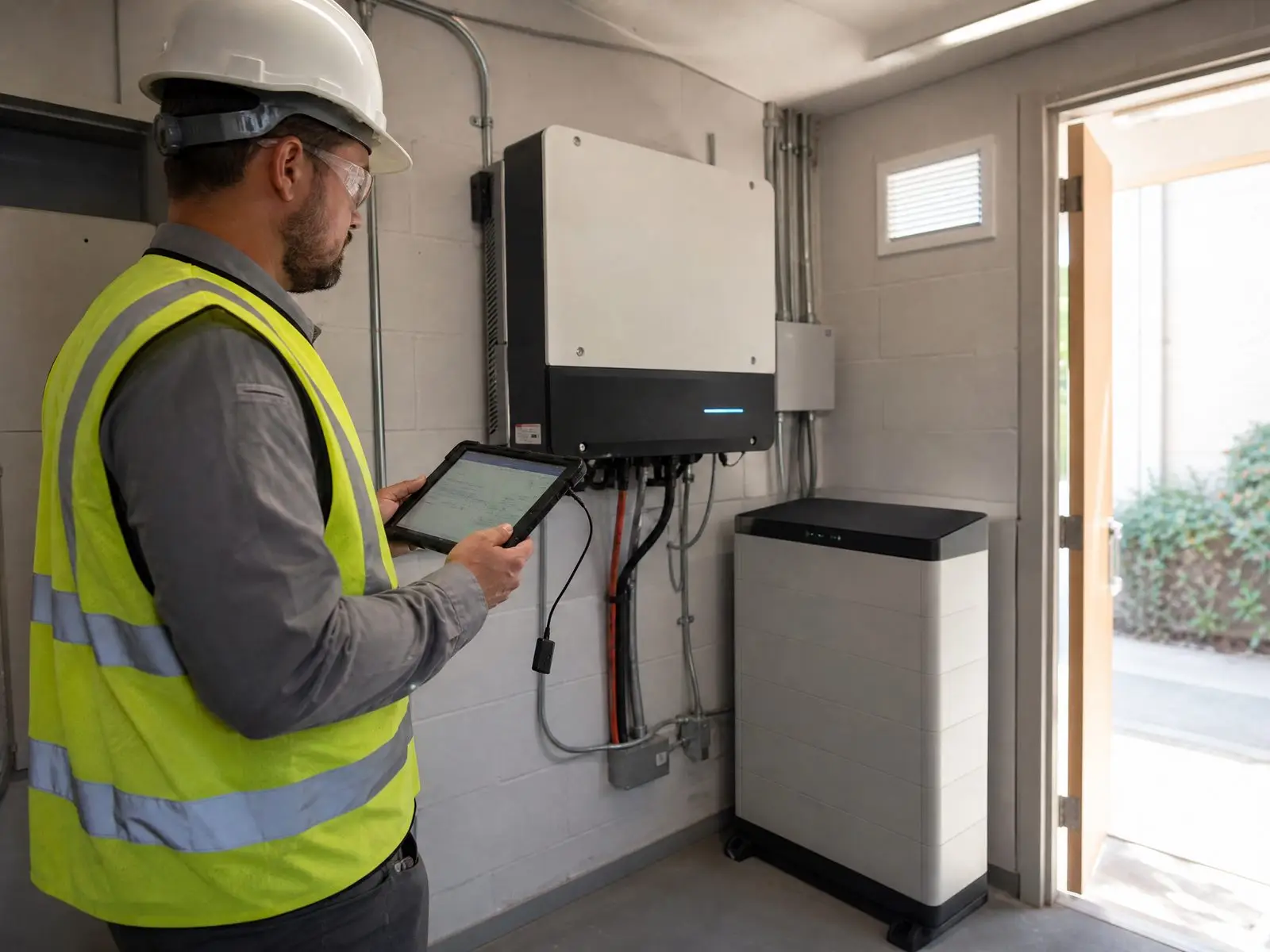
For a single 100 kWh cabinet with one hybrid inverter, pre-energization checks typically take one to two days and energization another half day, assuming documents are complete and the AHJ is available. A multi-unit commercial system with a utility witness test is different: two to four weeks is realistic, and the binding constraint is rarely the crew. It is inspection scheduling, utility witness availability, missing documents, or rework found during pre-energization.
Weather matters for outdoor containers: a capacity test run in freezing conditions without a recorded ambient temperature looks like a failing battery. Indoor battery rooms trade weather exposure for ventilation and detection requirements that must be satisfied before the room is energized.
“Done” is a specific state. It means SAT signed against written criteria; capacity and efficiency recorded with ambient conditions; monitoring live with every alarm path tested; O&M training delivered; spares on site; warranty registered with a documented start date; and an annual service plan covering thermal imaging of terminations, a torque re-check and a repeat capacity test under baseline conditions.
BESS commissioning checklist you can copy into your next PO
- ☐ Approved drawing set and equipment schedule issued before shipment
- ☐ UL 9540 certificate matched to model and file number
- ☐ UL 9540A report summary with edition identified
- ☐ UL 1741 SB certification and proposed grid profile submitted to the utility
- ☐ Commissioning plan with named hold points and signatories
- ☐ FAT witnessed or recorded; firmware versions captured
- ☐ Receiving inspection photos and serial reconciliation
- ☐ Anchorage torque and clearance verification
- ☐ Grounding and bonding continuity readings at every bonded point
- ☐ DC torque log with instrument identification and voltage table
- ☐ AC insulation resistance and phase sequence records
- ☐ Communications points list fully reporting, with telemetry sample
- ☐ Labels, disconnects, egress and fire plan verified before energization
- ☐ Approved grid settings loaded, demonstrated, locked and checksummed
- ☐ Capacity and efficiency test at recorded ambient temperature
- ☐ Owner monitoring accounts active; alarm routing tested end to end
- ☐ As-builts, O&M manual, spares list and warranty registration delivered
- ☐ Training delivered and attendance signed
Start with the documentation, not the discount
Storage procurement conversations tend to open on price per kWh and close on paperwork. Reverse the order. A supplier that can hand you a matched UL 9540 certificate, a current UL 9540A summary, an approved grid-settings record and a commissioning plan with hold points before the container ships has already removed most of the risk that appears in week three on site. Cell chemistry, cabinet layout and warranty length are easier to compare once those four documents are on the table.
If you are specifying a commercial or residential system and want the documentation set and BESS commissioning sequence reviewed against your project plan, send us the design basis and we will respond with the equipment list, compliance file and commissioning plan. Product lines are listed under commercial energy systems and solar inverters,.
This article summarizes code, standards and market information for planning purposes. It is not engineering, legal, tax or investment advice. Final designs must be sealed by a licensed professional and approved by the authority having jurisdiction and the serving utility.
Frequently asked questions
How long does BESS commissioning take?
For a single 100 kWh commercial cabinet, BESS commissioning typically takes one to two days of pre-energization checks, half a day for first energization, and one to two days for the capacity test and handover. Multi-unit commercial systems with a utility witness test typically need two to four weeks from mechanical completion to signed site acceptance. The variable is rarely labor; it is inspection scheduling, missing documents and rework.
What is the difference between FAT, SAT and commissioning?
The factory acceptance test proves the assembly works before shipment and fixes the firmware baseline. Commissioning is the on-site sequence proving the installed system matches the design, the listing and the interconnection agreement. The site acceptance test is the contractual gate where the owner accepts the system against criteria that reference the commissioning records.
What documents should a BESS supplier provide at handover?
At minimum: a UL 9540 listing certificate matched to model and file number, a UL 9540A summary with the edition identified, UL 1741 SB certification with the approved grid-settings record, an NFPA 855 installation compliance statement, as-built drawings, torque and continuity records, the monitoring points list, the O&M manual, the spare parts list, warranty terms with a defined start date, and cell-level transport and safety documentation.
Does commissioning affect the warranty?
Yes, twice. Warranty start dates are usually tied to a milestone such as substantial completion or first energization, and capacity-retention claims are measured against a baseline established during commissioning. If that baseline was recorded without ambient temperature, rate and measurement point, neither side can prove what changed. Define the test conditions in the purchase order.
Can a commercial battery system be energized before the AHJ inspection?
That depends on the jurisdiction and should be settled in writing before the crew arrives. Many AHJs require inspection before or at energization, and utilities often require their own witness test for grid-support settings. Sequencing both into the schedule at the start is far cheaper than discovering the requirement after the system is charged.
Sources
- U.S. Energy Information Administration, Electric Power Monthly, Table ES1.A, data for August 2026 (released October 23, 2026) — eia.gov
- NFPA, NFPA 855, Standard for the Installation of Stationary Energy Storage Systems, 2026 edition; Errata 855-26-1 issued 13 October 2025 — nfpa.org
- NFPA, NFPA 70, National Electrical Code, 2026 edition (Article 706, Energy Storage Systems) — nfpa.org
- UL Standards & Engagement, UL 9540, Standard for Energy Storage Systems and Equipment, Edition 3 — shopulstandards.com
- pv magazine USA, “Ten solar installation deficiencies that can cause project closeout delays,” November 4, 2026 — pv-magazine-usa.com
- pv magazine USA, “GridPoint launches energy storage initiative targeting 2 GW of distributed installations,” November 4, 2026 — pv-magazine-usa.com