
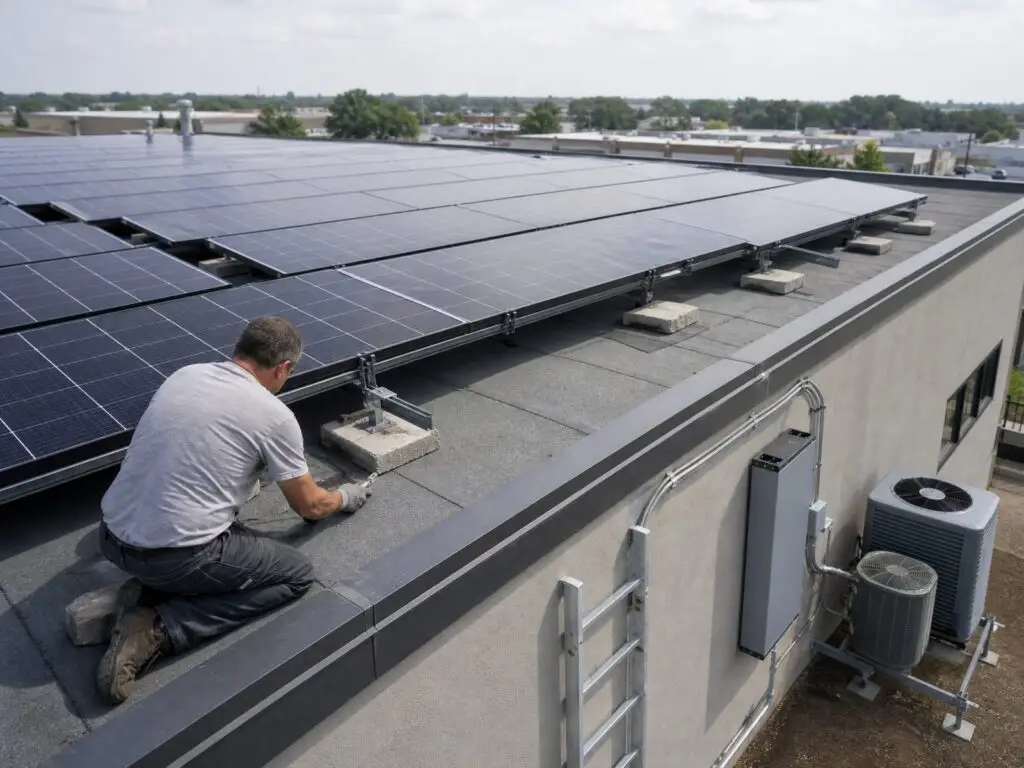
In 2026, the slowest part of a U.S. commercial power project is no longer the battery — it is the interconnection. FERC’s June 18, 2026 orders to six grid operators, Texas’s paused data-center queue, and PJM’s capacity auction clearing at the price cap all point the same way: behind-the-meter storage is now the fastest route to energizing a large load, and the only way to keep a facility productive while a transmission study runs. This guide reads the 2026 policy calendar the way a procurement team should — as a schedule, a cost line, and a specification.
Why Interconnection Became the Binding Constraint
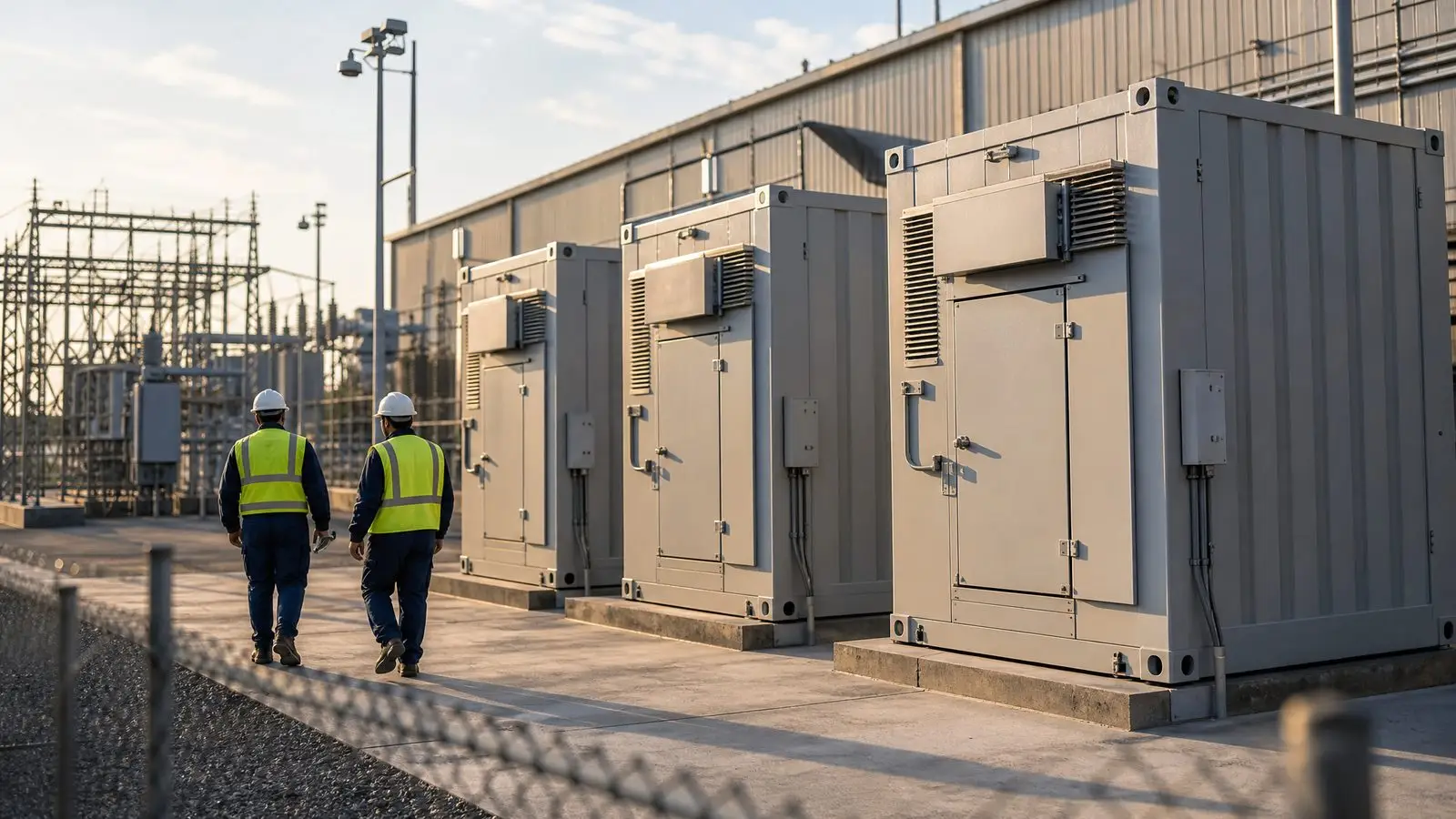
For most of the last decade, a commercial or industrial (C&I) power project was limited by equipment lead time. Transformers, switchgear and cells were the long poles. That has changed. Load growth from data centers, electrified heating and reshored manufacturing has moved the constraint upstream, into the transmission service study that decides whether a large load can be served at all — and at what cost. For a facility owner, that makes behind-the-meter storage the one asset that can be procured and commissioned ahead of the study outcome.
The federal government formalized that shift on October 23, 2025, when the Secretary of Energy, acting under section 403 of the Department of Energy Organization Act, directed FERC to consider an Advance Notice of Proposed Rulemaking on large-load interconnection. That docket, RM26-4, treats a large load as demand generally above 20 MW and asks whether flexible, curtailable loads and co-located facilities should move through studies faster — including whether a study could finish within 60 days — and whether a large load should pay the full cost of the upgrades it triggers.
Those questions matter to anyone specifying on-site storage, because they define the trade the market is now making: speed in exchange for flexibility. A load that can curtail, shape or self-supply is a different product to a grid operator than a load that cannot. Behind-the-meter storage is the cheapest way to convert one into the other.
What FERC’s Six Show Cause Orders Actually Require
On June 18, 2026, FERC issued tailored show cause orders under section 206 of the Federal Power Act to PJM, MISO, SPP, CAISO, ISO-NE and NYISO, together with their transmission owners. The Commission preliminarily found that existing tariffs may be unjust and unreasonable because they lack clear, consistent provisions for large loads and co-located loads. Each region must file within 60 days — either a justification that its tariff remains just and reasonable, or proposed revisions — plus an informational report within 30 days on how adequate generation will serve existing and new large loads.
Five reform categories were named, and three of them touch on-site storage directly:
- Study process efficiency, including alternative transmission technologies that can defer or avoid upgrades.
- Cost shifting and transparency, so the cost of serving a large load is identified, allocated and communicated.
- Co-location and behind-the-meter generation, for loads paired with on-site supply that do not fit traditional transmission service models.
- New transmission services for flexible large loads — the formal opening for curtailable, shapeable demand.
- Study processes for generation serving nearby large loads, so grid impacts of on-site supply are evaluated transparently.
The orders deliberately preserve regional difference: SPP already runs its High Impact Large Load process, PJM’s co-location questions sit in a separate proceeding, and CAISO offers no traditional Order No. 888 transmission service. FERC also stated the orders do not intrude on state authority over siting or retail rates, and are not intended to disrupt agreements already negotiated.
| Date | Policy action | What it changes for an on-site storage project |
|---|---|---|
| Oct 23, 2025 | DOE directs FERC to open the large-load interconnection docket (RM26-4) | Sets the ~20 MW definition of a large load and puts faster studies for flexible loads on the table |
| Jun 18, 2026 | FERC issues six Section 206 show cause orders to PJM, MISO, SPP, CAISO, ISO-NE and NYISO | Makes co-location and behind-the-meter generation an explicit tariff topic in every region |
| Jul 14, 2026 | PJM’s 2028/2029 capacity auction clears at the $325/MW-day cap | Capacity is priced at the ceiling and still short of the reliability requirement |
| Aug 3, 2026 | Texas orders an audit of data centers seeking ERCOT interconnection and pauses approvals | The fastest market in the country can still stop the clock on a new load |
| Sep 21, 2026 | Texas tightens the pause, holding state permits pending the audit | Project timelines now track a regulatory calendar rather than equipment lead time |
The 20 MW Line: Who Counts as a Large Load
The 20 MW threshold in RM26-4 is a transmission-level definition, not a comment on project size. Most C&I storage projects sit well below it, and they are not the target of these orders. The threshold still matters, for two practical reasons.
It tells you which neighbours compete for the same study queue: a single 20 MW load can absorb hosting capacity that several smaller distribution-connected projects were counting on, and can trigger upgrades that change the economics downstream. It also signals where regulators think flexibility value sits — if a region builds a faster path for flexible loads, a facility that can demonstrate curtailment capability through controls, on-site generation or storage inherits part of that advantage even at 2 MW or 5 MW, because the utility’s study assumptions become easier to defend.
For a procurement team, the takeaway is to stop treating grid capacity as a fixed input. Model the interconnection outcome with three states — served on schedule, served late with upgrade cost allocation, or not served — and price behind-the-meter storage against all three. It is the only line item that improves every outcome.
Texas: A Paused Queue and a December Audit
ERCOT has long been the counter-example to slow interconnection: an energy-only market with comparatively fast processing. In 2026 it showed how quickly policy can override that advantage. On August 3, 2026, Texas ordered a comprehensive audit of data centers seeking ERCOT interconnection approval and paused those approvals; ERCOT postponed its Batch Zero review in the same window. On September 21, 2026 the pause was tightened, with state permits held pending the audit and no new permits expected until at least December, when ERCOT is due to finish (RTO Insider, September 23, 2026; Willkie Farr & Gallagher, October 5, 2026).
Read that from the perspective of a facility owner rather than a data-center developer. The lesson is not that Texas is closed. The lesson is that queue position is not a property right: a state audit, a reliability study or a single docket can move a project by quarters. Any project that has commissioned switchgear, signed a lease or committed to a production date needs power that does not depend on a study finishing on time — which is the design brief for behind-the-meter storage paired with on-site generation.
PJM: Capacity at the Price Cap Raises the Cost of Waiting
Capacity markets quantify the same problem in dollars. PJM’s 2028/2029 Base Residual Auction, held in 2026, cleared at the $325/MW-day price cap while procuring 138,317.8 MW — about 6,831 MW short of the region’s reliability requirement (RTO Insider, July 14, 2026). A market that clears at its ceiling and still fails to procure enough capacity is telling buyers something unambiguous: firm capacity is scarce, and the scarcity is being priced into the capacity component of commercial electricity bills rather than absorbed by the market.
For a C&I facility, that has two consequences. Capacity and transmission components become less predictable, weakening any payback model built on a flat rate. And flexible demand becomes more valuable, because the capability that shortens an interconnection study also reduces exposure to peak-coincident charges. A behind-the-meter storage system that shaves a facility’s contribution to system peak does both jobs at once.
Why Behind-the-Meter Storage Becomes the Bridge
Behind-the-meter storage sits on the customer side of the utility meter, so it can energize loads without waiting for a transmission service agreement. For loads in the low single-digit megawatts, that is the difference between a project that operates this year and one that operates after the next study cycle. The engineering, not the policy, is what makes it credible — and the specification details that decide whether a system can actually carry a load are the ones buyers most often skip.
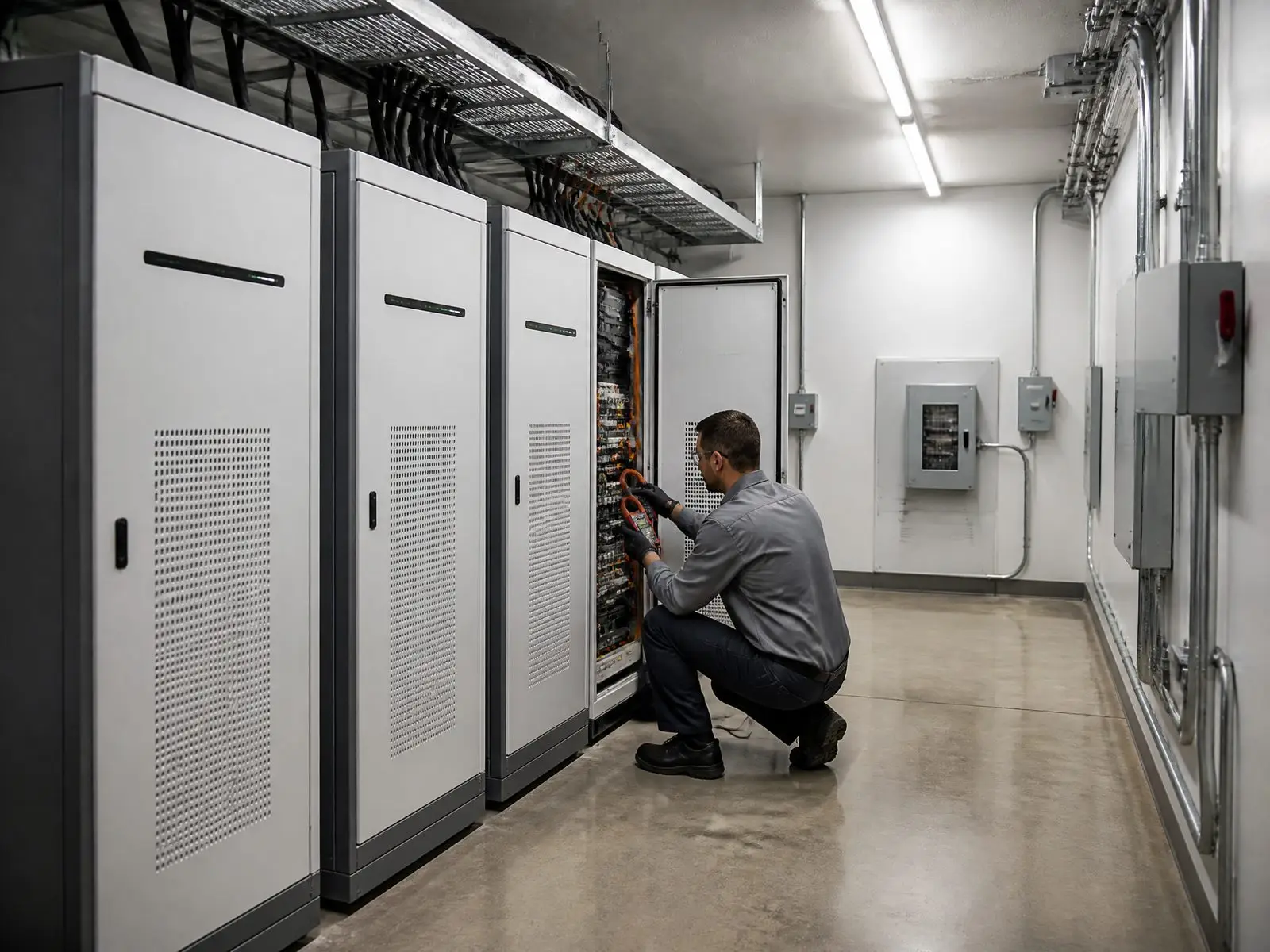
Three capabilities separate a system that bridges a delay from one that merely shaves a bill. Seamless transfer comes first: the inverter and transfer architecture must hold the load through a grid event without dropping sensitive equipment, which is a function of transfer time and ride-through behaviour rather than nameplate power. Usable energy at the actual load profile comes second — a battery rated for a two-hour discharge behaves very differently on a load with a high, short peak. Third is grid-support behaviour on the interconnection side, because a region rewriting its large-load tariff will ask what a facility’s on-site equipment does during a disturbance, not just how much it consumes. Those requirements are the ones covered in our UL 1741 SB interconnection checklist, and they should be specified before the utility asks.
Where a facility needs both resilience and lower energy cost, the sensible architecture is a hybrid: PV for daytime production, a LiFePO4 battery bank for firm capacity, and a hybrid inverter that manages both. Ruihan’s commercial and industrial energy storage line is built for that duty cycle, and the containerized energy system format is the practical choice beyond a few hundred kilowatt-hours of usable capacity.
Sizing a System When the Load Cannot Wait
Sizing behind-the-meter storage for interconnection risk differs from sizing it for tariff arbitrage. Arbitrage sizing follows the price spread; bridging sizing follows the load the facility cannot afford to lose, plus the duration of the events that cause that loss. The sequence below is the one that survives utility review.
| Step | What to establish | Why it decides the design |
|---|---|---|
| 1. Critical load inventory | Which circuits must ride through, in kW, and for how long | Sets the power rating and the minimum usable energy, independent of bill savings |
| 2. Peak and coincident peak | 15-minute peak and its timing against system peak | Determines whether the same battery can both carry load and cut capacity charges |
| 3. Existing service capacity | Transformer and service rating versus actual peak | Reveals whether storage can defer a service upgrade the utility has not yet approved |
| 4. Generation interface | Inverter standard, transfer architecture, protection settings | Determines whether the utility accepts the system as a controllable resource |
| 5. Footprint and code path | Indoor room versus outdoor enclosure, separation distances, ventilation | Drives enclosure format, fire strategy and the permitting timeline |
| 6. Growth and modularity | Five-year load growth, expansion method | Favours designs that scale without re-permitting |
Two engineering notes follow from this sequence. An outdoor containerized system generally moves faster than an indoor battery room, because it avoids the room-level fire and ventilation review that a cabinet installation inside an occupied building can trigger. And DC-coupled architectures reduce conversion losses when the same asset must both charge from PV and discharge to a critical load — which matters when behind-the-meter storage is sized to a resilience requirement rather than an arbitrage spread. Buyers comparing quotes should insist on round-trip efficiency at the intended C-rate and usable energy after depth-of-discharge limits, the two figures that move payback furthest beyond headline price per kilowatt-hour, as we set out in the quote breakdown for commercial storage.
Procurement Checklist: Ten Documents to Request Before You Sign
Policy risk is managed with paperwork as much as with cells, and behind-the-meter storage projects fail procurement review for documentation reasons as often as technical ones. Ask for these ten items before a purchase order:
- Interconnection-relevant certifications for inverter and storage system, with certificate numbers and issuing body — not a marketing claim.
- System-level test reports, including the large-scale fire test documentation the authority having jurisdiction will request.
- A single-line diagram and protection coordination study, stamped where local rules require it.
- Usable energy at the specified C-rate, with depth-of-discharge and end-of-life assumptions rather than beginning-of-life nameplate figures.
- Round-trip efficiency and auxiliary load, including HVAC consumption at design ambient temperature.
- Cell and BMS provenance — chemistry, format, cell supplier — plus warranty throughput and cycle terms.
- Firmware and controls documentation, including dispatch protocols and any utility- or aggregator-facing interface.
- Spare parts and service commitments for the warranty period, with response times in writing.
- Compliance file for the destination market, listing the standards the product is listed to and the ones it is not.
- Change-control clause, so a component substitution does not silently invalidate the certification the utility approved.
Distributors and installers building a repeatable offer around this specification can source the full set — inverter, battery, enclosure and documentation package — through Ruihan’s wholesale and distribution program or an OEM/ODM engagement where the compliance file carries the partner’s branding.
Sources
Frequently Asked Questions
Does behind-the-meter storage avoid the interconnection queue entirely?
Not entirely. A system that never exports can usually be installed under a simpler notification or net-metering process, but still requires a utility review of the service connection, protection settings and parallel operation. What behind-the-meter storage avoids is the transmission-level service study that governs larger and exporting projects — where the longest delays sit.
What does the 20 MW threshold in FERC Docket RM26-4 mean for a smaller facility?
The threshold defines which loads the federal discussion covers, so most C&I projects fall outside it. It still matters indirectly: a 20 MW load nearby can consume hosting capacity and trigger upgrades affecting smaller projects, and the flexibility principles FERC is developing migrate into utility practice for smaller loads too — the practical reason behind-the-meter storage is worth specifying even below 20 MW.
Why did PJM’s capacity auction clear at the cap in 2026?
PJM’s 2028/2029 auction cleared at the $325/MW-day cap while still procuring less capacity than the reliability requirement, roughly 6.8 GW short (RTO Insider, July 14, 2026). Scarcity of firm capacity in a high-load-growth region is expressed as a ceiling price, which is why capacity charges have become a larger and less predictable part of commercial bills — and why behind-the-meter storage that trims coincident peak now changes the bill in two directions.
How long does a commercial battery project take once the equipment is ordered?
Equipment lead time is rarely the long pole in 2026. The variables are the utility’s service review, the permitting path for the enclosure or battery room, and inspection scheduling. Containerized outdoor systems compress that path — a real advantage when behind-the-meter storage holds a construction schedule.
Is a hybrid PV-plus-storage system eligible for the same interconnection treatment as storage alone?
It depends on export behaviour and the local rule set, not the equipment label. A hybrid that limits export to a defined level is studied differently from one exporting at full inverter rating. Specify the export limit for the behind-the-meter storage component, and confirm how the utility classifies the system before ordering hardware.
The Bottom Line
The 2026 policy calendar has made one thing clear: grid capacity is now allocated by process, and process is slow. FERC’s six show cause orders force every organized market to define how large loads and co-located generation connect; Texas has shown that even a fast queue can pause; PJM has shown that scarcity gets priced at the ceiling. For a facility that needs power on a schedule it controls, behind-the-meter storage is no longer a sustainability gesture — it is schedule insurance, and it deserves the same specification rigour as the switchgear.
If you are sizing a system against a real interconnection timeline, send us the load profile and the utility’s service class. Ruihan Energy can price a hybrid or storage-only configuration with the compliance documentation your authority having jurisdiction will ask for. Start with a quote request.
This article is regulatory and market analysis, not legal or tax advice. Project eligibility, interconnection requirements and incentive treatment should be confirmed with your utility, authority having jurisdiction and qualified advisors.
- Federal Energy Regulatory Commission, Docket No. RM26-4-000: Interconnection of Large Loads (docket opened following the October 23, 2025 DOE directive).
- Federal Energy Regulatory Commission, Fact sheet: FERC takes action to speed large load integration, June 18, 2026.
- RTO Insider, PJM Capacity Auction Clears at $325 Cap, 6.8 GW Short of Reliability Requirement, July 14, 2026.
- RTO Insider, Abbott Tightens Pause on ERCOT Large Load Approvals, September 23, 2026.
- Willkie Farr & Gallagher, Texas Governor Halts Data Center Permits Pending ERCOT Audit, October 5, 2026.