
Published: 29 October 2026 | Category: Projects & Cases
A residential solar array in Portugal was earning €122 a year from its surplus. Not per month — per year, for the whole household. The array was working exactly as designed; the market underneath it had moved.
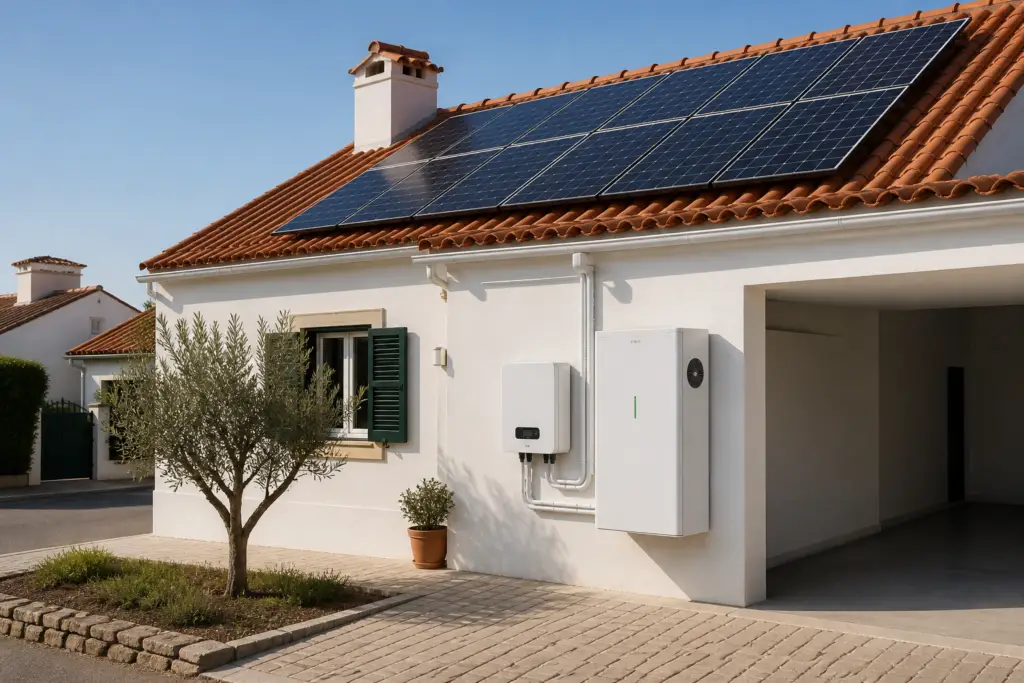
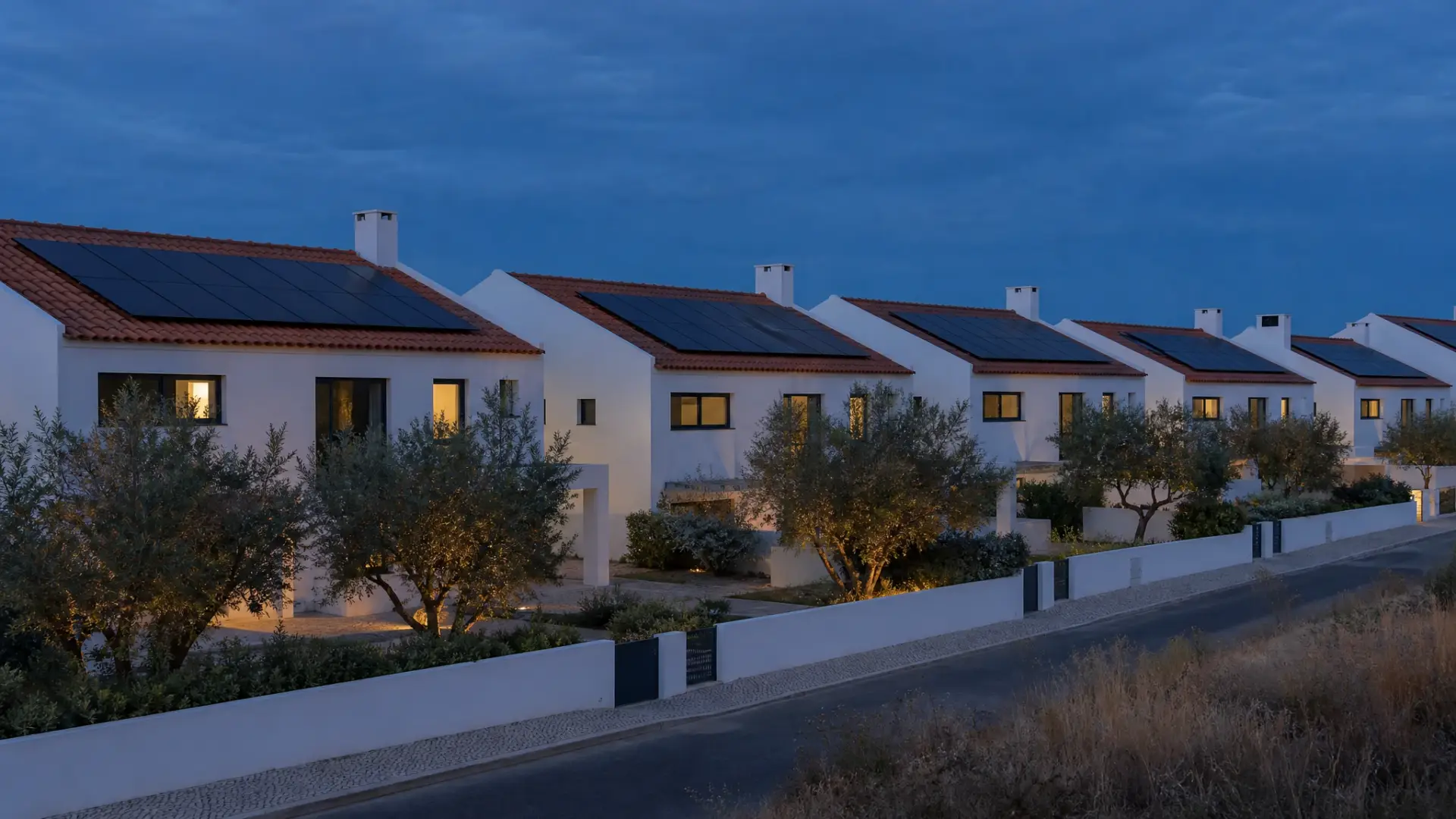
This case covers a 48-home residential retrofit in southern Portugal, supplied with Ruihan 5.12 kWh LFP wall-mounted storage, and the arithmetic behind a €13,430 annual saving across the development.
1. The problem in one number
Each home has a 4 kWp array producing roughly 5,600 kWh a year. Under a Portuguese solar PPA clearing at €33.46/MWh — the lowest in Europe in Q3 2025 — the surplus is worth almost nothing:
3,640 kWh exported × €33.46/MWh = €121.79 per year
That is €10.15 a month. Against an array cost in the thousands, the export line had stopped functioning as revenue and become an accounting entry.
The array was not the problem. Timing was. Most generation lands at midday, when the household is out and the grid is already saturated with solar. The power is produced, exported at near-zero value, and then bought back in the evening at retail price.
Storage does not generate a single additional kilowatt-hour. It moves them.
2. What we supplied
| Item | Specification | Quantity |
|---|---|---|
| Battery storage | 51.2 V / 100 Ah LFP wall-mounted, 5.12 kWh | 48 units |
| Cell grade | Grade A prismatic LFP, 6,000+ cycles | — |
| Inverter coupling | AC-coupled to existing string inverter | 48 sets |
| BMS | Per-module telemetry, enforced depth-of-discharge window | integrated |
| Monitoring | Household-level consumption and state-of-charge logging | integrated |
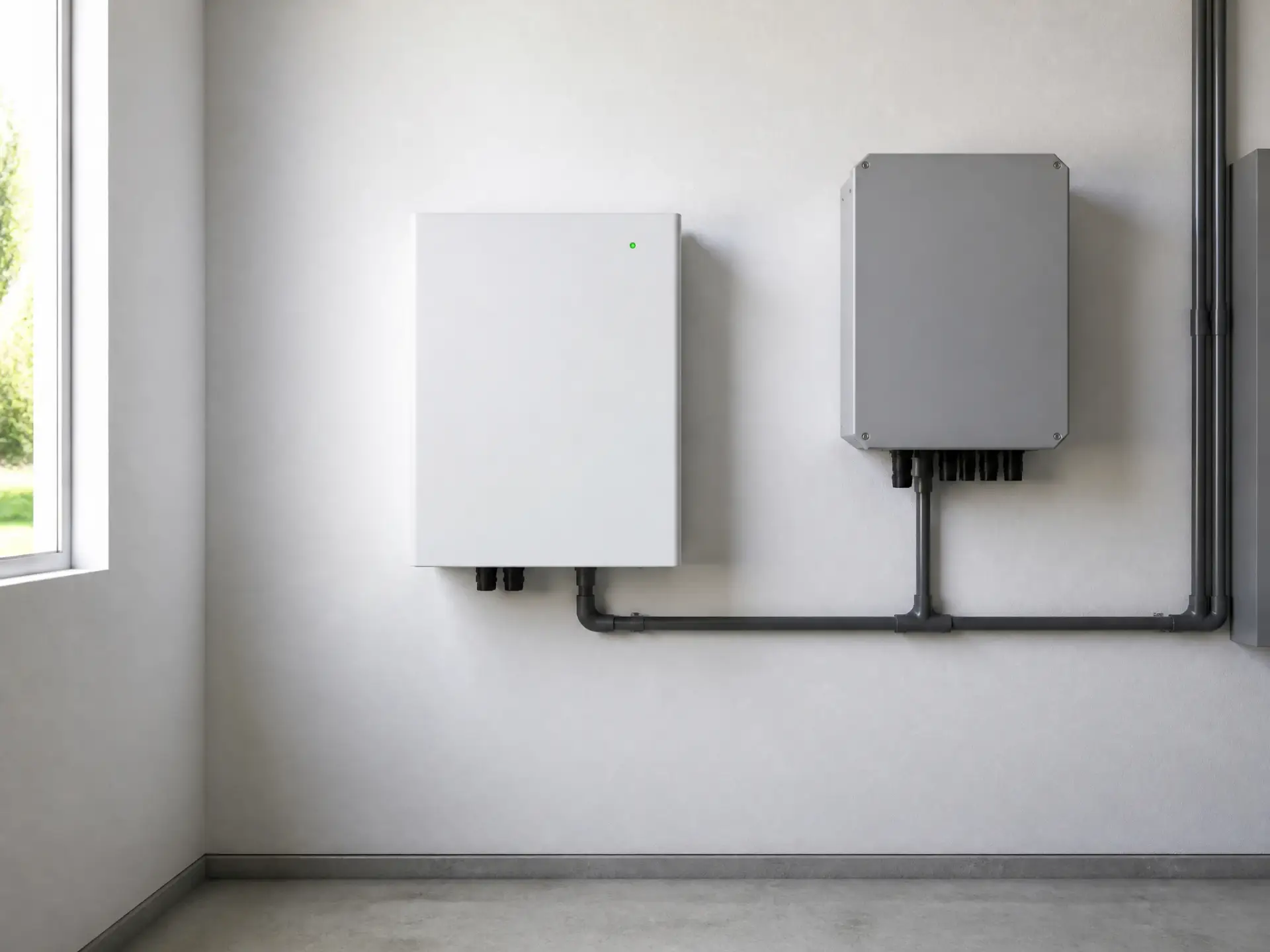
The selection was driven by one constraint: the existing 4 kWp arrays and string inverters were already installed and paid for. An AC-coupled retrofit avoided replacing them, which kept the intervention to the storage unit and its connection — no new array, no inverter replacement, no re-application for grid connection.
3. Before and after
Per household, per year, at an assumed retail tariff of €0.20/kWh:
| Line | Before storage | After storage | Change |
|---|---|---|---|
| Self-consumed | 1,960 kWh | 3,640 kWh | +1,680 kWh |
| Exported | 3,640 kWh | 1,960 kWh | −1,680 kWh |
| Value of avoided import | €392.00 | €728.00 | +€336.00 |
| Value of export | €121.79 | €65.58 | −€56.21 |
| Total annual value | €513.79 | €793.58 | +€279.79 |
Across 48 households:
| Metric | Value |
|---|---|
| Additional self-consumed energy | 80,640 kWh/year |
| Annual saving | €13,430 |
| Saving over 10 years | €134,300 |
| Export revenue given up | €2,698/year |
The last line matters for credibility: the saving is net. The households gave up €2,698 of export income to capture €16,128 of avoided import. Reporting only the gross figure would overstate the result by 20%.
4. Where the €279.79 comes from
The mechanism is a price spread, and every euro of it is traceable:
1,680 kWh shifted × €0.20/kWh retail     = €336.00 avoided import
1,680 kWh shifted × €0.03346/kWh export  = €56.21 forgone revenue
                                             ─────────
                                             €279.79 net per household
Two properties of this spread determine whether storage pays:
It is almost entirely driven by the retail tariff, not the PPA price. A 40% move in the PPA price shifts the net gain by about €23 per household. A 40% move in the retail tariff shifts it by about €134. The investment case rests on the buy side of the meter, which is a contract the customer controls — not the sell side, which is a market they do not.
It scales linearly with the energy shifted. Doubling the storage capacity does not double the saving, because marginal kilowatt-hours are progressively harder to capture. In this deployment, 5.12 kWh was sized to the evening peak rather than to full-day autonomy, which is why the marginal value stayed high.
5. Sensitivity
Same 48 households, same 80,640 kWh shifted, different retail tariffs:
| Retail tariff | Avoided import | Export forgone | Net annual saving | Payback per €1,000 installed |
|---|---|---|---|---|
| €0.15/kWh | €12,096 | €2,698 | €9,398 | 5.1 years |
| €0.20/kWh | €16,128 | €2,698 | €13,430 | 3.6 years |
| €0.25/kWh | €20,160 | €2,698 | €17,462 | 2.7 years |
The payback column is a ratio, not a price. At €279.79 saved per household per year, every €1,000 of installed storage cost is recovered in 3.6 years — apply that to your own quoted system cost rather than reading it as a Ruihan price.

6. Why the result holds over ten years
A saving calculated on year-one capacity is only real if the capacity survives. Four specification decisions carried the outcome:

Cycle life against the operating window. At one cycle per day, ten years requires 3,650 cycles before any allowance for degradation. A 6,000-cycle Grade A LFP cell leaves headroom; a 2,000-cycle cell would be at end of life before the payback period closes.
Depth of discharge enforced in firmware. The cycle-life rating only applies at the depth of discharge the BMS actually permits. In this deployment the window is enforced in firmware and visible in telemetry, so degradation can be evidenced against the warranty rather than argued about.
Round-trip efficiency at the terminals, not the cell. When the gross spread is €0.167/kWh, a four-point efficiency difference is a measurable share of margin. We specify measured terminal-to-terminal efficiency.
Backup capability as a second return stream. The April 2025 Iberian blackout, caused primarily by over-voltage, changed how Portuguese homeowners evaluate a battery. A grid-forming unit with sub-20 ms transfer converts the storage from an arbitrage device into a resilience asset, which shortens the decision cycle regardless of the tariff.
7. What would change in another market
The same 5.12 kWh unit would be misapplied in three of the markets in the same dataset:
- Ireland (€120.00/MWh) — the highest solar PPA in Europe on data centre demand. Export still pays; array sizing should be aggressive and storage justified by grid services, not self-consumption.
- Finland (+10% month on month) — the fastest riser. A rising price curve rewards contracted export and penalises capital-heavy storage.
- North America (+4% QoQ) — moving the opposite way to Europe on policy uncertainty. Contract risk, not price level, is the binding constraint.
The rule that travels: size storage against the spread between what you can sell power for and what you would otherwise pay for it. In Portugal that spread is now €0.167/kWh because the sell side collapsed. In Dublin it is narrow because the sell side is strong.
8. For Business Buyers
Ruihan Energy supplies Grade A LFP storage systems and solar accessories to distributors, installers and OEM partners across Europe, the Middle East and Africa.
- OEM / ODM — custom enclosure, BMS configuration and labelling
- MOQ — from 1 unit for evaluation orders
- Lead time — 3–7 days depending on volume and configuration
- Certification — EAC and UA TR certificates held; copies available on request
- Payment — deposit on order, balance per agreement
- Shipping — quoted per destination on request
For distributor terms, volume pricing, or a savings model run against your own tariff and load profile, request a quote or see our wholesale and distribution programme.
FAQ
How much does 5.12 kWh of storage actually save a household?
In this deployment, €279.79 a year, net of the export revenue given up. The figure is driven almost entirely by the retail tariff and the amount of energy shifted; at €0.15/kWh it falls to about €196 per household, at €0.25/kWh it rises to about €364.
Why not just install a bigger array instead?
Under a €33.46/MWh PPA, additional generation is exported at roughly 3.3 cents per kWh. The capital is committed, the revenue is not there. Storage captures value from energy already being generated at no additional generation cost.
Is this saving guaranteed?
No. The mechanism is arithmetic and verifiable; the inputs are site-specific. Results depend on the household’s load profile, its actual retail tariff, and the share of surplus that can realistically be shifted. We model both before quoting.
What cycle life do I need for a ten-year case?
At one cycle per day, 3,650 cycles before any degradation allowance. Specify the cycle count at the depth of discharge you will actually operate at, not at 100% DoD.
Does the April 2025 blackout affect the economics?
It changed the decision, not the arithmetic. Resilience does not appear in a tariff comparison, but after over-voltage took both Iberian grids down in April 2025, backup capability became a purchase reason independent of payback.
Case profile and figures are modelled by Ruihan Energy from the supplied system specification and the Q3 2025 LevelTen Energy PPA Price Index (published 24 October 2025). Retail tariff is an input, not a published rate. Results are illustrative and are not a quotation, a performance guarantee, or a record of a specific customer’s audited billing.