

A portable power station is not a generic consumer electronic. It ships as Class 9 dangerous goods, its warranty exposure is concentrated in a single component — the lithium cell — and its certification cost is a fixed investment you pay before the first unit is sold. The sourcing process therefore looks less like buying electronics and more like qualifying a process.
This guide sets out the due-diligence sequence we recommend to importers and distributors, ordered so that the expensive mistakes happen on paper rather than in a container.
1. Write the product brief before you contact a factory
Most sourcing failures are specification failures, not manufacturing failures. A supplier can only quote against what you define.
| Decision | What to specify | Why it drives the quote |
|---|---|---|
| Output power | Continuous W and peak/surge W with duration | Inverter topology and transformer sizing |
| Energy | Nameplate Wh and usable Wh (depth of discharge) | Cell count, BMS rating, weight, freight class |
| AC waveform | Pure sine wave (the baseline expectation in this category) | Modified-sine units generate returns |
| Cell chemistry | LiFePO4 or NMC | Cycle life, thermal behaviour, cost per kWh |
| Target market | Mains voltage, frequency, plug type | Certification scope and AC topology |
| Port set | AC outlets, USB-A / USB-C PD, 12 V socket, DC barrel, Anderson | PCB layout and certification scope |
| Enclosure | Plastic or aluminium, IP rating, handle or wheels | Tooling cost, weight, freight cost |
| Interface | LCD or LED, app, Bluetooth / Wi-Fi, BMS comms | Firmware ownership and after-sales model |
| Labelling | Brand, model, warning language, energy label | Destination-market compliance |
| Certification target | CE / UKCA / UL 2743 / FCC / EAC / UA TR | Test budget and lead time |
Two entries in that table cause most of the disputes we see. The first is nameplate versus usable energy: a pack that stops discharging at 80–90% depth of discharge delivers less energy than the label suggests, so ask for the usable figure in writing. The second is peak power without a duration: “4,000 W peak” is meaningless until you know whether it lasts two seconds or two minutes — and motors, compressors and pumps start at multiples of their rated current.
2. Qualify the factory, not the catalogue
Product catalogues converge. Factories do not. Twelve questions worth asking before you discuss unit price:
- Which cell manufacturer and grade do you buy, and can you show the cell datasheet or purchase documentation?
- Do you assemble the pack in-house — spot or laser welding, BMS mounting, insulation?
- Do you design the BMS yourselves or buy a third-party module? From whom?
- What in-house test capability do you have: charge/discharge, ageing, thermal chamber, drop, ESD?
- How many units per month can you commit to *our* model specifically, not your total capacity?
- Which export markets are your existing products already certified for?
- What is your MOQ for (a) our branding on your standard model, and (b) a fully custom ODM design?
- Who owns the tooling and moulds, and what would transfer to us cost?
- What is your incoming inspection plan for cells — do you reject by capacity and internal resistance binning?
- What was your RMA rate over the last twelve months, and how is a returned unit handled?
- How long will spare parts — BMS board, inverter board, display — remain available after a model is discontinued?
- Can we visit, or arrange a live video walkthrough of the production and QC lines?
Questions 1 and 9 separate a pack assembler from a battery manufacturer. “Grade A cells” is a marketing phrase until someone puts a cell report in front of you. If a supplier cannot produce documentation for the cells inside the product, treat every performance claim in the datasheet as unverified.
3. Read the specification sheet like a buyer
Continuous versus peak output. The continuous rating is the number that determines whether the product survives its warranty period. The peak rating is a marketing number unless the duration is stated.
Cycle life conditions. “6,000 cycles” is not a specification. Ask for the test conditions: depth of discharge per cycle, charge and discharge C-rate, ambient temperature, and the end-of-life threshold (commonly 80% of original capacity). A figure quoted at 25 °C with a shallow depth of discharge does not describe a unit that is cycled hard in a hot climate.
Efficiency and idle consumption. Inverter efficiency affects delivered energy, and standby or idle draw affects how long a unit can sit unused before it needs charging. Both matter more in rental fleets and field deployments than in a showroom.
Temperature derating. Ask for the charge and discharge temperature windows, and how output is derated at the extremes. Cold-weather and tropical deployments fail on this line item, not on capacity.
Warranty exclusions. Which components are covered, for how long, and who pays return freight? A two-year warranty that excludes the battery is a one-year warranty.
4. Sample validation: what a golden sample must prove
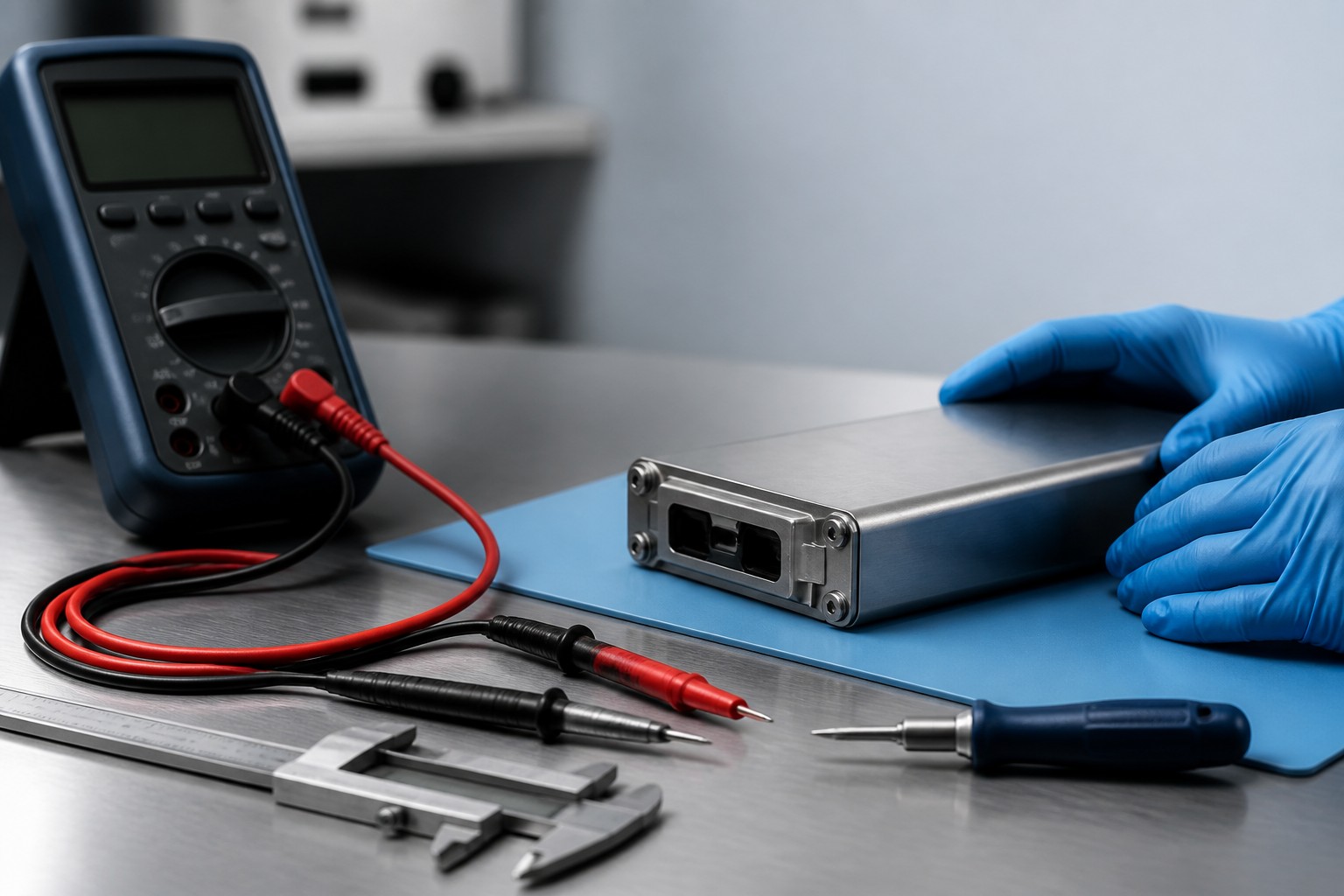
A sample confirms three things: build quality, consistency with the datasheet, and the factory’s ability to repeat both.
- A recorded discharge test at the stated load, for the full usable capacity
- A thermal check at continuous rated load, with surface temperatures taken on the inverter and the cell pack
- Load testing of every DC output at its rated current, not just the main AC output
- The UN 38.3 test summary for the exact cell and pack configuration offered
- For mains-output units: insulation and dielectric strength results in the test report
Then lock it down. Record the serial number of the approved sample, photograph it, and state in writing that mass production must match this configuration. “Same as sample” against a different cell batch is one of the most common causes of a first order that fails inspection.
5. Commercial terms that protect you
- MOQ tiers for your branding versus a custom design, in writing
- Tooling ownership and amortisation — who pays, who owns, what transfer costs
- Exclusivity by territory, channel or model, with a definition of what happens if targets are missed
- Warranty and RMA mechanics: an agreed RMA rate ceiling, repair versus replacement, and a commitment on spare board supply
- Software and app: who owns it, where data is hosted, and what happens if the vendor stops supporting it
- Incoterms and who prepares the dangerous-goods documentation for each leg
- Payment schedule tied to milestones — sample approval, first-article approval, pre-shipment inspection
- Change control: any BOM or component change requires written notice and, where relevant, re-testing
6. Scale-up and quality control
Before the mass run, agree a first-article approval on the actual production line, not the sample bench. During production, confirm the inspection points: incoming inspection of cells and boards, in-process checks at pack assembly and final assembly, and outgoing inspection with an agreed AQL sampling level. Require a pre-shipment inspection with photographs and video of the shipped batch, plus a load plan that satisfies the dangerous-goods rules for your mode of transport.
7. Sourcing mistakes that surface twelve months later
- Buying on price per peak watt instead of cost per usable kilowatt-hour.
- Accepting “Grade A” without a cell report.
- Skipping the first-article approval because the sample looked good.
- Single-sourcing the BMS, then discovering it is obsolete when the first failure comes in.
- Leaving tooling ownership undefined, so switching suppliers means paying twice.
- Assuming the certification on the standard model covers your customized version — it rarely does.
- No written change control, so the second shipment is not the first shipment.
What to prepare before your first RFQ
- Target markets and required certifications
- Continuous output power, peak power with duration, and usable energy
- Port list and enclosure requirements
- Branding scope: logo, packaging, manual languages, app branding
- Target annual volumes and first-order quantity
- Required certifications as a document list, not a marketing claim
- Warranty expectations and spare-parts requirements
A supplier that answers all of the above in one reply, with documents attached, has told you something useful about how they will handle your production order.

FAQ
Do I need a fully custom ODM design, or is private labelling enough? Start with branding on an existing platform unless your market requires a different form factor, port set or certification scope. Custom tooling makes commercial sense when your volume justifies the amortisation, or when the standard model genuinely cannot serve the application.
What MOQ should I expect? It depends on whether the changes are cosmetic or structural. At Ruihan Energy we quote from a single unit for trial orders so distributors can validate the product before committing — larger volumes are where tooling and price breaks become relevant. See our OEM/ODM manufacturing process for how a project turns into units.
How long does production take? Our standard production window is 3–7 days depending on order volume, and payment terms are structured around a deposit with the balance agreed per order.
Will the factory provide the certifications for my market? Ask for the documents, not the claim: UN 38.3 test summary, IEC 62133-2 or IEC 62619 report, CB certificate, CE declaration of conformity, UL file number, and the safety data sheet. See our guide to portable power station and battery certifications for importers for what each one covers.
What should I inspect before the first container ships? First-article approval, a recorded capacity test on a unit from the production batch, the UN 38.3 summary matching the exact configuration, and the pre-shipment inspection report.
Sourcing for a specific market? Ruihan Energy manufactures portable power stations from 200 W to 8,000 W and home storage systems from 5 kWh to 40 kWh, with OEM/ODM support on enclosure, port configuration, firmware branding and packaging. Tell us your target market, the certification set you need, and your volume — we will come back with a specification and a production timeline.