
A specification guide for dealers, fleet operators and OEM buyers
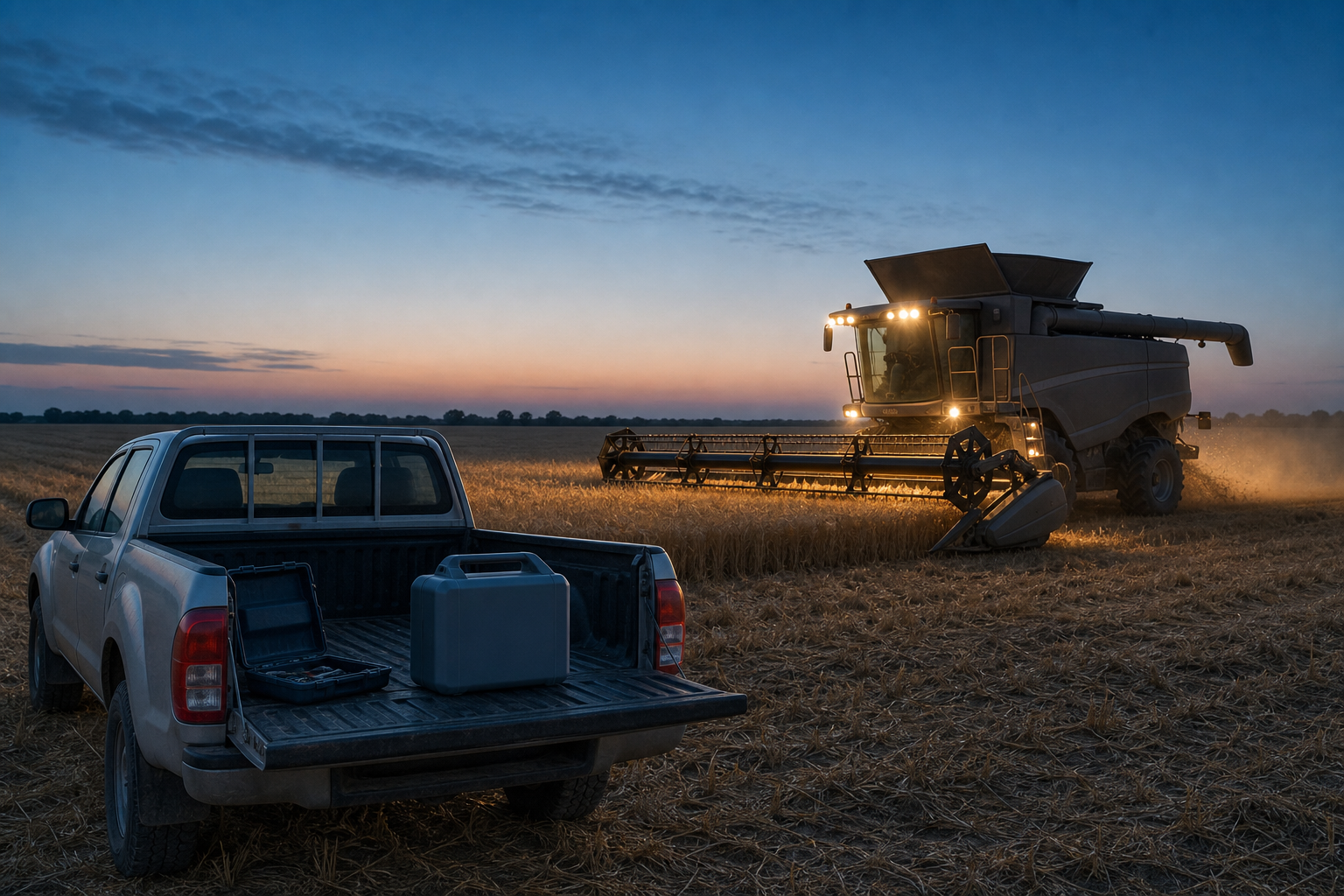
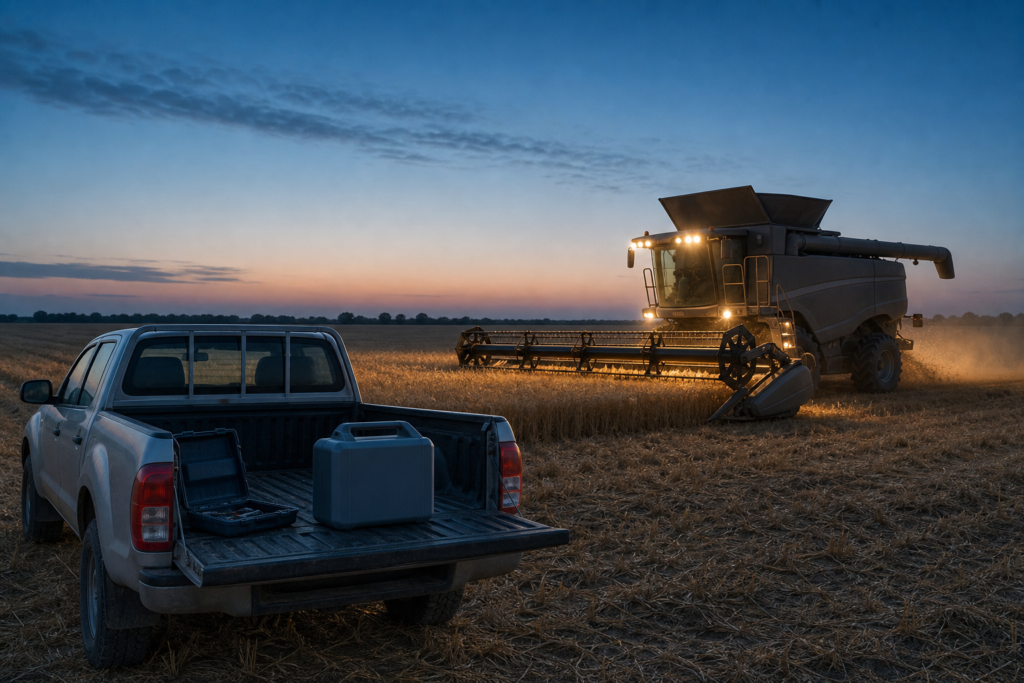
Harvest is the narrowest window in the farming calendar and the most expensive one to miss. A combine harvester is usually the highest-capital machine on the operation, it runs 16 to 20 hour shifts while the weather holds, and it sits idle for the rest of the year. That duty cycle is exactly what electrical systems handle worst.
This guide is written for the people who specify, stock and service backup power for agricultural machinery: equipment dealers, fleet maintenance managers and OEM procurement teams. It covers what backup power actually means on a harvester, how to size it, how lithium chemistry integrates with an existing charging system, and what to require from a supplier.
1. Why harvester electrical systems fail at the worst possible time
Four conditions converge. Individually each is manageable. Together they produce the classic failure: the machine that started perfectly in June is dead on the first morning of harvest.
A seasonal duty cycle. A combine may run a few hundred engine hours a year, concentrated into a few weeks. For the other ten months the battery sits, self-discharging — and in a lead-acid pack, sulfating. Capacity loss is driven by time at partial state of charge, not by hours worked. A battery can be “barely used” and still be finished.
A growing parasitic load. Modern harvesters carry yield monitors, auto-steer receivers, telematics gateways, cab displays, cameras and section control. These loads are small individually and continuous in aggregate. A battery originally sized for cranking amps is now also being asked to run an electronics package it was never specified for.
Vibration, dust and heat. Field conditions are hostile to any enclosure. Terminals loosen, dust bridges across contacts, and cells sit at elevated temperature through the working day.
No grid and no neighbour. Harvest happens in fields, often far from a workshop. When a machine refuses to start, you cannot roll another one over to it. Every hour of downtime is a full crew standing still inside a shrinking weather window.
The economics are straightforward: backup power is priced against downtime, not against a battery.
2. “Backup power” is four different jobs
Most failed specifications come from treating these as one requirement. They have different voltages, different duty profiles and different products.
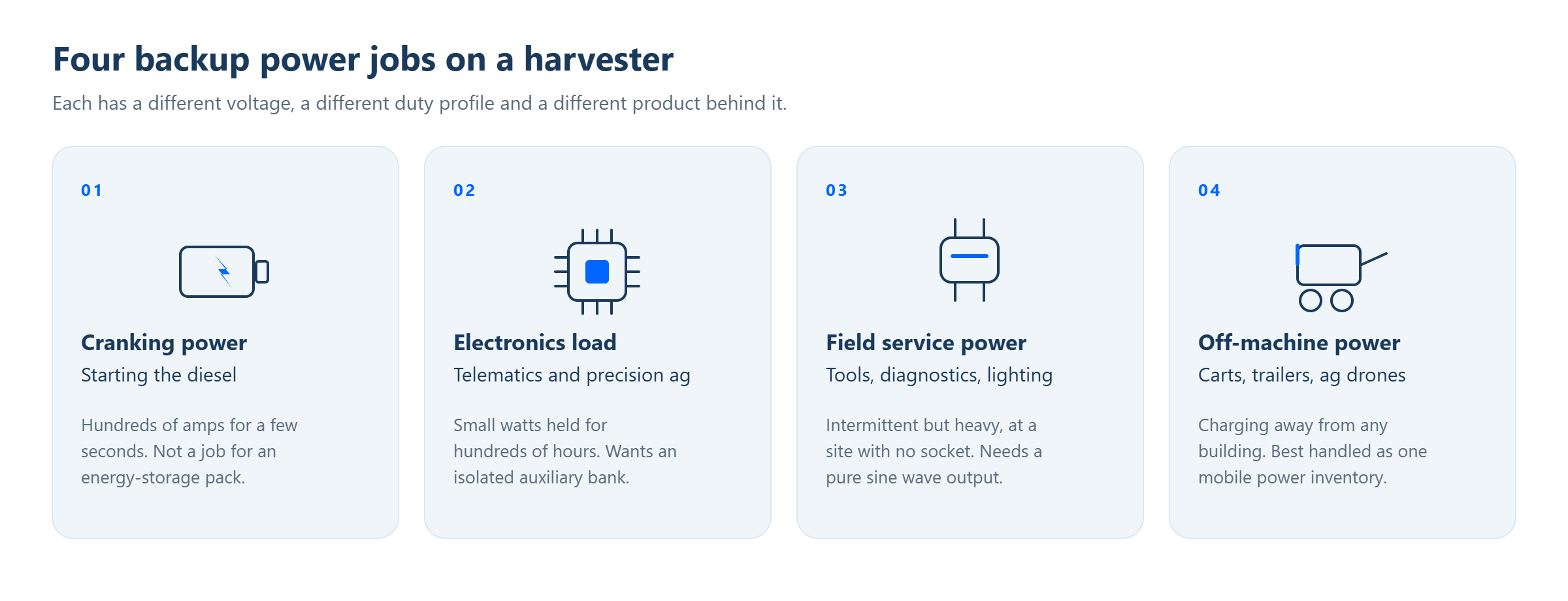
2.1 Cranking power — starting the diesel
This is the high-current, short-duration job: hundreds of amps for a few seconds to turn a cold diesel. It is the job the machine’s original battery was designed for, and it is the one job a small portable power station cannot replace. Cranking demand is governed by the engine and the climate, not by how much energy the pack stores.
What you can do here is add a boost source: an appropriately rated jump-start or boost function that lives on the service truck, so a flat machine is a ten-minute problem instead of a lost morning.
2.2 Continuous low-draw power — electronics and monitoring
This is the quietly expensive one. A 30 W continuous load held for 14 hours consumes 420 Wh. Over ten idle months, a small parasitic draw is enough to walk a battery down into the sulfation zone. For telematics and monitoring, the right answer is a dedicated auxiliary lithium bank that is isolated from the cranking battery, so machine electronics never discharge the pack that starts the engine.
2.3 Field service power — tools, diagnostics and lighting
Impact wrenches, diagnostic laptops, calibration equipment, LED work lighting, phone and radio charging. This load is intermittent but heavy, and it happens exactly where there is no socket. A portable power station with a pure sine wave AC output is the correct tool here, because modern diagnostic equipment does not tolerate a modified sine wave.
2.4 Off-machine power — trailers, carts and drones
Grain carts, trailers, remote sensors, irrigation controllers and agricultural drone batteries all need charging away from a building. Treated as separate requirements, this becomes a pile of mismatched gear. Treated as one requirement, it becomes a mobile power inventory: a small number of portable stations plus folding solar panels that the operation actually knows how to use.
3. Lead-acid or LiFePO4: matching chemistry to the duty cycle
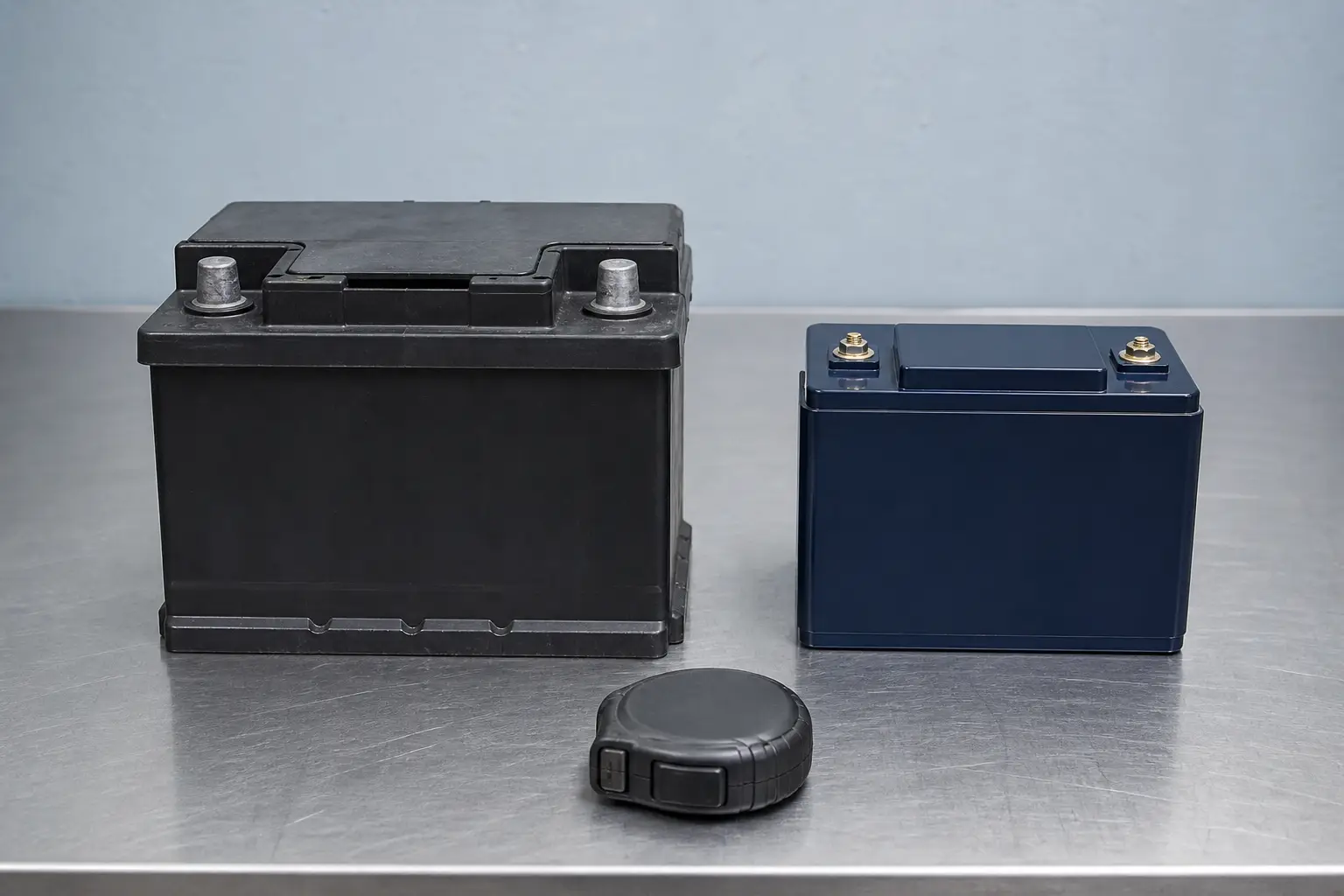
Use this comparison as a specification aid, not as a marketing claim. The right answer differs by application — and for cranking duty in deep cold, lead-acid still has a legitimate place.
| Attribute | Flooded / AGM lead-acid | LiFePO4 (lithium iron phosphate) |
|---|---|---|
| Usable depth of discharge | Roughly half of rated capacity to preserve life | Typically 80–90% of rated capacity |
| Cycle life | Limited at deep discharge; degrades quickly when cycled hard | Long — Ruihan rates Grade A cells at 6000+ cycles |
| Weight for the same usable energy | Baseline | Substantially lighter, which matters on towed and hand-carried equipment |
| Maintenance | Terminal cleaning, water top-up on flooded types, equalising | Sealed; no water, no equalising |
| Self-discharge over the idle season | Meaningfully higher — the main cause of off-season capacity loss | Lower, so a stored pack holds charge across the off-season |
| Vibration and shock | Plates and internal connections are vulnerable | No liquid, no loose plates |
| Charging in freezing conditions | Accepts charge below 0 °C (at reduced performance) | Must not be charged below 0 °C without low-temperature protection |
| Voltage profile | Nominal 12 V, sags under load | Nominal 12.8 V, holds voltage flatter under load |
| Integration with an existing alternator | Direct replacement | Requires charge-profile management — see Section 5 |
| Cost per cycle | Low upfront, higher over life | Higher upfront, materially lower over life |
For a machine that works hard and often, lead-acid remains adequate. For a machine that stands idle for ten months and then works around the clock, the idle season is what kills lead-acid — and that is precisely the harvester duty cycle.
4. How to size backup power for a harvester
Sizing is arithmetic, not guesswork. Five steps.
Step 1 — List the loads and their hours
Build the load list per shift, in watts and hours. A representative night-harvest service scenario:
| Load | Power | Hours per shift | Energy |
|---|---|---|---|
| Cab electronics, displays, telematics | 30 W | 14 h | 420 Wh |
| Work lighting (supplementary LED) | 60 W | 6 h | 360 Wh |
| Diagnostic laptop and calibration tools | 80 W | 3 h | 240 Wh |
| Cordless tool charging (impact wrench, torches) | 200 W | 1.5 h | 300 Wh |
| Phones, radios, tablets | 20 W | 6 h | 120 Wh |
| Total per shift | 1,440 Wh |
Illustrative load profile. Substitute your own measured figures — a clamp meter on the service truck takes ten minutes and removes all guesswork.
Step 2 — Separate cranking from everything else
Never size an auxiliary system to cover cranking. Keep the machine’s cranking battery, its circuit and its charging path intact. Add the backup layer beside it, not in place of it.
Step 3 — Apply a depth-of-discharge margin
If you plan to draw 1,440 Wh per shift, do not buy a 1,440 Wh station. Working within 80% depth of discharge means roughly 1,800 Wh of nameplate capacity. Round up, and remember that available capacity falls as ambient temperature falls.
Step 4 — Match the DC voltage and the AC output to the market
Agricultural machinery commonly uses 12 V systems; heavier machines often run 24 V, sometimes as two 12 V batteries in series. DC output, charging input and any auxiliary bank must match the machine. AC output must match the target market — Ruihan’s C-Series carry stations, for example, are specified with 220 V pure sine wave AC outputs, documented at 192 Wh with 100 W (C803) and 200 W with twin AC outlets (C804). For 110–120 V markets the AC configuration is set at the quotation stage of an OEM/ODM program rather than assumed.
Step 5 — Decide how the system will be recharged
A backup system with no recharge path is a consumable. Options are mains charging in the yard, a vehicle 12 V socket while the truck moves, or folding solar panels for genuinely remote sites. Choose the recharge path before you choose the capacity.
5. Integrating lithium with an existing charging system
This is where most field failures originate, and it is worth reading even if you never touch the machine’s wiring.
An alternator’s regulator is designed around a lead-acid acceptance curve. LiFePO4 accepts charge faster and rests at a higher voltage. Connect a large lithium bank directly and two problems appear:
- Alternator overload. The bank will pull high current for extended periods, and alternators are not continuously rated for that. The result is a hot, short-lived alternator.
- Load dump on BMS disconnect. If a lithium BMS opens the circuit at full charge while the alternator is running, the sudden loss of load can produce a voltage spike that damages electronics elsewhere on the machine.
Three workable patterns avoid both:
- DC-DC charger between the alternator and the lithium bank. Current is limited to what the alternator can sustain, and the lithium pack gets its correct charge profile.
- A battery with charge-current limiting built into the BMS, specified for the alternator’s continuous rating.
- A fully isolated auxiliary bank, charged from mains or solar only, never paralleled with the machine’s lead-acid system.
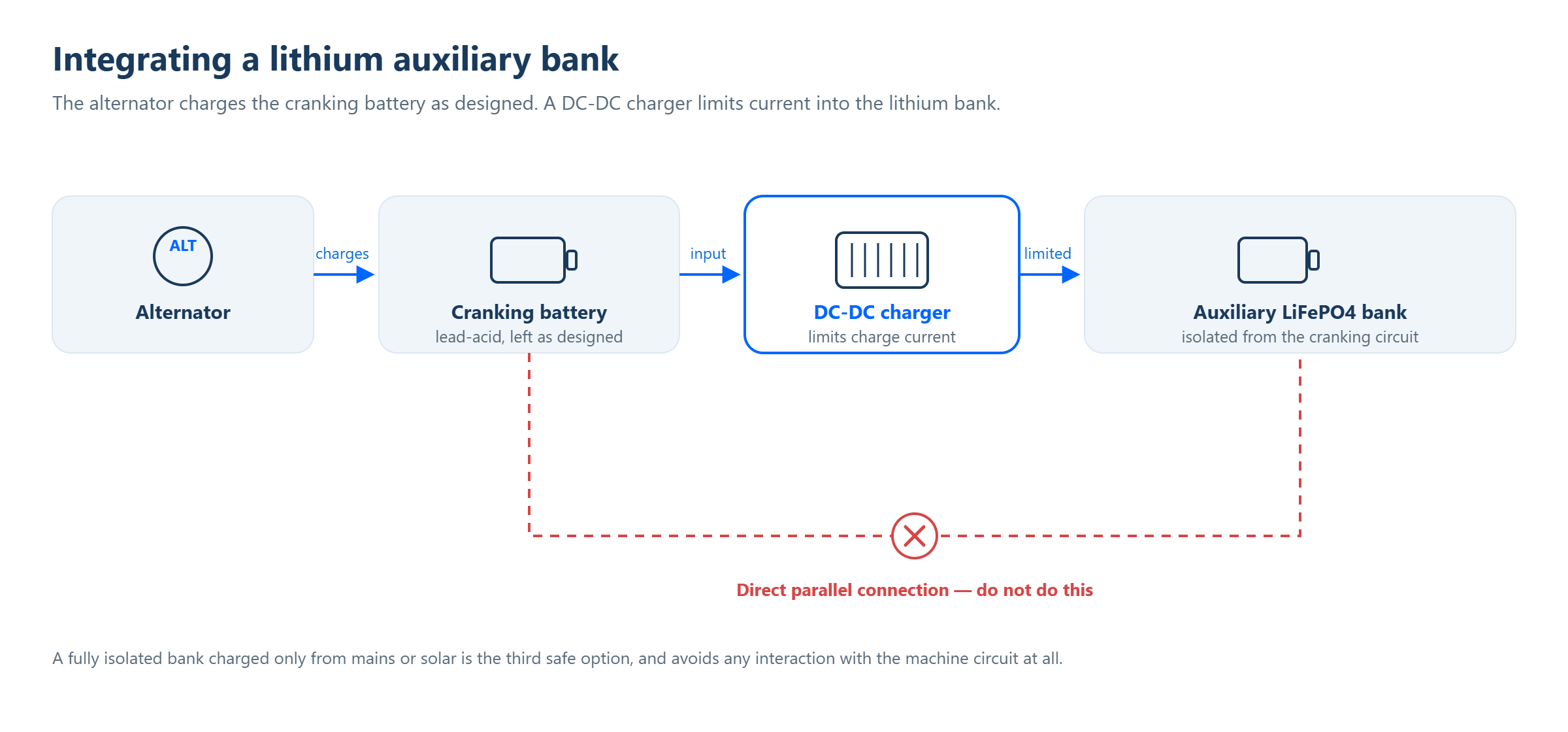
Never connect a lithium auxiliary bank directly in parallel with a lead-acid cranking battery and hope the two negotiate. They will not, and the cheaper battery will fail first.
6. Cold weather, storage and off-season care
Harvest season is warm. Winter is when the damage is done.
- Charge before storage. A pack stored at partial state of charge is the single most common cause of capacity loss in agricultural machinery. Bring it to a healthy mid-to-high state of charge before the machine parks.
- Protect against low-temperature charging. LiFePO4 cells must not be charged below 0 °C. If the site freezes and the equipment is used year-round, specify a pack with low-temperature charge cut-off, or plan to warm the equipment before charging.
- Disconnect or maintain. Either isolate the battery or connect a maintainer. Leaving it connected to a machine that draws parasitic load does neither.
- Do not store portable stations at zero. Leaving a portable power station fully drained for months is as harmful as leaving it fully charged in heat. Store it at a moderate state of charge, in a dry, frost-free place.
- Inspect terminals and enclosures each season. Vibration and dust are the two mechanical enemies. Check torque, clean terminals, and confirm seals and cable glands are intact before the season starts, not during it.
7. What to specify when you buy — a buyer’s checklist
For dealers and fleet buyers, the product is only half of the purchase. The other half is the supply relationship. Use this list as a tender or RFQ checklist:
| Dimension | What to require |
|---|---|
| On the product | Cell grade and traceability — ask for the cell specification sheet, not just a capacity claim Cycle life, and the conditions under which it was measured BMS functions: over/under-voltage, over-current, thermal protection, cell balancing, low-temperature charge cut-off IP rating and enclosure durability for field conditions AC output voltage and waveform for the target market DC output count and type for the service-truck use case |
| On compliance and logistics | Market-access certifications for the destination market (CE, FCC, RoHS) and transport certification for lithium cells (UN38.3) Packaging and documentation suitable for the channel you sell into |
| On the supply relationship | MOQ and whether trial orders are accepted Sample lead time and whether branded samples are possible Private-label depth: logo only, or colour, packaging, manual, firmware Warranty terms, spare parts availability and technical support language Delivery performance — ask for an on-time dispatch figure |
8. Why we publish this
Ruihan Energy manufactures LiFePO4 storage and portable power equipment in Guangdong and supplies agricultural, off-grid and channel markets through wholesale and OEM/ODM programs. Our own specification sheet states the parameters above because they are the ones that decide whether a backup system survives its first off-season.
A short list of what that means in practice:
- ISO 9001 / ISO 14001 certified factory, with 100% cell testing before shipment
- CE, FCC, UN38.3 and RoHS on standard product lines
- Grade A cells rated at 6000+ cycles — the parameter that matters most for a machine that idles ten months a year
- Product lines from 200 W to 5000 W+, so a single supplier can cover service-truck power, auxiliary machine power and stationary farm storage
- ≥ 95% on-time dispatch rate across shipped programs
For Business Buyers
If you are evaluating this category for a distribution territory, a dealer network or an OEM program, these are the four points worth leading with in a supplier conversation:
- Trial orders before volume. Validate product and branding with a small batch before committing to container quantity. Volume tiers then scale from 50 to 100 units, 100 to 500 units, and 500 units or more.
- Private-label depth that matches your channel. Logo and branding, case colour and finish, retail packaging, multilingual manuals, and firmware behaviour such as charge curves and output priorities.
- A dedicated project engineer. One named engineer per program, from sample approval to mass production, with NDA signed before specifications are shared.
- Territory discussion at volume. Territory protection is a volume-tier conversation, not a catalogue line — raise it early if your channel depends on it.
Frequently Asked Questions
Can a portable power station start a combine harvester?
Not by itself. Cranking a cold diesel requires very high current for a short duration, which is a different duty from energy storage. A portable station belongs in the auxiliary role: field service power, diagnostics, lighting and electronics back-up. For starting, use a correctly rated boost or jump-start device as a separate item.
What voltage do combine harvesters use?
Most agricultural machinery uses 12 V systems, while heavier machines commonly run 24 V — often as two 12 V batteries in series rather than a single 24 V unit. Always confirm the machine’s actual system voltage and charging path before specifying an auxiliary system, because DC outputs, charging inputs and battery configuration all follow from it.
Can I replace my harvester’s lead-acid battery with LiFePO4?
In many applications yes, provided the replacement matches the machine’s cranking requirement and its charging system is compatible. The critical detail is charge management: a lithium battery needs a correct charge profile, and the charging path may need a DC-DC charger or a BMS with charge-current limiting. Compatibility with the machine’s regulator should be confirmed by a qualified technician, not assumed from the voltage label.
Will a lithium battery damage my alternator?
A large lithium bank connected without current limiting can overload an alternator, because the bank accepts charge faster and for longer than the lead-acid unit the alternator was designed around. Limiting charge current — by DC-DC charger or by BMS design — removes the problem.
How much backup power does a harvester actually need?
It depends entirely on what you are backing up. Build a load list in watts and hours, total it per shift, and add a depth-of-discharge margin of roughly 20%. A representative night-harvest service load of about 1,440 Wh per shift points to roughly 1,800 Wh of nameplate capacity. Measure your own loads rather than adopting someone else’s number.
What happens to LiFePO4 in cold weather?
Discharge performance falls in the cold, and more importantly these cells must not be charged below 0 °C. For year-round cold-climate use, specify low-temperature charge protection, or plan to warm the equipment before charging. Off-season storage for harvesters is usually warm enough — the real risk there is storing at the wrong state of charge.
Do you offer OEM/ODM for farm-brand backup power?
Yes. Ruihan operates OEM/ODM programs across product lines from 200 W to 5000 W+, with private-label options including logo and branding, case colour and finish, packaging and manuals, and firmware behaviour. Branded samples typically take two to three weeks after specification confirmation, and NDAs are signed before specifications are shared.
What certifications should a backup power product carry for agricultural channel sales?
At minimum, market-access certification for your destination market — CE and RoHS for the EU, FCC for the United States — plus UN38.3 for lithium cell transport. Ask for the documentation for the specific line you intend to stock rather than a general company certificate.
Next step
Tell us the machine class, the market and the volume, and we will come back within one business day with a configuration and a quotation.
Wholesale & DistributionChannel terms for dealers and importers
OEM / ODM ManufacturingPrivate-label programs from 200 W to 5000 W+
Portable Power StationsC-Series carry stations and larger units
LiFePO4 Battery RangeCells and packs for stationary and mobile use
Folding Solar PanelsRecharge for genuinely remote sites