
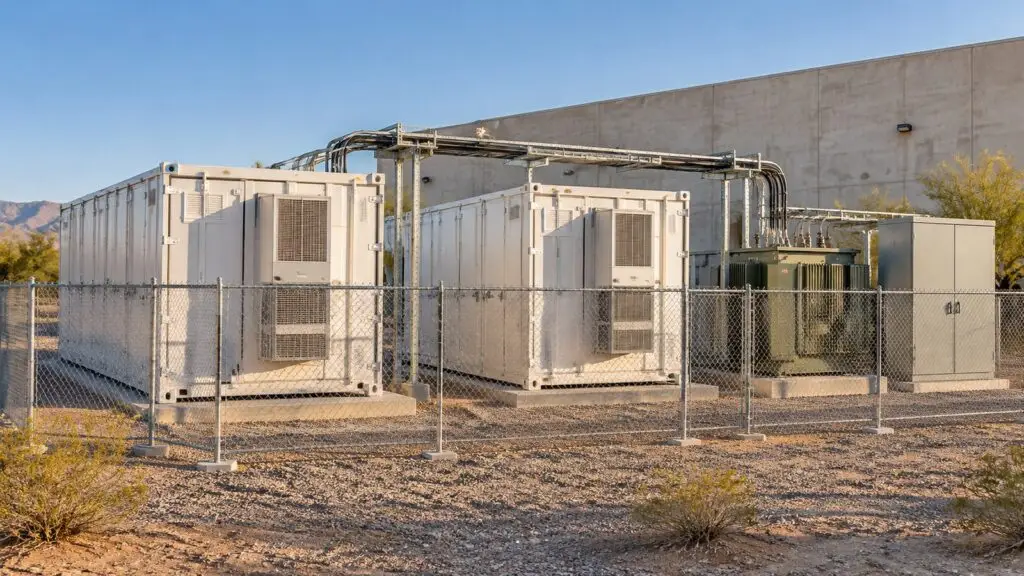
On January 1, 2027 the domestic content bonus battery storage projects can claim gets harder to win: any U.S. storage project that begins construction after December 31, 2026 must show a 55% domestic cost percentage to collect the 10-point adder under Section 48E, up from 50% for 2026 starts (26 U.S.C. §48E(a)(3)(B)(iii)–(iv), as amended July 2025). For a grid-scale system built on imported cells, the arithmetic stops at 34.4%.
That number is a sourcing decision before it is a tax formality, because the component that decides the test is the one most projects import. What follows covers the threshold, how it is scored, where common sourcing structures land, and what a distributor or EPC should change for a 2027 quote. It is a sourcing analysis, not tax advice.
What changes on January 1, 2027
Section 48E replaced the old investment tax credit for property placed in service after December 31, 2024. Its base rate is 30% for a project that meets the prevailing wage and apprenticeship requirements, and 6% for one that does not (26 U.S.C. §48E(a)(2)). The domestic content bonus is separate: it adds 10 percentage points when the domestic content requirement is met, and only 2 percentage points when it is met but the project misses prevailing wage, apprenticeship, or the under-1-megawatt exception (IRS, Domestic content bonus credit, 2026).
The percentage a project must hit to earn that adder is not fixed. It is an “adjusted percentage” set by the calendar year in which construction begins, and it steps up on a published schedule. The current statute reads 40% for construction beginning before June 16, 2025; 45% from June 16 through December 31, 2025; 50% for calendar year 2026; and 55% for construction beginning after December 31, 2026. The 2025 reconciliation law rewrote this subsection, and the 55% step is the operative number for every project that has not yet started.
Two other provisions decide whether the adder is even in play. Storage is explicitly carved out of the wind-and-solar termination that stops Section 48E credits for those technologies after December 31, 2027, so a battery project placed in service later still qualifies. And a project whose construction begins after December 31, 2025 that includes material assistance from a prohibited foreign entity is excluded from the credit altogether — a separate test from domestic content, and a harder one to cure after the fact.
Rule: the 10-point adder requires 100% U.S. structural steel and iron plus a domestic manufactured-product cost percentage above the statutory line. Threshold: 55% for construction beginning after December 31, 2026; 50% for calendar 2026; 45% from June 16 to December 31, 2025; 40% before that (26 U.S.C. §48E(a)(3)(B)).
How the domestic content bonus battery storage test is scored
The test has two independent parts, and a project must pass both.
Steel and iron. All structural steel and structural iron in the project must be produced in the United States. For a standalone battery system the list is short — in the IRS elective safe harbor the only steel-or-iron line item is reinforcing products in the foundation, which many container and cabinet installations do not use at all. Where it is used, the 100% rule applies with no partial credit.
Manufactured products. Everything else is measured by cost, using the “adjusted percentage rule.” The taxpayer compares the direct cost of domestically produced manufactured products against total manufactured product cost. The decisive detail is that a manufactured product counts as domestic only if all of its manufactured product components are domestic; one imported component takes the entire product to zero rather than reducing it proportionally. That all-or-nothing rule is stated in the IRS safe harbor notices and is the mechanism most buyers underestimate.
Taxpayers can compute cost percentages from actual supplier data, or elect the IRS safe harbor, which assigns fixed cost percentages to each component for representative project types. The battery energy storage table was revised in Notice 2025-08 (January 2025), which replaced the original 2024 table with updated percentages sourced from the Department of Energy and split the model into two columns: grid-scale systems above 1 megawatt-hour of nameplate capacity, and distributed systems at or below that line. The safe harbor is elective, so a project is not locked into it — but it is the only public basis on which a buyer can model the test before a supplier discloses direct costs.
Where a battery storage project lands on the 55% test
The table below applies the IRS safe-harbor percentages from Notice 2025-08 to five sourcing structures a U.S. buyer can realistically assemble in 2027. Percentages are shares of total manufactured product cost, and each row assumes the structural steel-and-iron requirement is satisfied or not applicable. Values in the first four rows are sums of the published component percentages; the last row is the imported-content baseline.
| Sourcing structure (2027 construction start) | Grid-scale BESS >1 MWh (% of manufactured product cost) | Distributed BESS ≤1 MWh (% of manufactured product cost) | Meets 55%? |
|---|---|---|---|
| Cells and pack domestic; container, BMS, thermal management and inverter domestic | 95.4% | 89.3% | Yes, both |
| Cells and pack domestic; container, BMS, thermal management and inverter imported | 65.6% | 43.2% | Grid-scale only |
| Cells imported; pack, container, BMS, thermal management and inverter domestic | 34.4% | 56.8% | Distributed only |
| Cells and pack imported; container domestic; BMS, thermal management and inverter imported | 16.8% | 25.9% | No |
| All manufactured products imported | 0% | 0% | No |
Read the table as a cost stack, not a quality ranking: the cell line is 52.0% of a grid-scale system’s manufactured product cost and 26.9% of a distributed system’s, so where the cells are made determines whether the rest of the bill of materials can rescue the number. The 65.6% figure for a domestic cell-and-pack grid-scale system matches the published worked example in which cells and packs are U.S.-made and everything else is imported.
Three practical readings follow. First, a grid-scale system with imported cells cannot reach 55% under any combination of domestic balance-of-system, because the pack block alone is 65.6% of the cost basis and its imported cells zero it out — the ceiling is 34.4%. Second, a distributed system at or below 1 MWh can still clear 55% with imported cells, but only if essentially every other component is domestic, since the ceiling is 56.8%. Third, a domestic cell-and-pack system that clears 65.6% passes the 2027 test comfortably, which is why cell sourcing has become the first question in an adder conversation.
Does an imported battery cell disqualify the whole project?
No — but it removes the largest cost block from the calculation, which for grid-scale systems has the same commercial effect. The cell is a manufactured product component inside the battery pack/module, and the pack/module is the manufactured product. Because a manufactured product only counts as domestic when all of its components are domestic, an imported cell sets the entire pack/module row to zero: 65.6% of the grid-scale cost basis, or 43.2% of the distributed basis. Everything else in the system can still count. The project does not lose the base credit, and it does not automatically fail; it simply cannot reach the threshold from the remaining components.
Distributed systems are the exception worth modelling. At 43.2% for the pack block, a distributed system retains 56.8% of cost basis in container, enclosure, battery management, thermal management, inverter and production — enough to clear 55% with imported cells only if every one of those lines is domestic. One imported inverter enclosure or thermal management unit takes the total below the line.
Why the December 4 price floor moves your number
Domestic content is a ratio, so it moves when the denominator moves — and the denominator is about to change. The Section 232 action signed in August 2026 imposes a 15% ad valorem duty on polysilicon derivatives plus minimum import prices of $21/kg on polysilicon, $100/kg on ingots and wafers, $0.22/W on solar cells and $0.38/W on solar modules, effective December 4, 2026 (pv magazine India, 7 August 2026).
For a standalone storage project the direct effect is limited. For a solar-plus-storage project it is not: imported modules rise toward the floor, their cost line in the project grows, and because imported manufactured products contribute zero to the domestic numerator, a larger foreign cost line dilutes the domestic percentage of everything around it. A hybrid project that modeled at 56% on 2026 module pricing can model below 55% on post-December pricing without changing a single supplier. Buyers who fixed a domestic content assumption in Q3 and are pricing in Q1 should re-run it against the new floor rather than assume the number held.
What the adder is worth on a 2027 purchase order
The adder is 10 percentage points of eligible basis, so its value scales with system cost. On a $1.6 million commercial and industrial installation, 10 points is $160,000 of additional credit; on a $4.0 million project it is $400,000. That is the prize, and it is why a sourcing change that costs a few percent of hardware can still be the right decision — and why a sourcing change that costs 15% of hardware to chase 10 points of credit usually is not.
The comparison to run is not “domestic versus imported” but “domestic premium versus credit delta.” If moving to a domestic container, enclosure and battery management package adds 12% to hardware cost while lifting the project from 34% to 65% domestic content, the project buys 10 points of credit for the incremental spend and should model both cases. If the same move lifts a distributed project from 54% to 58%, the total value is 10 points for a premium that may exceed them. Because the threshold is binary, the project sitting at 54% gets nothing extra — so the correct target is a margin above 55%, not a number close to it.
The five-step sourcing checklist
- Fix the construction start date in writing. The 50% or 55% threshold follows the year construction begins, not the year of commissioning. A project slipping from December 2026 to January 2027 moves to the harder test; one starting in 2026 and completing in 2028 keeps 50%.
- Get a component-level origin declaration, not a country-of-origin statement. You need the origin of each manufactured product component — cells, packaging, pack production, enclosure, battery management system, thermal management, inverter printed circuit boards, inverter assembly — because the all-or-nothing rule operates at that level.
- Compute the percentage before you compute the price. Ask the supplier for direct costs per component and run the ratio against the Notice 2025-08 percentages as a cross-check. Two bids at the same price per kWh can sit ten points apart on this test.
- Separate the two foreign-entity tests. Domestic content is a percentage test. Material assistance from a prohibited foreign entity is an eligibility test that removes the credit entirely. A supplier document that addresses one usually does not address the other, and both belong in the procurement file.
- Model the hybrid case separately. If the project pairs storage with PV, run the domestic content calculation on the combined applicable project, with modules priced at post-December 4 levels.
If the adder is out of reach, what should a 2027 buyer do instead?
Price the project at 30% plus the energy community adder, and compete on levelized cost rather than credit stacking. In practice that means three moves. Specify a system whose cost per kilowatt-hour is low enough that the missing 10 points do not decide the payback — which is a BOM and warranty question, not a tax question. Where the site qualifies as an energy community, capture that adder, since it carries no domestic content test. And keep the domestic content file complete anyway: a project that begins construction in 2026 at 50% may pass while the same design fails in 2027, and buyers who documented component origins in 2026 will be able to re-run the test quickly rather than rebuild a supplier file.
For distributors, the practical consequence is a two-tier catalogue. One tier is documented for domestic content, with component-level origin files and cost data ready for a buyer’s tax adviser. The other is priced for projects that will not reach the threshold. Mixing the two in a single quote is the most common way a good project loses ten points on a technicality discovered in diligence.
Before you fix a bill of materials for a 2027 start, send us the project size and target threshold. We will return the component breakdown, origin documentation and cost structure your tax adviser needs to run the test — for commercial and industrial storage, containerized systems and LiFePO4 battery modules, and we will tell you plainly where an imported cell line sits against the 55% test. Start at request a quote, or read how demand charges decide storage payback in 2027 and how the November 2026 AD/CVD orders affect module and kit pricing. Distributors planning a 2027 line can review wholesale and distribution terms.
FAQ
Is the 55% threshold measured by cost or by capacity?
By cost. The manufactured products test compares the direct cost of domestically produced manufactured products with total manufactured product cost. Nameplate capacity only matters for choosing the applicable table — grid-scale above 1 megawatt-hour, distributed at or below it — and for the under-1-megawatt exception that preserves the full 10-point adder without prevailing wage compliance.
Does the domestic content bonus apply to standalone storage, or only to solar-plus-storage?
It applies to standalone storage. Section 48E covers energy storage technology as its own credit category, separate from a qualified facility, and the IRS safe harbor publishes a dedicated battery energy storage table for both grid-scale and distributed systems. A project does not need PV on the same site to run the test.
Can a project change suppliers after construction begins and still clear the threshold?
The threshold is set by the year construction begins; substitution later does not change which percentage applies. Documentation, however, is assessed against what was actually installed, so a mid-build substitution that introduces an imported component can move the project below a threshold it was designed to clear. Treat the component origin file as a live document through commissioning.
Do imported cells create a prohibited-foreign-entity problem, or a domestic content problem?
They can create both, and the tests are different. Domestic content is a percentage: imported cells zero the pack/module block and reduce the percentage. Material assistance from a prohibited foreign entity is an eligibility rule that can remove the credit for property whose construction begins after December 31, 2025. A project can fail the first and pass the second, or fail both. Neither answer can be inferred from a country-of-origin label alone.
What documentation does a buyer actually need to keep?
A domestic content certification statement is filed with the return on Form 3468, and the supporting file is what survives diligence: component-level origin declarations, supplier direct-cost data, the election if the safe harbor is used, and steel-and-iron records. For projects relying on the statutory exceptions to elective payment phaseouts, the transition relief in Notice 2024-84 runs to construction beginning before the later of January 1, 2027 or further guidance, which makes the 2026 file the one that matters for co-operatives and municipal utilities.
Sources
- 26 U.S.C. §48E, Clean electricity investment credit, subsections (a)(2), (a)(3)(B), (b)(6), (c)(3), (e)(4) — as amended by Pub. L. 119-21 (July 4, 2025). Statute text.
- Internal Revenue Service, Domestic content bonus credit (page current 2026), including the 10-point and 2-point adder conditions, Form 3468 certification, and Notice 2024-84 transition relief.
- Internal Revenue Service, Notice 2025-08, First Updated Elective Safe Harbor (January 2025): updated assigned cost percentages for battery energy storage, grid-scale and distributed columns, and the all-or-nothing component rule.
- Internal Revenue Service, Notice 2024-41, Internal Revenue Bulletin 2024-24 (May 2024): original elective safe harbor and BESS cost table.
- U.S. Energy Information Administration, Short-Term Energy Outlook, Electricity, Coal and Renewables (released November 10, 2026): 2026 generation 4,539 BkWh, +2.7%; 2027 growth 1.2%; residential price 18.2¢/kWh in 2026 and 18.7¢/kWh in 2027; utility-scale solar capacity 183 GW in 2026 and 223 GW in 2027.
- pv magazine India, Global polysilicon prices hold steady as U.S. unveils Section 232 import floors (7 August 2026): 15% duty and minimum import prices of $21/kg polysilicon, $100/kg ingots and wafers, $0.22/W cells, $0.38/W modules, effective December 4, 2026.
This article summarizes published statute, IRS guidance and trade measures for procurement planning. It is not tax or legal advice; domestic content eligibility is determined on a taxpayer’s facts, and every project should be reviewed by qualified counsel before a credit position is taken.
{“@context”: “https://schema.org”, “@type”: “FAQPage”, “mainEntity”: [{“@type”: “Question”, “name”: “Is the 55% threshold measured by cost or by capacity?”, “acceptedAnswer”: {“@type”: “Answer”, “text”: “By cost. The manufactured products test compares the direct cost of domestically produced manufactured products with total manufactured product cost. Nameplate capacity only decides which IRS table applies (grid-scale above 1 MWh, distributed at or below) and whether the under-1-megawatt exception preserves the full 10-point adder.”}}, {“@type”: “Question”, “name”: “Does the domestic content bonus apply to standalone storage, or only to solar-plus-storage?”, “acceptedAnswer”: {“@type”: “Answer”, “text”: “It applies to standalone storage. Section 48E covers energy storage technology as its own credit category, and the IRS elective safe harbor publishes a dedicated battery energy storage table for grid-scale and distributed systems, so a project does not need PV on the same site.”}}, {“@type”: “Question”, “name”: “Can a project change suppliers after construction begins and still clear the threshold?”, “acceptedAnswer”: {“@type”: “Answer”, “text”: “The threshold is set by the year construction begins, and later substitution does not change which percentage applies. Documentation is assessed against what was installed, so a mid-build substitution that introduces an imported component can push the project below a threshold it was designed to clear.”}}, {“@type”: “Question”, “name”: “Do imported cells create a prohibited-foreign-entity problem, or a domestic content problem?”, “acceptedAnswer”: {“@type”: “Answer”, “text”: “They can create both, and the tests differ. Domestic content is a percentage: imported cells zero the battery pack/module block, which is 65.6% of a grid-scale cost basis. Material assistance from a prohibited foreign entity is an eligibility rule that can remove the credit for property whose construction begins after December 31, 2025.”}}, {“@type”: “Question”, “name”: “What documentation does a buyer actually need to keep?”, “acceptedAnswer”: {“@type”: “Answer”, “text”: “A domestic content certification statement filed with Form 3468, plus component-level origin declarations, supplier direct-cost data, the safe harbor election if used, and steel-and-iron records. For elective payment recipients, Notice 2024-84 transition relief runs to construction beginning before the later of January 1, 2027 or further guidance.”}}]}