
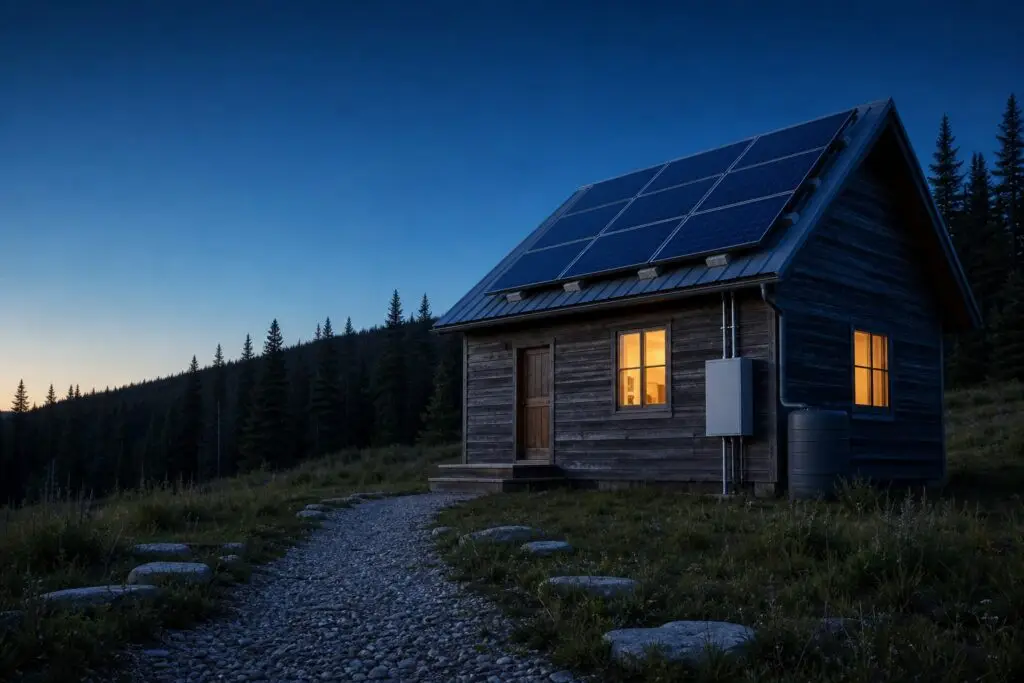
Inverter returns are rarely manufacturing faults. They are selection faults: an inverter that could not start a pump, a battery that could not deliver the current, or a unit that ran at 40 °C ambient where it was rated at 25 °C.
This guide covers the decisions that determine whether a 3–15 kW off-grid or hybrid system performs as promised, in the order an installer should make them.
1. Start with the architecture, not the wattage
DC-coupled hybrid. PV and battery share one DC bus through an integrated MPPT and inverter. Highest round-trip efficiency for self-consumption, simplest wiring, and the common choice for residential and light commercial retrofits.
AC-coupled. A separate grid-tie PV inverter feeds the AC bus, and a battery inverter charges and discharges alongside it. Useful when PV already exists, when the PV array is far from the battery room, or when you want to scale PV and storage independently.
Pure off-grid. No grid interconnection. Everything depends on the battery and the PV array, so autonomy and generator coordination become the primary design constraints rather than nice-to-haves.
Decide the architecture first, because it constrains which battery voltages, MPPT windows and transfer arrangements are available.
2. Build the load inventory before choosing a model
For every load, record four numbers, not one:
| Load | Rated W | Surge requirement | Duty | Notes |
|---|---|---|---|---|
| Refrigeration / compressor | Running current | 3–6× rated at start | Cyclic | Motor starting current dominates |
| Well or booster pump | Rated kW | High, sustained for seconds | On demand | Single-phase pumps often need 240 V split-phase in North America |
| Air conditioner | Rated kW | Compressor + fan surge | Long duty | Consider soft-start kits |
| Power tools | Rated kW | High instantaneous | Intermittent | |
| Electronics / IT | Low | None | Continuous | Sensitive to waveform quality |
| Resistive heating | Rated kW | None | Long duty | Drives energy, not surge |
Two errors follow from using rated watts only. The first is a system that browns out on every compressor start. The second is oversizing the inverter to compensate, which raises idle consumption and cost on a system that is often operating at low load.
Rule of thumb for the first pass: size continuous inverter output to carry the coincident continuous load plus the largest motor at running load, and confirm the surge rating covers that motor’s starting current for its actual start duration.
3. Understand what “surge rating” is worth
Specifications quote peak output without always quoting the duration or the underlying topology. Topology matters:
| Low-frequency (transformer-based) | High-frequency | |
|---|---|---|
| Surge behaviour | Handles motor starting and inductive loads more comfortably | Surge window typically shorter |
| Weight and size | Heavier, larger | Lighter, easier to wall-mount |
| Idle / standby draw | Generally higher | Generally lower |
| Cost | Higher for the same rating | Lower for the same rating |
| Best fit | Pumps, compressors, tools, poor power factor loads | Electronics, lighting, light-duty backup, tight installs |
For an off-grid site whose main loads are pumps, compressors or machine tools, a low-frequency design is usually the correct engineering choice even at a higher price. For a backup-only installation dominated by electronics and lighting, a high-frequency unit is often sufficient and cheaper to run.
Ask for surge output in watts and the duration in seconds, plus the load type it was validated against.
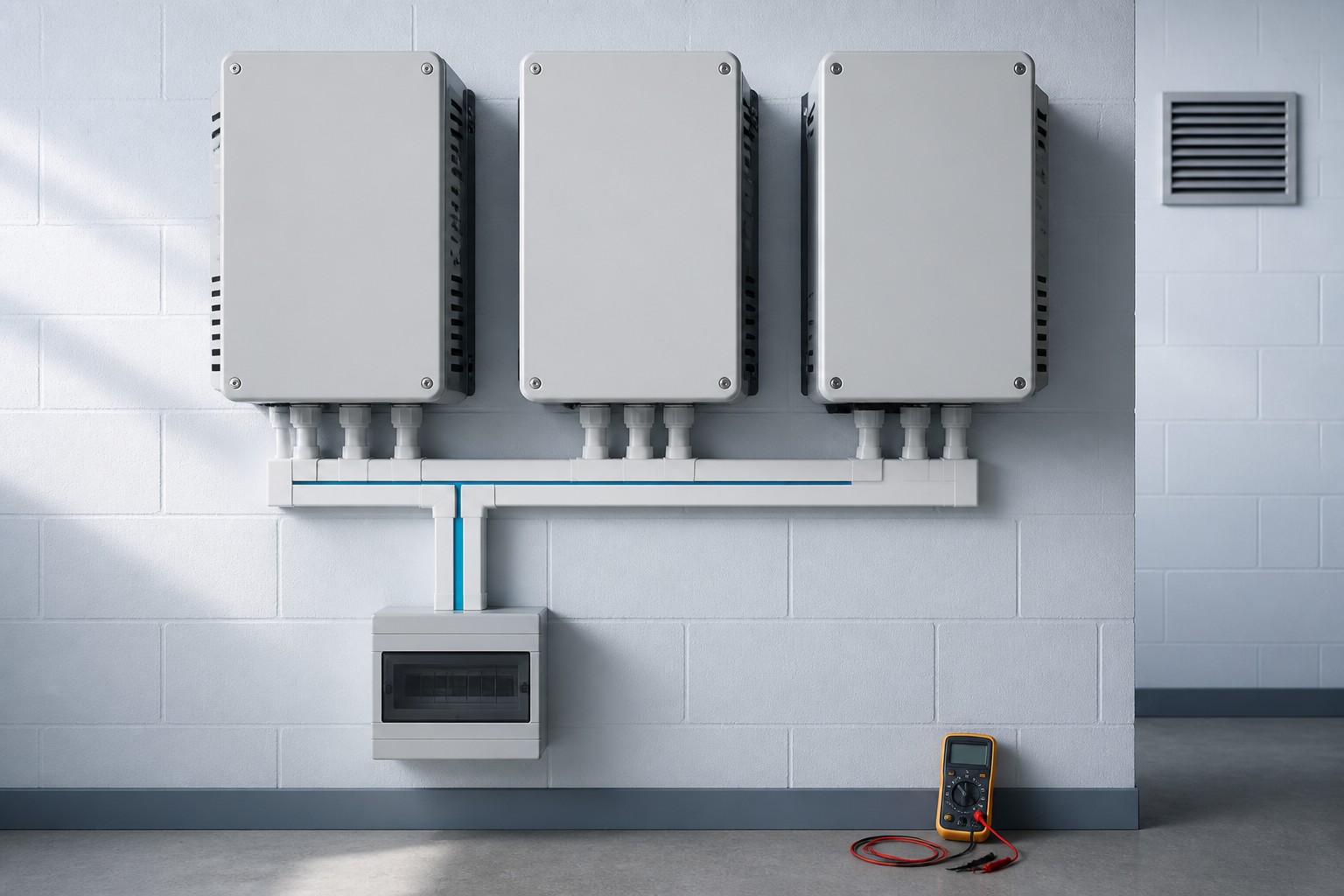
4. Battery: voltage, chemistry and communications
- DC bus voltage. 12 V and 24 V suit small systems with short cable runs. 48 V is the practical default above roughly 3 kW — it reduces current, cable size and heat for the same power.
- Chemistry and depth of discharge. LiFePO4 packs are typically cycled deeper and deliver more usable energy per nameplate kWh than lead-acid, which changes the array and autonomy calculation. Verify the warranty’s depth-of-discharge and throughput limits.
- Closed-loop versus open-loop. With closed-loop communication the inverter and BMS exchange state of charge, voltage and current limits over CAN or RS485, and the inverter respects the BMS limits. Where the protocols are not matched, the system runs open-loop on voltage thresholds — workable, but it needs conservative setpoints and better monitoring. Confirm the protocol compatibility in writing before shipping.
- Discharge rate. Check the pack’s continuous and peak discharge current against the inverter’s maximum DC draw. A battery that matches the system on kWh can still be undersized on kW.
5. PV side: MPPT window and string design
Four parameters decide compatibility: maximum PV input voltage, MPPT operating range, maximum input current per MPPT, and the number of independent MPPT trackers.
- Calculate string open-circuit voltage at the coldest recorded temperature at the site, not at standard test conditions. Cold increases Voc, and exceeding the input limit damages the inverter.
- Keep the string’s maximum-power voltage inside the MPPT window across the site’s temperature range, not just at midday in summer.
- Decide the array-to-inverter ratio deliberately. Oversizing the array improves yield in poor conditions but clips at peak; undersizing wastes inverter headroom.
- Count trackers against shading reality. Two orientations on one tracker will underperform, whatever the datasheet says.
6. Grid interface, split-phase and parallel operation
- Single-phase 230 V is the common residential configuration in many markets. In North America, 120/240 V split-phase output is required for well pumps, dryers and many large appliances — a single-phase 120 V unit will not serve them, and a step-up transformer is not an equivalent substitute.
- Parallel capability lets two units share a larger load and provides a degree of redundancy. Confirm the parallel kit, the communication cable and the firmware version required, and whether parallel operation is supported for your configuration.
- Transfer time determines whether connected IT equipment rides through an outage. For anything with a switch-mode supply, ask for the transfer time in milliseconds, and consider a small UPS on critical loads.
- Anti-islanding and grid protection. Grid-tied and hybrid units must comply with the local grid code, which differs by market. Ask which standard the unit is certified to and for which country settings it ships.
- Generator input. If a generator is part of the design, confirm the inverter supports generator charging with the correct power quality, and size the generator above the charger’s demand plus site load.
7. Efficiency, derating and the things that show up in service calls
- Idle and standby consumption is a real load in off-grid systems. A unit that draws tens of watts continuously can consume a meaningful share of a small array’s daily harvest.
- Temperature derating. Rated output at 25 °C is not output at 45 °C. Ask for the derating curve, not just the ambient range, and plan ventilation accordingly.
- Overload headroom and recovery. How long can the unit run at 110–150% of rated output, and does it restart automatically after an overload trip?
- Serviceability for the dealer. Fault-code documentation, firmware update method, spare board availability and warranty logistics matter more to a dealer than a marginal efficiency difference. Confirm the spares path before you commit to a range.
Matching the range to the application
| Application profile | Typical configuration | Example from our range |
|---|---|---|
| Small off-grid cabin, electronics and lighting | 3–5 kW, 48 V, high-frequency, single-phase | US 3.6 kW single-phase hybrid |
| Residential self-consumption + backup, EU/APAC | 6 kW, 48 V, single-phase, WiFi monitoring | 6 kW hybrid off-grid inverter |
| Residential with pumps and workshop tools | 7.2–8 kW, 48 V, low-frequency for surge | 7.2 / 6 / 8 kW off-grid hybrid |
| Larger home or light commercial, single-phase | 10.2 kW, 48 V, single-phase MPPT | 10.2 kW hybrid inverter |
| North American split-phase commercial | 12 kW, 120/240 V split-phase, parallel-capable | US 12 kW split-phase hybrid |
Commissioning checklist
- Load inventory and surge calculation documented and signed off.
- String Voc verified at minimum expected temperature.
- Battery continuous and peak discharge current compared against inverter DC demand.
- BMS communication verified live — not just configured.
- Transfer time and anti-islanding behaviour tested on site.
- Temperature derating reviewed against the actual installation location.
- Firmware version recorded, and fault-code reference left with the end user.
FAQ
How do I choose between 48 V and 24 V for a 5 kW system? At 5 kW, 24 V means high DC current, thicker cable and more heat. 48 V is the practical choice above roughly 3 kW unless the battery bank already exists and constrains you.
Can I use a single-phase inverter for a well pump in North America? Most 240 V well pumps need split-phase output. Use a 120/240 V split-phase unit rather than a step-up transformer, and check the pump’s starting current against the inverter’s surge rating.
Does the inverter need to talk to the battery? It should. Closed-loop CAN or RS485 communication lets the inverter respect BMS current and voltage limits instead of estimating state of charge from voltage. Confirm protocol compatibility in writing before shipping, and verify it on site at commissioning.
What array size should I pair with an inverter? Start from the daily energy requirement and the site’s worst-month irradiance, then check that the resulting array fits inside the MPPT window and the maximum input current per tracker. Array oversizing improves poor-weather yield but clips in strong sun.
How do I handle an overload trip in service? Establish which load caused it before changing hardware. Overload faults are usually a load inventory error — a compressor or pump that was not counted at starting current — not an inverter defect.
Building a range for your market? We supply hybrid and off-grid inverters from 3 kW to 15 kW in single-phase and North American split-phase configurations, with datasheets for string sizing, derating curves and parallel kits on request.
Explore off-grid systems → · Hybrid inverter range → · Request a quote →