
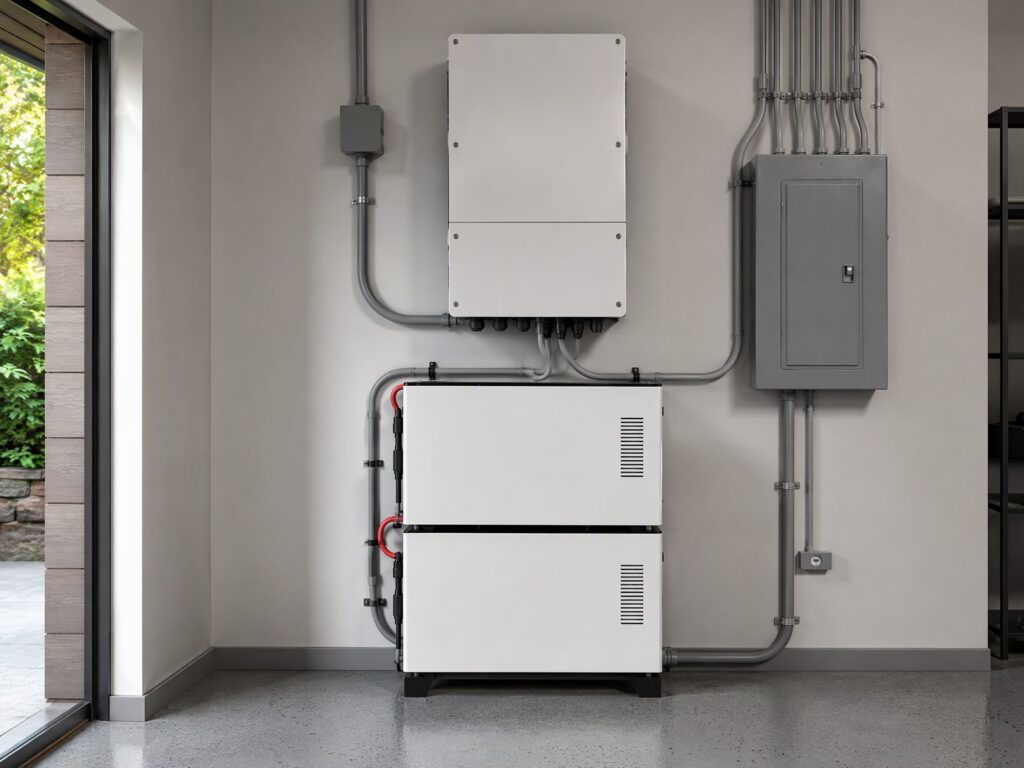
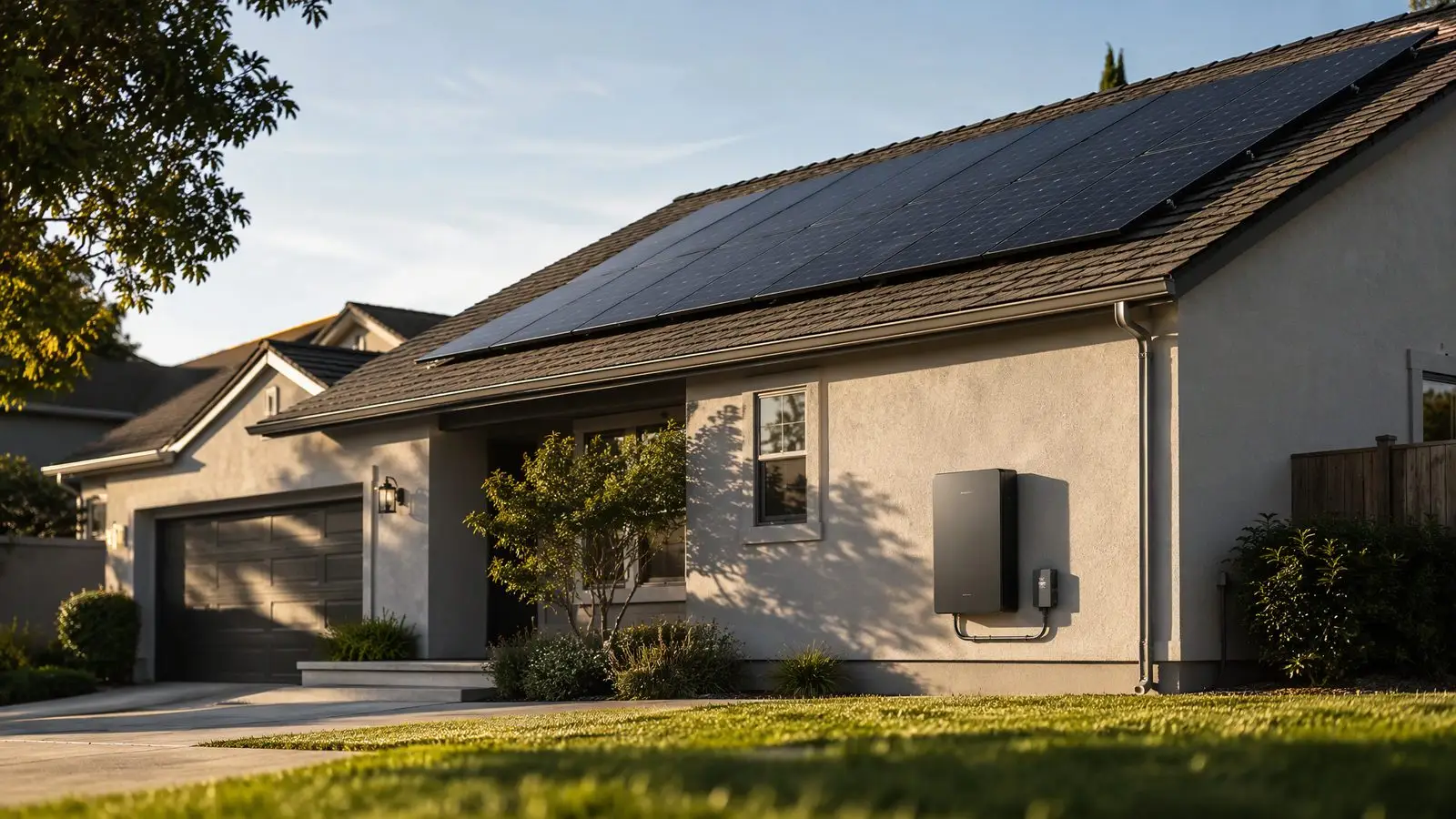
Adding storage to an existing solar array is now a rate-arbitrage decision, not a feel-good upgrade. U.S. residential electricity averaged 18.16 cents per kWh in August 2026, up from 17.57 cents a year earlier, and EIA expects the national average to reach 18.7 cents in 2027. Net billing has simultaneously compressed what exported solar is worth. A solar battery retrofit is technically simple — most systems can add an AC-coupled battery without touching the existing inverter — but sizing, paperwork, and stocking choices decide whether it pays back in five years or fifteen.
Why existing arrays, not new builds, are the 2026 storage market
The installed base is enormous and largely storage-less: EIA estimates U.S. small-scale solar generation grew from 18,812 GWh to 92,979 GWh over the past decade (EIA, October 16, 2026), and most of that capacity was interconnected before batteries made economic sense. Storage is already the default at utility scale — more than 16% of new utility-scale solar capacity added in 2026 is co-located with batteries, against 2% in 2017 (EIA, October 30, 2026). Retail rates keep climbing while export compensation does not, which is the spread a battery captures.
The national average hides how uneven that spread is. EIA’s Electric Power Monthly, released October 23, 2026 with August 2026 data, shows residential averages from 15.91 cents per kWh in Texas to 47.18 cents in Hawaii:
| Market | Residential price, Aug 2026 (¢/kWh) | Aug 2025 (¢/kWh) | Year-over-year |
|---|---|---|---|
| United States | 18.16 | 17.57 | +3.4% |
| California | 29.75 | 30.92 | −3.8% |
| Massachusetts | 30.48 | 30.55 | −0.2% |
| New York | 28.65 | 26.64 | +7.5% |
| Texas | 15.91 | 15.40 | +3.3% |
| Hawaii | 47.18 | 38.53 | +22.5% |
Read that table as a routing map. A retrofit returning four years of savings in Hawaii is the same hardware that struggles past twelve years in a low-cost, high-export-credit market. EIA’s short-term outlook, published October 6, 2026, points the same way: residential prices rise from 17.3 cents in 2025 to 18.2 cents in 2026 and 18.7 cents in 2027, while wholesale prices across the eleven hubs EIA tracks average $52/MWh in 2026 — 11% above 2025 — before easing to $49/MWh in 2027.
Solar battery retrofit architectures: three options and when each wins
Every proposal resolves to one of three electrical architectures. This is the only decision that touches the existing array, which makes it the most expensive one to get wrong.
- AC-coupled battery, no backup. A dedicated battery inverter connects to the main panel and charges from solar surplus or the grid. No PV rewiring, no rapid-shutdown rework, fastest to permit, but the house goes dark during an outage. Best for bill-management customers who already own a generator.
- AC-coupled battery with a critical-loads panel. The same battery inverter plus a transfer arrangement feeding a subpanel of backed-up circuits. This is the workhorse configuration: it works with almost any existing grid-tied string inverter, leaves the PV interconnection untouched, and usually avoids a main-panel upgrade — often the largest line item in a retrofit quote.
- DC-coupled replacement (hybrid inverter). The existing inverter is removed, strings are re-terminated on a hybrid unit, and the battery sits on the DC bus. Highest round-trip efficiency and clean whole-home backup, but it re-opens the PV permit and may force a service upgrade. It becomes rational when the existing inverter is out of warranty or failing — at that point you are replacing it anyway.
A ten-minute rule: if the existing inverter is under five years old and still supported, option two wins on cost per delivered kWh of backup. If it is a decade old or its monitoring platform is dead, price option three, because a replacement inverter is coming within two years regardless.
The survey checklist that prevents bad quotes
Solar battery retrofit failures are rarely installation errors; they are information errors made during the site visit. Capture these before anyone writes a number:
- Service equipment: busbar rating, main breaker size, and the 120% allowance calculation — this decides whether a panel upgrade enters the quote.
- Existing inverter: make, model, firmware version, support for frequency-watt response or export limiting (required for stable AC coupling), and warranty end date.
- Array details: string count, Voc and Isc, module age, and any already-mismatched strings.
- Tariff status: legacy net metering versus net billing, and when the legacy period ends — this decides whether the value is arbitrage, backup, or both.
- Backup load list: measured kW and daily kWh per circuit the homeowner expects to survive an outage. Measured, not guessed.
- Physical siting: wall or floor space, clearances, ambient temperature range, and conduit distance to the main panel.
- Authority requirements: AHJ submittal format, utility interconnection portal, and current review timelines.
- Load growth: planned EV charger, heat pump, or ADU — a battery sized to today’s load is a callback in eighteen months.
Sizing: backup load block versus arbitrage throughput
Two lenses produce two numbers, and the customer usually wants both. Size to the larger, then discuss cost honestly.
Backup lens: required energy equals the essential load block times outage duration, divided by usable depth of discharge, with a temperature reserve.
Required kWh = (Σ load kW × hours) ÷ (usable DoD × temperature derate)
Arbitrage lens: throughput, not nameplate, sets the value.
Annual shifted kWh = nameplate kWh × round-trip efficiency × cycles per year
| Backup circuit (planning values) | Average draw (kW) | Daily energy (kWh) |
|---|---|---|
| Refrigerator and freezer | 0.15 | 3.6 |
| Furnace blower and controls | 0.50 | 4.0 |
| Well pump | 0.75 | 1.5 |
| Sump pump | 0.80 | 0.5 |
| Lights, router, phones, laptop | 0.30 | 7.2 |
| Medical or mobility device | 0.10 | 2.4 |
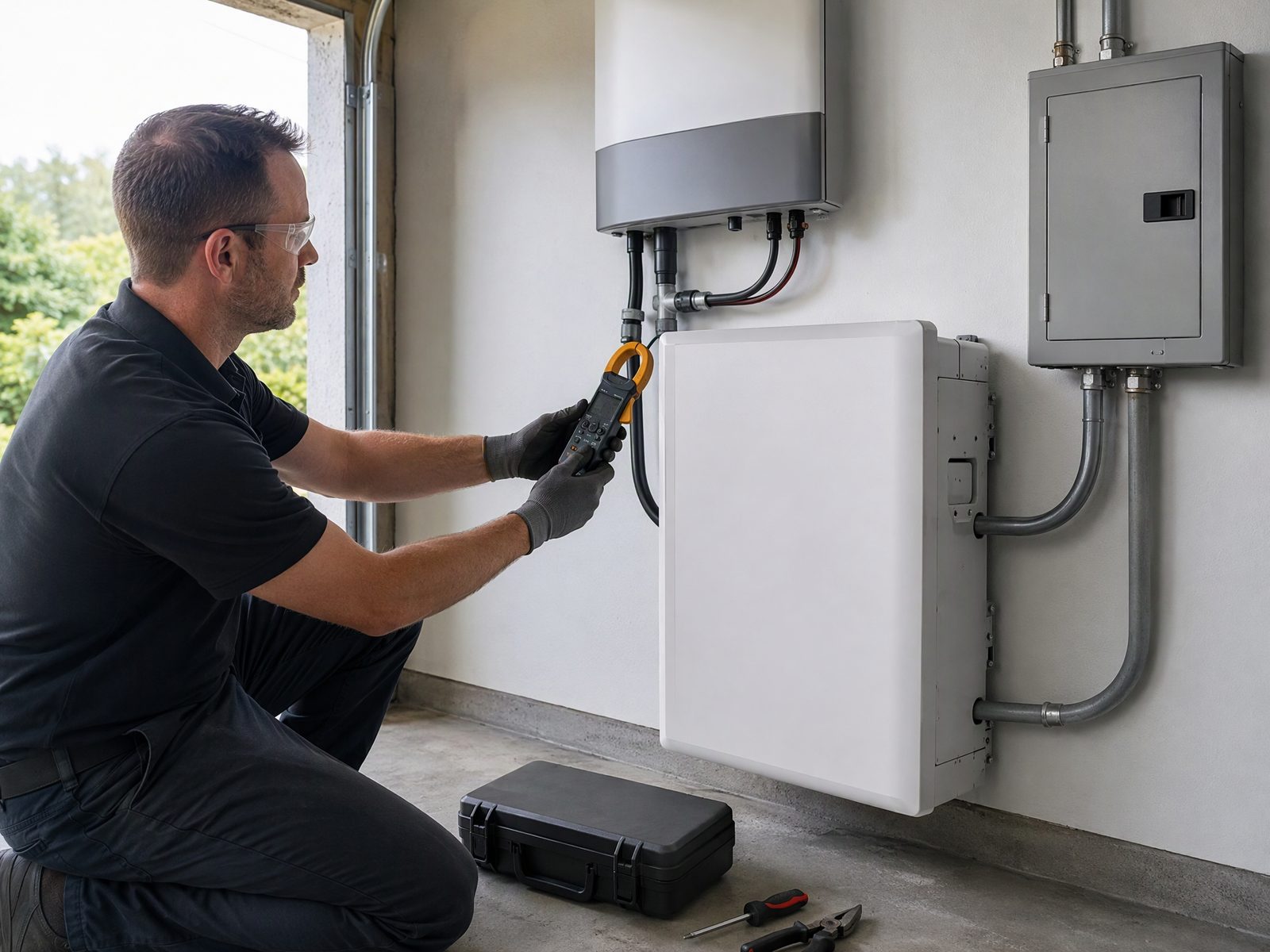
Those are planning placeholders for a quote template, not nameplate data — replace them with clamp-meter readings. The point is that a “whole-home” promise collapses once you add the numbers: 19.2 kWh per day of essential load needs a stacked system, while a 13.5 kWh unit realistically covers staged loads for 12–18 hours. Sell staged backup, and sizing stops being an argument about price.
Payback math with the assumptions exposed
Dealers lose credibility by quoting payback as a single number. Publish the formula and a matrix instead:
Annual savings = shifted kWh × (avoided retail import − forgone export credit)
That spread is the entire business case. Under net billing, exports are credited at avoided-cost values usually below the retail rate, which is why pairing storage is the recommended path; under legacy net metering, exports already earn near-retail credit, so the case rests on resilience and time-of-use shaping. The matrix uses a 13.5 kWh unit, 90% round-trip efficiency, and 300 cycles per year — 3,645 kWh shifted annually — varying only the spread and installed cost:
| Annual savings | Installed cost $6,000 | $8,000 | $10,000 | $12,000 |
|---|---|---|---|---|
| $365 (spread $0.10/kWh) | 16.4 yrs | 21.9 yrs | 27.4 yrs | 32.9 yrs |
| $729 (spread $0.20/kWh) | 8.2 yrs | 11.0 yrs | 13.7 yrs | 16.5 yrs |
| $1,094 (spread $0.30/kWh) | 5.5 yrs | 7.3 yrs | 9.1 yrs | 11.0 yrs |
| $1,458 (spread $0.40/kWh) | 4.1 yrs | 5.5 yrs | 6.9 yrs | 8.2 yrs |
Below roughly $0.20/kWh of spread, a solar battery retrofit sold purely on arbitrage does not clear a residential hurdle rate — at that point the proposal must be a resilience product and the backup load block drives sizing. Above $0.30/kWh the same hardware pays back inside a warranty period, and the constraint shifts to how fast the utility approves interconnection.
Incentive treatment for residential storage has changed repeatedly since 2025 and differs by state, utility, and installation date. Confirm current eligibility and adder deadlines with the utility and a tax professional before quoting net cost; this article is engineering guidance, not tax or legal advice.
Interconnection and documentation: where schedules actually slip
In California the tariff structure, not the equipment, sets the retrofit calendar. Applications since April 15, 2023 take service under the net billing tariff adopted in D.22-12-056: on-site generation serves on-site load first, exports are credited at avoided-cost values that can exceed retail only in late-summer evening hours, non-bypassable charges apply to all imports, and billing is monthly with a twelve-month true-up. A residential adder applies to PG&E and SCE customers who interconnect before the end of 2027, paying slightly higher export credits for nine years. That deadline is the most useful sales fact in the state — a retrofit that slips into 2028 loses the adder.
Two administrative details derail projects more often than hardware. Adding storage to an existing interconnection is a new application in most jurisdictions even when the array is untouched, so build two to six weeks into the schedule. And grid-charging behavior is tariff-dependent: California has allowed storage to charge from the grid ahead of a public safety power shutoff since D.20-06-017, but that permission is event-specific, not a license to arbitrage imports.
Submittal expectations are converging: a UL 9540 listing for the energy storage system, UL 1741 SB certification for the inverter and its grid-support functions, UL 1973 for the modules, plus the manual revision and firmware actually shipped. Inverters meeting UL 1741 SB and IEEE 1547-2018 are the baseline in most large markets; our UL 1741 SB compliance checklist covers the details reviewers ask for.
What dealers should stock for a retrofit program
Retrofit inventory differs from new-build inventory. New-build jobs are quoted weeks ahead with known designs; retrofits are sold in a kitchen and installed in a week. Stock for variability:
- Two battery blocks, not five. One modular 5 kWh unit for staged backup, one stackable 10–15 kWh platform for whole-home or high-spread markets. Every extra SKU adds certification, firmware, and spare-parts overhead.
- One AC-coupled battery inverter and one hybrid inverter. The first covers option-two retrofits, the second covers end-of-life replacements. Our solar inverter range is specified for both roles.
- A submittal packet per SKU. UL 9540 certificate and listing file, UL 1741 SB certificate, UL 1973 module listing, UN38.3 report, FCC Part 15 declaration, CEC listing where required, warranty terms, and the current installation manual.
- Spares that stop truck rolls. BMS boards, communication modules, fans, and DC fuses for every stocked platform. A $40 board in stock prevents a $400 return visit.
- Firmware discipline. Hold one approved version per SKU and record it on the commissioning sheet; utility grid-profile lists are version-specific.
Order timing deserves its own line in the business plan. Between interconnection queues, the 2027 adder deadline, and a tariff calendar that has already moved twice this year, hardware arriving in six weeks can still miss a sales window. Distributors building a 2027 retrofit program should place platform-level orders now and hold buffer stock on the two highest-turnover SKUs; our wholesale and distribution program is built around quarterly allocations for that reason. The same logic applies to the platform itself — LiFePO4 battery modules and home energy systems should share a BMS family, so one spare kit and one firmware track cover both.
Commissioning is where a solar battery retrofit either becomes a reference account or a callback. Confirm the grid profile matches the utility’s approved list, verify export limiting and frequency-watt behavior during a simulated outage, record backup transfer time, log measured capacity at installation, then hand over monitoring with a one-page explanation of what reserve means. Schedule a first-year review against that baseline — capacity, cycles, curtailment events. That visit converts a warranty conversation into a performance conversation, and it is the cheapest retention tool a dealer has.
Conclusion: sell the spread, document the schedule
Retrofit storage works when three numbers line up: a retail rate high enough to make shifting valuable, an export credit low enough to make exporting unattractive, and an installed cost that keeps payback inside the warranty. The 2026 data says those conditions are met in more U.S. markets than at any point in five years — 18.16 cents national average, 29.75 cents in California, and policy that rewards self-consumption over export. What separates a profitable program from a frustrating one is not cell chemistry. It is whether the dealer sized the load block honestly, filed interconnection early, and stocked the two SKUs that actually sell.
Building or restocking a retrofit program for 2027? Send us your target markets, typical array sizes, and the tariff structures you quote against, and we will map them to a platform, a submittal packet, and an allocation schedule. Request a quote to start.
Frequently asked questions
Can you add a battery to an existing solar system without replacing the inverter?
Yes, in most cases. An AC-coupled battery uses its own battery inverter and connects to the main panel or a critical-loads subpanel, leaving the PV inverter and array wiring untouched. The exceptions are systems whose inverter cannot support stable frequency-watt behavior, service equipment with no capacity for the added load, or an inverter already at end of life where replacement is the better use of budget.
What size battery should I add to an existing solar system in 2026?
Size to the larger of two numbers: the essential backup load block multiplied by promised outage duration, or the daily shiftable energy that clears the customer’s rate spread. For most U.S. homes a 10–15 kWh usable system covers staged essential loads for a day and still cycles enough to matter on the bill. Homes with electric heat, a well pump, or an EV charger usually need two stacked units or a deliberately staged load plan.
Is a solar battery retrofit worth it in 2026?
It depends on the spread between retail rate and export credit. At the August 2026 U.S. average of 18.16 cents per kWh, pure arbitrage rarely clears a residential hurdle rate; in markets above 28 cents, or where net billing credits exports at avoided-cost values, the same hardware often pays back in five to eight years at typical installed costs. Backup value is real but is not a bill line, so quote it separately.
Does a retrofit battery require a new permit or interconnection application?
Usually yes, even when the array is unchanged. Most utilities treat added storage as a modification to the interconnection agreement and require a new application, and most AHJs require an electrical permit for the battery circuit and any subpanel work. Plan two to six weeks for review, and check whether a program deadline — such as California’s residential adder for interconnections completed before the end of 2027 — puts the project on a fixed clock.
What documents should a dealer receive with each battery shipment?
At minimum: the UL 9540 system certificate with listing file number, the UL 1741 SB inverter certificate, UL 1973 module listings, a UN38.3 transport report, an FCC Part 15 declaration, a CEC listing where the state requires it, the current installation manual revision, warranty terms including throughput and cycle limits, and the firmware version shipped. Missing any of these turns a two-week submittal into a two-month one.
Sources
- U.S. Energy Information Administration, Electric Power Monthly, Table 5.6.A: Average Price of Electricity to Ultimate Customers by End-Use Sector, August 2026, released October 23, 2026.
- U.S. Energy Information Administration, Short-Term Energy Outlook: Electricity, Coal, and Renewables, released October 6, 2026.
- U.S. Energy Information Administration, U.S. small-scale solar generation has quadrupled in the last decade, October 16, 2026.
- U.S. Energy Information Administration, The share of solar generation with co-located battery storage is increasing, October 30, 2026.
- California Public Utilities Commission, Net Energy Metering and Net Billing (net billing tariff under D.22-12-056; adder and legacy-period rules), accessed October 31, 2026.
- U.S. Energy Information Administration, How much electricity does an American home use? (10,791 kWh per residential customer, 2022 data), updated January 8, 2024.
Related reading: what still qualifies under the 2026 residential storage rules, and our residential energy storage platform overview.