
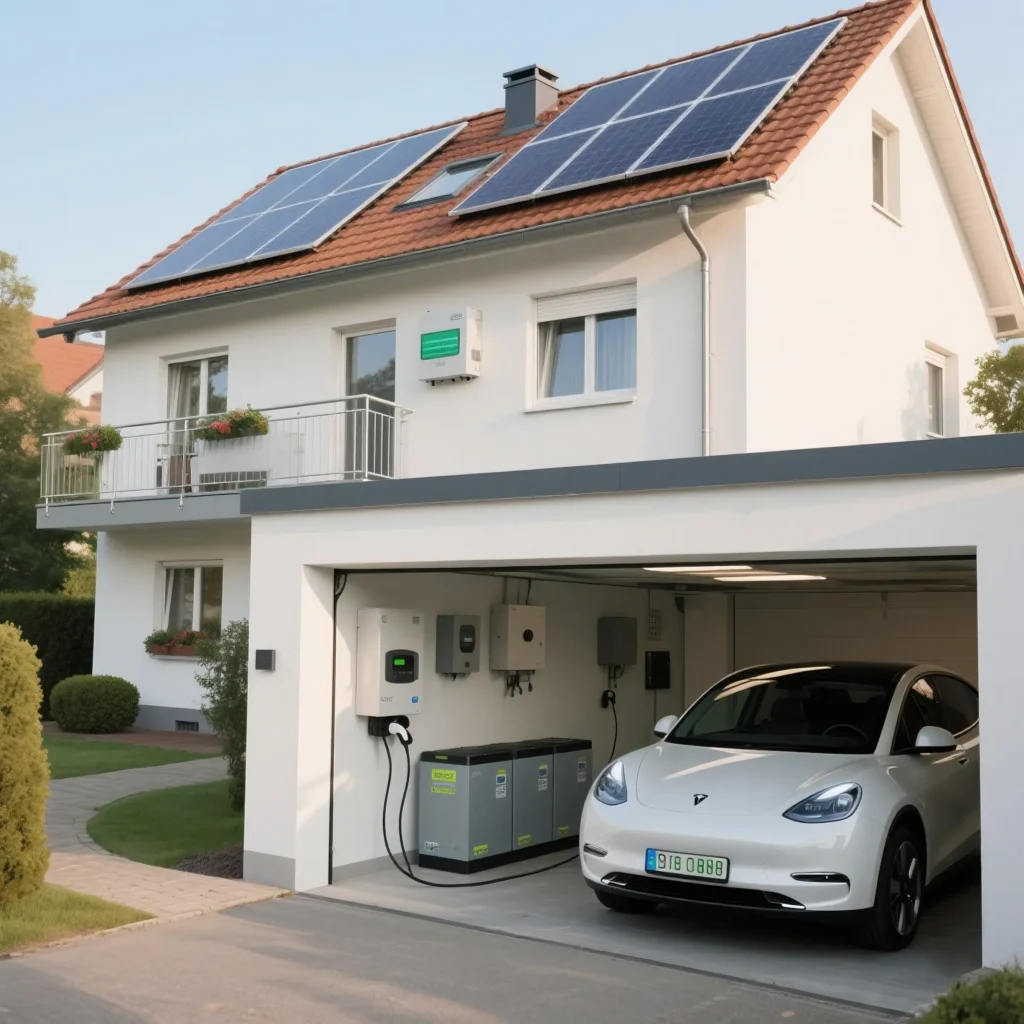
Project at a glance. A four-person family (two adults, two children) in a 200 m² single-family house in the Hamburg area runs a 6,200 kWh annual consumption including electric-vehicle charging, at 0.38 €/kWh — roughly 2,356 € a year. The house already had an 8 kW rooftop PV array, but no storage, so every kilowatt-hour the family could not consume in the moment left the meter at the feed-in price of 0.10 €/kWh. The project added a low-temperature battery system with CE and VDE dual certification and an energy management controller, sized to serve three jobs at once: peak-valley arbitrage, winter outage backup and EV charging from PV surplus.
Why an 8 kW array was not enough
Production and consumption in this household do not overlap. The array peaks around midday, when the house is empty; the load peaks in the evening, when the array is at zero. Without storage the family exported midday surplus at 0.10 €/kWh and bought the same energy back in the evening at 0.38 €/kWh — a round trip that costs 0.28 €/kWh on every unit. Over a year at 6,200 kWh of consumption, that gap is where most of the bill sits.
Two further constraints shaped the design. The first is climate: an outdoor installation in northern Germany sees sub-zero nights from November to March, and a battery that cannot accept charge at low temperature either throttles or protects itself exactly when winter demand peaks. The second is regulatory: connection and insurance requirements on the German market are settled by CE and VDE documentation, and a system without both is a project risk rather than a product.
Three jobs, one battery
Peak-valley arbitrage
The household buys at 0.25 €/kWh in the valley window and displaces 0.45 €/kWh peak energy. The spread is 0.20 €/kWh, and the controller charges only inside the valley window and discharges only inside the peak window — it does not chase prices intraday, which keeps cycle count predictable.
Winter outage backup
Backup was specified as a load list rather than a whole-house promise: heating circulation, refrigeration, lighting and communications. That list is what the battery is sized against, and it is what the system actually carried during the December 2023 snowstorm outage, when the house ran for 48 hours without grid supply.
EV charging from surplus
The vehicle charges from PV surplus before any export happens, so the array’s midday output is consumed on site instead of being sold at 0.10 €/kWh. This is the largest single line of savings in the case, and it works because the car is at home during the day.
What the configuration includes
- Low-temperature battery. Cells and charge management specified for sub-zero charging limits, so winter operation is a design case rather than a fault case.
- Dual certification. CE and VDE documentation supplied with the system, covering the grid-connection and safety requirements the German market applies.
- Energy management controller. A fixed priority order — household load first, then EV, then battery charge, then export — so the same kilowatt-hour is never counted twice in the savings.
The twelve-month result
- Arbitrage: 420 € saved per year by shifting valley energy into the peak window.
- EV from PV surplus: 1,100 € saved per year in fuel cost.
- Backup: 48 hours of continuous supply during the December 2023 snowstorm, covering heating and refrigeration.
- Total: 1,520 € per year against a 2,356 € annual electricity bill — about 64.5% of the bill offset by the storage system and the behaviour it enables.
Reading the arbitrage number
420 € at a 0.20 €/kWh spread means the system moved roughly 2,100 kWh through the battery in a year — about 34% of the household’s 6,200 kWh consumption. That ratio is the practical ceiling for this kind of house: it is set by how much load can be shifted into the peak window, not by how large the battery is. Buyers who size storage against annual consumption rather than against the shiftable evening load usually pay for capacity they never cycle.
A sensitivity check with the same inputs
Hold the 2,100 kWh of shifted energy constant and change only the tariff spread. At 0.15 €/kWh the same battery earns 315 € a year; at 0.20 €/kWh, this household’s case, it earns 420 €; at 0.30 €/kWh it earns 630 €. The battery does not change between those three columns — the tariff does. That is why a quote built only on battery price per kWh tells a buyer almost nothing about payback, and why the tariff structure has to be collected before the system is specified.
The other half of the return is not arbitrage at all. The 1,100 € EV line comes from consuming PV output on site instead of exporting it at 0.10 €/kWh, and it exists only because the vehicle is parked at home during daylight. A household with the same array, the same battery and an EV that is away all day would take the 420 € line and lose most of the 1,100 € one.
Where projects like this go wrong
- Sizing against annual consumption. A 6,200 kWh year does not mean a battery that can hold 6,200 kWh of cycling; it means the shiftable evening load, which in this house was about a third of the total.
- Backup promised as a whole-house figure. Without a written load list, the first real outage discovers the gap. This project fixed the list before the hardware was ordered.
- Certification handled at the end. CE and VDE documentation requested after the inverter is on the wall turns a two-week handover into a two-month one.
What transfers to other households
The pattern repeats where four conditions hold. A time-of-use spread of at least 0.15 €/kWh between valley and peak. A PV array that already exports a meaningful share of its output at a low feed-in price. An EV — or any large load — that can absorb midday surplus. And a history of winter outages that makes backup a requirement rather than a nice-to-have. Where the spread is narrower, the arbitrage line shrinks and the case has to rest on backup and self-consumption instead.
If you are quoting a similar project, send the annual consumption, the tariff structure (peak, valley, feed-in), the PV size and the backup load list. We will size the storage against those four inputs and return a configuration with the expected annual savings split by line item.